Mutualidad or RETA: what changes for lawyers and solicitors and at what point is the gateway in 2026

The catwalk to the RETA for mutual members advances in the Senate after receiving the backing of Congress. The measure would allow lawyers, solicitors, and other professionals to transfer their economic rights accumulated in alternative mutual societies to the public regime for the self-employed, although final approval and regulatory development are still pending.

4 minutes

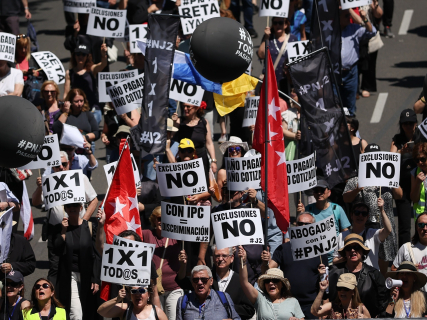
EuropaPress 7544305 numerosas personas marchan manifestacion exigir reta pasarela completa

EuropaPress 7544305 numerosas personas marchan manifestacion exigir reta pasarela completa

Add DEMÓCRATA to Google

Ask FREN

Published

Last updated

4 minutes

Most read

The word mutualidad is back among the trending searches in Spain due to the advancement of the so-called pasarela al RETA, a reform that directly affects thousands of lawyers, solicitors, and other registered professionals who for years contributed to alternative mutual societies instead of to the Special Regime for Self-Employed Workers of Social Security.

Congress approved in June the bill that opens the door to transfer the economic rights accumulated in those mutual societies to the RETA. The text then passed to the Senate, where it may still undergo modifications before its final approval.

What is an alternative mutual society to the RETA

Alternative mutual societies are private social security systems that, for years, allowed certain registered professionals to practice on their own account without registering with the RETA.

This system particularly affected lawyers and solicitors, but also other professional groups. The problem arises now because many members of mutual societies report that the expected benefits are much lower than the public pensions they would have generated had they contributed to Social Security.

What is the pasarela al RETA

The pasarela al RETA is the mechanism that would allow members of mutual societies to transfer the economic rights accumulated in their mutual society to the public Social Security system.

The objective is that these amounts can be counted in some way for access to future public pensions, preventing thousands of professionals from being trapped in a system they consider insufficient.

According to the text sent to the Senate, professionals included in alternative mutual societies will be able to request the voluntary transfer of their accumulated economic rights within one year from the entry into force of the development regulation.

What is the status of the pasarela in 2026

The reform is still not finalized.

Congress gave the green light to the bill on June 11, 2026, but the text must complete its processing in the Senate. Amendments may be introduced there before the regulation is definitively approved.

Then another key phase will arrive: the regulatory development. That regulation will have to specify how the pasarela is requested, how the transferred economic rights are calculated, and how they are transformed into recognized periods within the RETA.

What changes for lawyers and solicitors

The main change is that mutualists could stop depending exclusively on the benefit provided by their alternative mutual insurance and transfer part of their rights to the public system.

The proposition approved in Congress expanded access compared to previous versions, by eliminating requirements that excluded many professionals. Among them, the requirement of not being entitled to a pension or not being a pensioner of any scheme.

It was also clarified that the transfer of funds would not have an immediate fiscal impact for the mutualist.

Who could benefit

The text is intended for registered professionals included in mutual insurance schemes alternative to RETA.

Among the most affected groups are: lawyers; solicitors and other registered professionals with recognized alternative mutual insurance.

The specific application will depend on the final wording of the law and the regulation that develops the procedure.

What happens to those over 52 years old

One of the most relevant points of the debate is the treatment of older mutualists.

The text approved in Congress states that mutualists who are 52 years or older as of December 31, 2026, can benefit from a formula that allows each full month of registration and contribution in the alternative mutual insurance to be counted as a full month of registration in RETA, for the exclusive purpose of the percentage applicable to the regulatory base.

This point is especially important for those who are close to retirement and fear not being able to generate a sufficient public pension.

What remains to be decided

Although the gateway has taken a decisive step, central elements still need to be finalized: if the Senate introduces changes, when the law will be definitively approved, when the regulation will come into force, how the conversion of economic rights will be calculated, what documentation mutualists will have to submit, and how it will affect those who are already retired or close to retiring.

Professional associations and affected groups demand that the regulatory development guarantee real, secure, and exclusion-free application. The ICAM, for example, has requested legal certainty so that the gateway does not become a formal but difficult-to-apply solution.

Why there are protests from mutualists

The affected groups have been denouncing very low future pensions for months and demanding a more favorable equivalence between what has been contributed to mutual insurance and the periods recognized in the public system.

The J2 movement and various professional associations have requested a broad gateway, without exclusions and with sufficient recognition of years contributed to mutual funds.

Common Questions

Is the gateway to the RETA already in effect?

No. Congress approved the bill, but the reform must complete its process in the Senate and will then require regulatory development.

Does it only affect lawyers?

No. Lawyers and solicitors are the most visible groups, but the reform affects registered professionals who have been included in mutual funds alternative to the RETA.

Will it be possible to transfer everything accumulated in the mutual fund?

The text foresees the voluntary transfer of accumulated economic rights, but the exact form of conversion will depend on the final law and subsequent regulation.

More key points, information and questions with FREN

AI-GENERATED CONTENT

What does the parliamentary procedure in the Senate for a bill consist of, and what are the remaining steps for its final approval?

In the Senate, a bill originating from the Congress follows the ordinary legislative procedure: it is published and a period is opened for amendments and vetoes, it goes through a committee and commission, and finally it is debated and voted on in Plenary. During this process, the Senate can approve it without changes, introduce amendments, or veto it. The veto requires an absolute majority and is not definitive: the Congress can override it according to article 90 of the Spanish Constitution. The law is definitively approved when the Congress resolves, if applicable, on the Senate's veto and amendments or, if the Senate does not act within the deadline, by tacit approval.

Constitutional and regulatory framework

The basis is article 90 CE, which regulates the Senate's intervention on projects and proposals approved by the Congress: a maximum period of two months (reducible to twenty days for urgent projects), possibility of veto by absolute majority or to introduce amendments, and the Congress's power to ratify the initial text or decide on the amendments by simple majority.

In the Senate Rules —consolidated text of 1994, now heavily reformed, published in the BOE as Senate Rules and also accessible on the Senate website (Rules on the Senate website)— the ordinary procedure is developed in the Title on the legislative procedure. The reform of November 12, 2025, published in the BOE as 2025 reform of the Rules, updates many of these articles, maintaining the basic structure: reception, amendments/vetoes, commission, Plenary and relation with the Congress. For the general rules of voting and majorities, the chapter “On voting” applies, particularly article 93 of the Rules, reformed in 2013 (2013 reform), which establishes simple majority as the general rule, except for special majorities (such as the veto).

Phases in the Senate for a proposal sent by the Congress

1. Reception, publication and qualification

The text approved by the Congress is sent to the Senate. According to the Rules (former art. 104 and current wording after the 2025 reform), the President, by delegation of the Board, qualifies the text, determines the applicable procedure, orders its publication and the opening of the period for veto and amendment proposals. At the same time, a competent commission is assigned.

2. Period for amendments and veto proposals

Article 90 CE and the Rules establish that the Senate has two months from reception to veto or amend (period reduced to twenty calendar days if the project has been declared urgent by the Government or the Congress). Within this general framework, the Rules set an initial period of ten days from publication to submit amendments and veto proposals, extendable by up to five more days if requested by twenty-five senators. If no amendments or vetoes are submitted, or none are approved in commission, the text may go directly to the Plenary or be tacitly approved after the constitutional period expires.

3. Committee and Commission

Assigned to a commission, the groups designate a committee that prepares a report on the text and amendments. The commission, within a set period (fifteen days to issue a report, extendable or reducible), first debates the veto proposals and then the amendments, being able to admit transactional amendments and technical corrections. The result is a report that may: a) raise a veto proposal; b) incorporate amendments; or c) introduce no changes.

4. Debate and voting in the Senate Plenary

The Plenary must conclude its debate before the two-month period mentioned in article 90 CE expires. The scheme is:

  • Defense of the commission's report.
  • General debate (if there are no vetoes) or specific debate on veto proposals (if any).
  • Debate and voting on particular votes and maintained amendments.

The Rules require for approving a veto proposal, or to reject the text sent by the Congress when submitted to a general vote, the favorable vote of the absolute majority of senators (article equivalent to the former 122). For other decisions (approval of amendments, approval of the report, etc.) the simple majority of senators present applies, according to article 93 of the Rules and article 79 CE.

Relation with the Congress and final approval

According to article 90 CE and the updated regulatory norms (added in the 2025 reform), there are several scenarios:

  • No veto or amendments: the text is understood as definitively approved by the Cortes Generales in the terms sent by the Congress, and is sent to the Government for sanction and promulgation (art. 91 CE).
  • With Senate amendments: the text is sent back to the Congress, which decides on each amendment by simple majority; its decision configures the final text.
  • With Senate veto (absolute majority): the Congress can:
    • Ratify the initial text by absolute majority (immediately lifting the veto), or
    • Wait two months from the veto's imposition and ratify by simple majority.
  • Silence of the Senate: if within the constitutional period it neither vetoes, amends nor rejects the text by absolute majority, it is understood as definitively approved in the terms of the Congress.

Remaining steps, in abstract, until final approval

From the moment a bill arrives at the Senate, the remaining steps are, abstractly: publication and opening of the period for amendments/vetoes; work of committee and commission until the report; debate and votes in the Plenary (on vetoes, amendments and final text); and, if applicable, a final intervention of the Congress to resolve the veto or decide on the Senate's amendments. Once these phases are passed and article 90 CE is fulfilled, the law will proceed to the final phase of sanction, promulgation and publication in the BOE.

Among the numerous recent related regulatory reforms are, besides those already mentioned, the 2022 reform on telematic voting and types of voting (2022 reform), as well as other partial reforms from 2018 ([link]), 2016 ([link]), 2009 ([link], [link]), 2008 ([link]), 2007 ([link]), 2005 ([link]), 2004 ([link], [link]), 2001 ([link]), 2000 ([link], [link], [link]) and other connected decisions, such as the constitutional challenge on the reform of articles 133 and 182 ([link]) and the reform of those articles in 2023 ([link]). Also cited in the research are norms unrelated to the legislative procedure (for example Spanish Constitution and multiple orders and resolutions between 1978 and 1983: [link], [link], [link], [link], [link], [link], [link], [link], [link], [link], [link], [link], [link], [link], [link], [link], [link], [link], [link], [link], [link]), which do not alter, however, the description of the legislative procedure summarized here.

Could you explain in more detail how the committee and commission procedure works in the Senate for a specific bill? What exactly happens in the Congress when the Senate has vetoed a bill and what majorities apply in each scenario? How does the ordinary procedure in the Senate differ from the urgent procedure for bills?

What are the main functions and competences of the ICAM (Illustrious Bar Association of Madrid) in the Spanish legal system?

The Illustrious Bar Association of Madrid (ICAM) is a key piece of the Spanish legal system: it acts as a public law corporation responsible for regulating and representing the Madrid bar, guarantees compliance with professional ethics, and provides essential services such as legal aid duty and mediation. Its competences combine public functions (access control and discipline, organization of free legal aid, defense of the rule of law) with corporate services to its more than 75,000 members and to the public. Additionally, it has established itself as an institutional actor with its own voice in debates on judicial independence, legislative reforms, and the quality of Justice.

Legal nature and institutional fit

According to its Statutes, ICAM is a Public Law Corporation with its own legal personality and full capacity to fulfill its purposes, essentially subject to administrative law, and with exclusive representation of the bar in the Community of Madrid (except the Alcalá de Henares area), in accordance with the General Statute of the Spanish Bar, contained in the ICAM statute and the Community of Madrid order published in the BOCM. This nature explains that its agreements are appealable before the contentious-administrative jurisdiction and that it exercises public powers in matters such as membership, discipline, or organization of legal aid duty.

Regulation and defense of the profession

The Statutes assign ICAM the regulation of professional practice in its scope: control of membership, classification of practicing and non-practicing lawyers, and maintenance of the updated census (for example, the reclassification of Félix Bolaños as non-practicing was presented as an exercise of its function to “guarantee the correct functioning of the membership census,” as reported by Demócrata in this news). It also holds the corporate defense of the profession, with standing to act in proceedings affecting the bar.

This dimension is seen in its presence in litigation and own projects, such as the announcement to appear before the TSJM to defend the legality of its university center, described by Demócrata in this article, or in its participation in national debates on protection of the profession, alongside the Council of Europe Convention cited by the Ministry in this note.

Deontological functions and discipline

ICAM is competent to approve and apply specific deontological norms, within the framework of the General Statute of the Bar and deontological circulars. Its Statutes grant it disciplinary power over ethical infractions, and its recent activity includes the preparation of good practice guides (for example, on the use of artificial intelligence, noted on its institutional website and in outreach materials such as the AI guide video on YouTube).

The ethical and deontological dimension of the bar is also highlighted in the speech of the General Council president, who emphasizes that the bar can only claim social legitimacy if it submits to “demanding standards of conduct,” as reported by Demócrata in this piece; that ethical culture is applied corporately through bar associations like ICAM.

Institutional representation and defense of the rule of law

ICAM institutionally represents the Madrid bar before administrations, courts, and other bar associations. This function also projects towards public debate: the Contentious-Administrative Court No. 9 of Madrid endorsed ICAM's institutional declaration critical of the PSOE-Junts pact, emphasizing that it remained “within the competencies” of its Statutes to defend the rule of law and constitutional values, as explained by Demócrata in this article.

The same logic explains its intervention as prosecution or party in sensitive cases, which has generated debates about its neutrality, such as the controversy described in this information. The ruling that forced RTVE to rectify a caption about an alleged subsidy to ICAM, narrated in Demócrata, also shows how the corporation's actions and funding are judicially scrutinized.

Services to the public: legal assistance and mediation

In the public service sphere, ICAM is a central actor in free legal assistance and the legal aid duty in Madrid. The regional decree regulating this service details the functions of bar and solicitor associations, to “guarantee proper performance and thus its quality,” according to the official note from the Community of Madrid in this link. At the state level, Moncloa recalls that applications are channeled through the legal orientation services of the Bar Associations, according to the official explanation on free justice in this note.

In practice, ICAM has warned of the risk of “collapse” of free justice in the National Court due to the precariousness of the legal aid duty, supporting lawyers' claims, as reported by Demócrata in this information. And the Community of Madrid has highlighted its “prestige and social work,” including legal literacy programs in which more than 1,400 members collaborate annually, when awarding it the Madrid Excelente seal described in this note.

Another relevant competence is mediation and alternative dispute resolution. The Madrid City Council and ICAM maintain an agreement to refer intra-judicial and extra-judicial mediations to the MediaICAM Center, strengthening dialogued conflict resolution between citizens and with the municipal administration, as detailed by the city council in this agreement.

Training, legal literacy and influence on legal policy

ICAM develops intense training and legal literacy activities, recognized by the Community of Madrid when highlighting the magnitude of its legal volunteer programs in awarding the Madrid Excelente seal. Additionally, it promotes initiatives for monitoring and disseminating regulations, such as the digital EU law platform mentioned by Demócrata in this news, which strengthens its role as an intermediary between Brussels, Spanish institutions, and professional practice.

Altogether, all these functions position ICAM as a hybrid actor: a public professional regulatory body, guarantor of ethics and defense, and at the same time a direct provider of essential legal services for Madrid's citizens and for the functioning of the social and democratic rule of law.

How is the dean and the Governing Board of ICAM elected and what role do they play in these functions? What problems and reforms are currently being demanded in Madrid regarding Free Legal Aid and legal aid duty? In what other recent cases has ICAM intervened with institutional declarations or by appearing in relevant judicial proceedings?

What legal requirements must a registered professional meet to transfer their economic rights from an alternative mutual fund to RETA according to current legislation?

In the current state legislation, there is no general regime that allows a registered professional to freely “transfer” their individual economic rights from an alternative mutual fund to RETA as if it were a transfer between private plans. What the legal system provides are, on the one hand, rules regulating alternative mutual funds to RETA and the professional's affiliation, and, on the other hand, specific collective integrations of certain groups into Social Security, in which contribution periods are recognized and funds are transferred between entities. Outside those legally established integration cases, the professional cannot directly convert their mutual reserves into contributions to RETA; they remain governed by the mutual contract.

1. Legal regime of alternative mutual funds to RETA

The basic framework of social welfare mutual funds is contained in the Regulation of social welfare mutual funds, approved by Royal Decree 1430/2002. It defines mutual funds as private insurance entities, non-profit, complementary to Social Security, and expressly provides that, “in accordance with the provisions of the fifteenth additional provision of the Law,” they may be alternatives to the Social Security scheme for Self-Employed Workers.

The fifteenth additional provision (cited in the regulation itself) of the former Law 30/1995 on the regulation and supervision of private insurance established that registered professionals who work on their own account are included in RETA but may be exempt from RETA registration if they opt for a social welfare mutual fund that meets the requirements of an alternative mutual fund.

The Resolution of July 24, 2007 of the Directorate General of Social Security Regulation further clarifies:

  • That certain mutual funds acting as alternatives only in part of the territory may extend that status to the rest of the profession's members.
  • That professionals who were mandatorily in RETA and move to an alternative mutual fund may deregister from RETA if they opt for the mutual fund, within a six-month period, without refund of paid contributions.

All this refers to registration (enrollment/deregistration) and the obligation to contribute, but does not contemplate that the professional transfers their mutual “reserves” to Social Security.

2. Fit with retirement and pension compatibility

Order TIN/1362/2011 addresses the compatibility between retirement pension from the Social Security system and self-employed activity by registered professionals who have opted for an alternative mutual fund. It reiterates that the general incompatibility regime between retirement pension and work that leads to inclusion in a Social Security scheme applies, and extends that incompatibility also to those who, although not in RETA due to opting for an alternative mutual fund, continue practicing the profession.

Again, this regulation governs whether pension and activity can be compatible, but does not establish any mechanism for “transfer” of economic rights from the mutual fund to RETA.

3. Collective integrations in RETA with fund transfers

Where a true “integration” of rights from mutual funds to the public system appears is in special regimes for specific groups, not as an open individual right for any registered professional. A relevant example is Royal Decree 1505/2003, on the inclusion of members of the single Notaries Corps in RETA.

In this case:

  • It provides for the inclusion of all notaries in RETA, “so that the public system assumes social protection of the group” replacing the Notarial Mutual Fund and the Mutual Fund of Registered Commercial Brokers.
  • Periods contributed to the mutual funds are considered “credited as contributed” in RETA for pension calculation purposes.
  • It foresees that the integration is financed by the transfer of funds from the mutual funds to the General Treasury of Social Security, in the amount necessary to compensate the cost assumed by the public system.

Previous integration rules of mutual funds into the system (such as Royal Decree 1220/1984, on integration of groups from the Mutualidad de la Previsión into the General Regime, and its development by Order of July 4, 1984; or Royal Decree 2248/1985 on integration into Social Security of substitutive entities) follow the same logic: the rule orders the integration of the entity and the group, recognizing rights and setting patrimonial transfers between institutions.

Again, these are collective, closed, and case-by-case regulated processes; not a general right for each mutualist to unilaterally decide to transfer their individual savings to RETA.

4. Current situation of the registered professional

The consolidated text of the General Social Security Law, approved by Royal Legislative Decree 8/2015, and the specific regulations on self-employment (for example, Law 20/2007 on the Statute of Self-Employment) focus on defining the scope of RETA, the obligation to register and contribute, and the computation of periods, but do not articulate a general mechanism for mobility of rights from alternative mutual funds.

Consequently, as of today:

  • The professional can choose between RETA or alternative mutual fund (if it exists and meets requirements) for their mandatory protection, with the registration/deregistration and incompatibility effects explained above.
  • Their economic rights in the mutual fund are governed by insurance regulations (Royal Decree 1430/2002 and, as long as applicable, Law 20/2015 and Royal Decree 1060/2015), and by the statutes and benefit regulations of each entity.
  • Only if a law or royal decree of collective integration expressly provides it (as in the case of notaries) can those periods be recognized as contributed and funds be transferred from the mutual fund to the public system.

No further information is available in the consulted regulations recognizing a general right of the professional to transfer their individual reserves from an alternative mutual fund to RETA outside these specific integration processes.

Play

Test your knowledge with FREN!

How much do you know about this topic? Answer the following 3 questions.

What is the main objective of the gateway to RETA approved in Congress?

Question 1 of 3

Which professional groups are most affected by this reform on alternative mutual societies?

Question 2 of 3

What fundamental aspect remains pending after the approval of the law in Congress?

Question 3 of 3

Hola, soy Fren. ¿Cómo te ayudo?