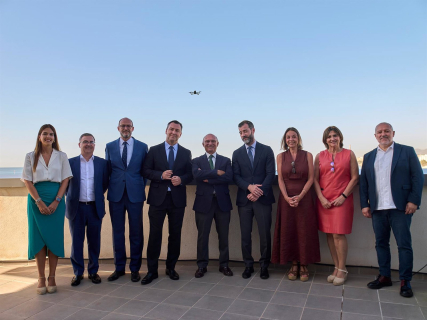

Puertos del Estado announced this Thursday, in an event held together with the Port Authority of Malaga, the "Guide for the use and application of unmanned aircraft systems (UAS) in the port environment". This is a document prepared in collaboration with the port authorities and with the support of Ineco and Enaire, in addition to the technical contributions of Senasa, ITG and ITE, which establishes a common reference framework to promote the progressive, safe and coordinated incorporation of UAS into the general interest port system.
During the opening of the event, the Secretary General of Air and Maritime Transport, Benito Núñez, stressed that "drones are no longer an experimental element, but are part of our productive fabric, with applications in areas such as logistics, infrastructure inspection, agriculture, emergencies or public services".
Núñez remarked that these aircraft allow for novel operational solutions, by enabling access to complex areas or carrying out work in conditions that previously involved greater restrictions, which contributes to reducing risks and costs and optimizing the use of available resources.
He also insisted that the advancement of this technology must be based on safety, effective management of airspace and compatibility with other aeronautical and non-aeronautical uses.
The Secretary General highlighted the coordination achieved in Spain to promote the deployment of UAS and recalled that the National Action Plan for the Deployment of U-space and its update, Pandu+, mark a structured roadmap to continue developing the use of drones in the country in the coming years.
According to Puertos del Estado in a statement, Enaire, the state air navigation manager, "is being key in the development of European U-space projects such as Uelcome, Spatio or Ensure, to enable the safe integration of drones in complex environments through advanced digital air traffic management services".
On the other hand, the president of Puertos del Estado, Gustavo Santana, pointed out that this action "demonstrates our commitment to innovation and continuous improvement of the general interest port system".
He also stressed that the guide is the result of a cooperation process between Port Authorities and aeronautical and regulatory bodies and entities, which "has made it possible to develop a practical, rigorous guide adapted to the real needs of Spanish ports and the regulatory context."
In the same way, he pointed out that "this document constitutes a starting point for continuing to advance, in a coordinated manner, in the incorporation of UAS into the port system."
The president of the Port Authority of Malaga, Carlos Rubio, expressed himself in similar terms, stating that "the launch of this guide occurs at a critical moment and comes to cover a necessary normalization of procedures, to the extent that the demand for the use of drones by port authorities as a method of control of public domain, or by private operators for various commercial purposes, is growing very significantly."
The guide, presented at an event in which the Directorate General of Civil Aviation and EMSA also participated, offers a global perspective on the use of UAS in the port environment. It analyzes issues such as governance, the regulatory framework, direct operation by Port Authorities, management of third-party operations, protection against non-collaborative UAS, the main current applications, and possible future lines of evolution for this technology.
The use of drones has already spread to numerous Spanish ports, where they are used for surveillance and perimeter security tasks, infrastructure inspection, topographic measurements, emergency management, or water surface control.
These utilities have proven their effectiveness in reinforcing infrastructure supervision, improving available operational information, supporting environmental management, increasing safety, and speeding up response to different operational scenarios.
With this document, Puertos del Estado seeks to facilitate the integration of UAS in the port environment through a common framework that helps to face the regulatory, operational, and organizational challenges associated with these technological solutions.
The guide is born with the aim of accompanying the transformation of the port system in a context of constant change and serving as a basis for future innovation and digitalization initiatives in ports.