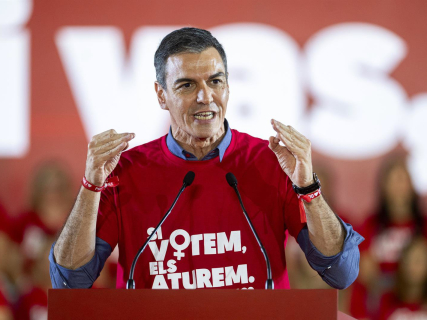










The President of the Government, Pedro Sánchez, reiterated this Wednesday that there are "all" guarantees to sustain in the long term the public pension system, which, in his view, shows "extraordinary health". In addition, he has set as a goal raising the Reserve Fund, the well-known 'pension stash', to 50,000 million euros by 2030 if he secures the mandate again following the elections of 29 November.
In an interview on TVE, recorded by Europa Press, the head of the Executive recalled that the 'stash' has gone from 5,000 million in 2018 to the 20,000 million with which he expects to close 2026, and he framed this evolution as proof of the system's strength.
Sánchez has claimed credit for the public pay-as-you-go model based on solidarity between generations and has emphasized that its sustainability rests on three pillars: the increase in wages, higher employment, and the advancement of productivity.
During the televised conversation, the president linked the rebound in inflation, placed at close to 5%, to the war in the Middle East and the resulting rise in the price of gasoline and diesel, stressing that the "cheapest" measure to contain the cost of living is to put an end to that conflict.
At the same time, he criticized the way in which the wealth generated by growth is being distributed in communities governed by the PP, such as Madrid. He denounced that, despite having transferred more than 300,000 million euros to the entire set of autonomous communities, the Madrid government has allocated 7,000 million to private healthcare and 5,000 million to "tax giveaways to the elites".
Building without regulating and the risk of a new real-estate bubble
In terms of housing, the president warned that "building without regulating means a real-estate bubble", recalling the precedent of the 2008 financial crisis, which ended with a bank bailout of more than 50,000 million euros.
Along these lines, he accused the PP and Vox of advocating for deregulation which, in his view, would worsen the situation in the residential market, and he pointed to both these formations and Junts per Catalunya for having acted as a "block" and a "brake" to the regulation proposals promoted during the legislature.
To improve access to housing, especially for the young population, Sánchez has called for a "reinforced progressive majority" in the next Congress of Deputies that would make it possible to deepen public intervention in the market, as well as promote the construction of subsidized housing and the rehabilitation of the existing housing stock.