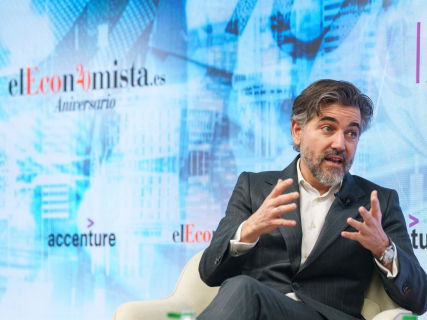

The chief executive officer of Banco Santander España, Ignacio Juliá, has warned this Friday that geopolitical tensions and armed conflicts are being transferred to the "real prices" with more intensity than expected. In his view, this pressure will lead the European Central Bank (ECB) to end the year with interest rates at 2.75% and to set them at a maximum close to 3.25% in the summer of 2027. At the same time, he stressed that both the banking sector and the Spanish economy are "much better prepared" to face a scenario "somewhat more complex" than the current one.
During his participation in the IX Banking Forum organized by the newspaper 'elEconomista', the top executive of the Cantabrian bank in Spain pointed out that central banks face a delicate balance between containing inflation and sustaining growth, in an environment shaped by the debate over the autonomy and productivity of the European continent.
Despite this, the first executive of Santander España has conveyed a message of confidence in the resilience capacity of both the national economy and the financial system. He detailed that an interest-rate range between 2% and 3% corresponds to "normal rates" compared with the previous stage of "free money", and he emphasized that the country, families, and institutions are facing this new cycle from a much more robust position than during the 2010 crisis.
Along these lines, Juliá has focused on the fact that household indebtedness in Spain has been cut in half over the last fifteen years, by falling from levels close to 80% to be around 40%.
He has also highlighted that approximately 50% of the current mortgage portfolio is tied to a fixed rate — as happens with the vast majority of the mortgages signed in recent years — which mitigates the immediate effect of rate increases on the domestic economy.
DE COS: "A FLAG PROFESSIONAL"
On the other hand, the chief executive officer of Santander España addressed the transition at the helm of the European Central Bank and assessed as "very good news" the possible election of the former governor of the Banco de España, Pablo Hernández de Cos, whose chances of becoming Christine Lagarde's successor he has considered "very high".
Thus, Juliá has supported the candidacy of the Spanish economist for two fundamental reasons: his proven technical profile, which he has described as "a professional on the flag with an exceptional track record", and the "sense of belonging" that his nationality brings to the Spanish financial system as a whole.
FROM A "PRODUCT BANK" TO A "CLIENT BANK"
In terms of the transformation of the banking business, the executive has argued that the evolution of consumer habits forces traditional institutions to make the leap from a model of "product and network bank" to a "client bank" with an eminently mobile approach, supported by the strength of the existing physical infrastructure.
In this context, he has detailed that Santander España has carried out a process of consolidating branches in order to have "larger and better equipped" centers, maintaining the branch as a key piece for personal attention and advice on operations of greater complexity, while daily operations are moved to the mobile phone.
Regarding the competition from neobanks —which he prefers to call 'challengers'—, the executive has admitted that they provide a digital experience that is "very simple and accessible" that traditional banking must observe and even "copy".
Nevertheless, he has argued that Santander enjoys a differential advantage in being able to combine that digital agility with the capillarity of its physical network, customer proximity, and specialization at an international scale.
"The strength of banks like us and of course at Santander is that you have the strengths that they don't have, that you have all the capillarity of the network, the closeness to customers, the specialization at scale in a global world that also allows you to do it much cheaper and make a much more digital bank with a fantastic experience. I think that we have the 'win-win'", he concluded, the CEO of Santander España.