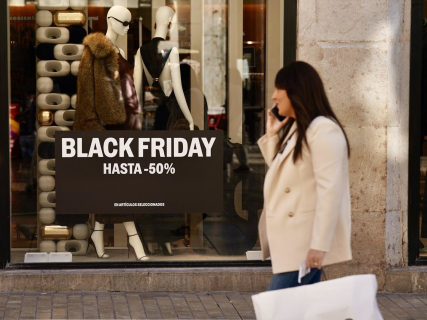

The 2026 Black Friday breaks into Spain with a purchase intention that exceeds 70%, representing the highest record of willingness to acquire products on this promotional day in the last eight years.
According to a survey conducted by the comparison site Banqmi, more than 1,300 adults have taken part in the poll, which places the percentage of people who plan to buy during Black Friday at 71.8% and sets the expected average spending at something more than 140 euros.
At the same time, a report prepared by Amazon indicates that 71% of Spanish consumers expect to take advantage of Black Friday deals, compared with 62% who did so in 2025. The document highlights the growing importance of planning and comparing prices as key factors when deciding purchases.
On the other hand, the president of the Association of Small and Medium-Sized Commerce of Mallorca (Pimeco) has pointed out in statements to Europa Press that this Friday, November 27, “paralyzes November sales,” since many customers delay their purchases until that day and limit themselves to visiting stores to find out about possible discounts.
These views are joined by an increase in part of the public’s distrust of this campaign, which appears as the second reason not to take part in shopping, after recommendations to review the previous prices of products to verify that the discounts announced for Black Friday are indeed real.
ADVANCE OF THE CHRISTMAS CAMPAIGN
The Christmas campaign is starting earlier and earlier and is directly linked to Black Friday for 51.7% of consumers who intend to buy with the aim of saving. This percentage has increased from the 50.7% recorded in 2025 and the 30.5% noted in 2018.
As for the level of expected savings, 72.5% of shoppers trust that they will be able to get discounts of up to 40%. In detail, 39.4% expects markdowns of up to 20% and 33.1% calculates that it will obtain between 20% and 40% reduction in price.
Among those who do not plan to make purchases, the main cause is lack of budget (36.2%), followed by distrust of the offers (30.1%) and the feeling that the discounts are not sufficiently attractive (14.8%).
For their part, 27.9% of those surveyed will limit themselves to reviewing the promotions and will probably end up buying some item, while 18.8% will use the sales to buy a specific product they already had in mind.
BUDGET AND MOST DEMANDED CATEGORIES
The association of Black Friday with Christmas shopping has pushed up the average budget, which goes from 142.72 euros in 2025 to 146.35 euros in this edition. The percentage of consumers who plan to spend more than 200 euros also increases, from 21.1% to 23.4%, while 65.1% does not set a spending limit in advance.
According to the survey, fashion and accessories continue to be the top category, with 75% of potential buyers, followed by the field of computing and electronics, which accounts for 51.6%.
With less weight are video games (18.4%), books (18.1%) and games (10.1%). The data also indicate that each consumer has plans to buy products from two different categories.
By age group, the most active is that of 36 to 45 years, which represents 28.7% of those who plan to buy during Black Friday, followed by consumers aged between 46 and 55 years, who account for 21%.
THE "REAL" BLACK FRIDAY DISCOUNTS
The Organización de Consumidores y Usuarios (OCU) estimates that only around 6% of electronics and home appliances products show a real and relevant 'online' discount on Black Friday, after analyzing more than 12,000 prices.
The entity has calculated the discount by taking as a reference the lowest price offered by the main 'online' platforms in recent months, an indicator that it considers of little use given the large number of promotions that are already circulated on a regular basis.
In this analysis, only four categories stand out due to the proportion of offers among electronics and home appliances items: sound equipment (26%), robot vacuum cleaners (26%), kitchen robots (17%), and televisions (13%).
The study also identifies the selling platforms with the greatest presence of "good deals" at present: Xiaomi (24%), Amazon (19%), Mediamarkt (17%) and Fnac (11%). Other websites with a noticeable percentage of prices with "interesting discounts" are Carrefour, Cecotec and Sihogar, which reach up to 9%.
"THE NEW WAVE OF BLACK FRIDAY"
The report prepared by NTT DATA concludes that the growth of this commercial campaign has been moderated compared with the pace of previous years from the consumer perspective.
In a scenario of lower purchasing power, higher logistical costs and growing pressure on margins, companies are betting on artificial intelligence (AI) to decide which promotions to launch, how to distribute the marketing budget and how to adjust inventory with greater precision, in order to safeguard the profitability of one of the key campaigns on the calendar.
The analysis also points to a structural change in competition: what used to be an event concentrated over a few days has been transformed into a commercial wave that begins at the start of October and lasts until the first week of December.
Despite this complex context and the slowdown in spending, Spain remains one of the European markets where the phenomenon reaches greater intensity. In the latest Black Friday edition, the number of transactions was 4.47 times higher than that of a normal Friday, the second-largest increase among the countries studied, only behind Denmark.