
Industrial crises are seen coming from afar. They don't fall from the sky one day. Six years ago, in the early stages of the Covid-19 pandemic, the then secretary of the CCOO Industry Federation, explained before the Industry Commission, Agustín Martín, explained that there are multiple indicators that allow to identify if a production center is viable or will have problems. “Industry does not operate in the short term”.
In the case of Tubos Reunidos, which requested the declaration of bankruptcy proceedings this Monday, the origin of its crisis dates back about twenty years, when the company multiplied its net debt by ten in just two fiscal years to around 200 million.
Since then, he has not been able to shake off that burden. During the pandemic, he requested a bailout from SEPI, which injected 113 million into the company, and he has weathered the storm until finding himself in these months in a perfect storm.
Debt, tariffs, and energy crisis
The collapse of Tubos Reunidos has a clear diagnosis: the company is not capable of facing the payment schedule demanded by the weight of its substantial net debt –263 million euros– in the midst of a particularly acute crisis. The steel company closed 2025 with net losses of 118 million, 35 million in cash, and negative consolidated equity of 86 million.
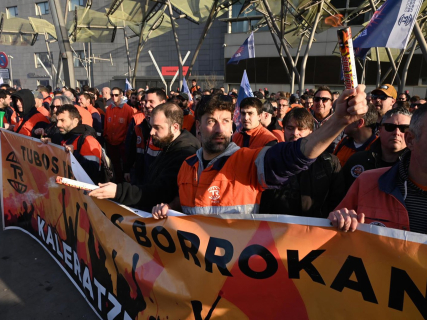
In its communication to the National Securities Market Commission (CNMV), which decided to suspend its stock market listing, the company alleged that treasury tensions had been aggravated by the "unwanted" shutdown of its Amurrio plant. The workforce is on strike in protest against an employment regulation file (ERE) to dismiss 285 workers, almost a quarter of the entire company.
It was the company's management's response to the closure of its main market, the United States, which raised import tariffs on steel by 50%. The company also cited as key factors the depreciation of the dollar against the euro, strong competition from low-cost tubing in Europe, and the weakness of the US market due to sector concentration and oil.
“We are not facing a simple problem of ‘bad individual performance’, but rather a very damaging combination of cycle, commercial policy, currency, margins and balance,” explains Antonio Castelo, an analyst at iBroker.
And, as if one more ingredient were needed, the geopolitical uncertainty due to the war in Iran and a new energy crisis. “Nobody wants to make relevant decisions in a context of crisis,” emphasizes César Sánchez-Grande, co-director of the Renta4 analysis department.
This analyst, specialized in tracking this company, emphasizes how competition with other Asian industries, with much lower costs, forces European ones to seek specialization, greater added value. "Tubos Reunidos' focused on technology for oil extraction, particularly 'fracking'. And the market is where it is." And with 50% tariffs, he sees it as impossible to compete. Trump's tariff policy has been the final nail in the coffin.
Industry, in the eye of the hurricane
The crisis at Tubos Reunidos is one more in a trickle that the push for reindustrialization after the pandemic had slowed. Europe encourages the transformation of production plants to avoid closures and relocations, and industry has gained momentum.
“It is a sector that in recent years is undergoing a profound restructuring,” explains Javier Santacruz, a financial analyst who underlines the sector's difficulty in generating positive results through which to invest in technology. Also the lack of geographic and product diversification that his colleagues cite.
In the background, the ghosts of the industry's lower weight among the big names in business compared to other countries like France, Germany, or Italy. The Spanish selective, dominated by banking, energy, and infrastructure companies. The block that encompasses industry concentrates 20% of the Ibex, but that percentage falls by half when excluding construction companies.
The ‘B-side’ of a sector with winners and losers
Is the crisis at Tubos Reunidos extrapolable? Analysts consulted agree in ruling out such a specific case, due to its high exposure to a concrete market and its starting situation.
Sánchez-Grande, for example, gives the example of the good behaviors of Acerinox and Arcelor. “They have made very aggressive cost efficiency plans to position themselves in such a competitive environment,” he explains.
This analyst considers that, in general terms, Spanish industries are much more competitive than a few years ago. “They operate in a very specific market niche where many are leaders or main players worldwide”
“It would be a mistake to mechanically transfer the case to the entire listed industrial sector,” Castelo (iBroker) elaborates. This analyst highlights the quotation data for the basic materials, industry, and construction block, which rebounded with increases of almost 50% at the end of the year after falling in 2023 and 2024. “More than a linear crisis in the sector, what we have seen has been an enormous dispersion between winners and losers.”
Who are these winners? “Companies with scale, reasonable balance, diversification, and business visibility”. And he gives examples. Indra, with 13% more revenue with a rising defense portfolio due to the boost in military spending. CIE Automotive, with the best results in its history. Tubacex closed the year with an order backlog of 1.266 million, maintaining profitability. “And Acerinox, in a complicated year, achieved an adjusted Ebitda of 422 million,” he concludes.
And what's coming? How can it affect the markets?
“The Spanish industry is in a good moment, but in the coming quarters or the next year, depending on the duration of the war, it will be necessary to go seeing company by company,” adds Sánchez-Grande.
Inflation has not yet hit with all the hardness that is expected due to the prolongation of the war in Iran. And it will affect all industrial value chains. The impact will depend on the company's ability to pass on its cost increases and adjust its margins.
It remains to be seen what impact the news will also have on industries with a profile similar to Tubos Reunidos in terms of high debt, limited liquidity, and the need for debt restructuring, as it poses a reputational and trust risk.
“It is a warning sign, but not a perfect thermometer of the listed industrial complex,” points out Castelo (iBroker), who does not see an indiscriminate contagion effect.
It also relativizes the role that the retail investor may have. According to data from Bolsas y Mercados Españoles, it represents 8% of purchases and 11.6% of stock sales in a market dominated by foreign investors, mostly institutional.
“This crisis will make the small investor more selective, but it should not close the door to the entire industrial sector. Rather, it will further separate between industry with a structural thesis and that with a solvency problem,” he concludes.