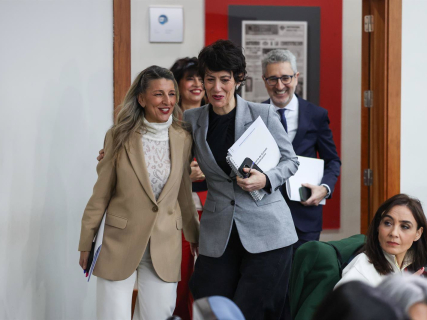










The Council of Ministers has given the green light this Tuesday to a royal decree-law that extends to ten working days the bereavement leave for the death of a spouse, domestic partner, children, or first-degree relatives by blood.
The new regulation expressly assumes the doctrine of the Supreme Court in order to specify that these leaves must be counted in working days, an aspect that has been generating interpretation conflicts in the courts, as the second deputy prime minister and Minister of Labour, Yolanda Díaz, has detailed.
This right now goes by the name "bereavement leave in the event of a death" and may be taken within the four weeks following the loss of a loved one. Díaz has emphasized that the extension will allow employees to go through their grief without the obligation to return immediately to their job. "It is one of the most difficult moments in which people have to go to work, surely without the proper conditions," Díaz said.
At the same time, the Executive increases to three working days the bereavement leave for relatives up to the second degree of blood or affinity, with the option to extend it to five days when it is necessary to travel. Until the approval of this regulation, the duration was two days.
The royal decree-law also includes the right to reduce or adapt working hours in order to care for and accompany the spouse, domestic partner, or relatives up to the second degree who are in a situation of palliative care.
"They can adapt their working hours with all the flexibility they see fit and, of course, reduce their working hours," Díaz explained, who described this measure as especially in demand to facilitate accompanying loved ones in the final stretch of their lives.
The regulation also adds a specific day of leave to accompany a person who is going to undergo an euthanasia procedure. The minister has defended that it is a measure "absolutely necessary" in order to be able to accompany both the person receiving euthanasia and their relatives.
Díaz has argued that taken together these reforms help build "a better country, that cares, that provides labor rights for our working people" and that guarantees social protection in moments of particular hardship.
The approval of this standard was anticipated on Monday by Díaz and by the President of the Government, Pedro Sánchez, who defended in his X profile that the initiative represents one more step toward "recognizing and consolidating the right to mourn of workers".
In addition, Sánchez assured that "no one gets over a loss in two days or in ten," and for this reason he has argued that the extension will allow those who benefit "to say goodbye without looking at the clock".
This is a measure already advanced by Yolanda Díaz in October 2025 in the "Desayunos Informativos" of Europa Press, where she explained that she would push for a new norm to modify the Workers' Statute and extend this leave.