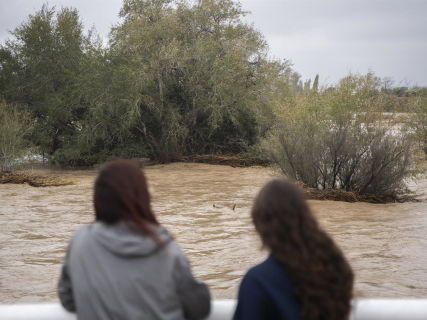
The Government restricts the purchase of homes in flood-prone areas: what changes with the new decree

The Government will bring this Thursday to public hearing the new royal decree on flood-prone areas, a rule that will require informing buyers if a home is located in an area with flood risk

2 minutes

fotonoticia 20260707182312 1920

fotonoticia 20260707182312 1920

Add DEMÓCRATA to Google

Ask FREN

Published

Last updated

2 minutes

Most read

The Government will approve this Thursday the start of the public hearing process for the new royal decree on flood-prone areas, a regulation with which it intends to reinforce protection against the risk of floods and increase transparency in the buying and selling of homes.

The third vice-president and Minister for Ecological Transition, Teresa Ribera, has explained that the decree will require the Property Registry to report whether a property, whether new or second-hand, is located in an area at risk of flooding.

The risk of flooding must be stated before the sale

Until now, the identification of a home located in a flood-prone area was mainly applied to certain new construction developments. With the new regulations, this information must also appear on already built homes, so that any buyer knows in advance whether the property is exposed to this risk.

Ribera has specified that the measure will not prevent the sale or habitation of these homes, but rather seeks to ensure that citizens have all the information before formalizing the transaction. "It does not mean that they cannot be inhabited, it means that the population is informed and can act. That they know their home is more vulnerable," the minister pointed out.

More restrictions on building in risk areas

The decree also includes new urban planning limitations to reduce the population's exposure to floods.

Among the planned measures are limiting new construction in areas with the highest risk, favoring buildings located above the flood level, avoiding the construction of underground garages in particularly vulnerable areas, or restricting certain uses that may increase the risk to the population.

The minister has argued that rivers must have sufficient space to absorb floods and has warned that Spain continues to build in areas exposed to floods.

Risk maps and historical floods

The text also incorporates new prevention tools.

Urban development plans must include hazard and flood risk maps, while a catalog of historical floods will be drawn up so that town councils can take these precedents into account in territorial planning.

Likewise, the royal decree provides for adaptation measures aimed at local administrations and training programs for public employees and young people.

The Government opens the text to public participation

Sara Aagesen has explained that the objective is to open a "highly participatory" process to gather contributions before the final approval of the decree.

The vice president has stressed that the future regulation "does not affect consolidated rights" and has defined it as a "transformative" and "novel" decree, susceptible to improvements during the public information period.

More key points, information and questions with FREN

AI-GENERATED CONTENT

What is the parliamentary procedure for the final approval of a royal decree in Spain and what procedures remain pending after the public information period?

In Spain, "ordinary" royal decrees are regulations approved by the Government, not by the Cortes, so they do not follow a parliamentary approval procedure like laws or royal decree-laws. The Cortes only intervene indirectly, through subsequent political control over the Government. The decisive procedure is governmental and administrative, mainly regulated by Law 39/2015 and Law 50/1997, and culminates with approval by the Council of Ministers and publication in the BOE. After the public information period, several mandatory internal procedures remain before the draft can be submitted to the Council of Ministers.

1. Basic legal framework

The drafting of Government regulations, including royal decrees, is mainly governed by:

  • Law 39/2015, on the Common Administrative Procedure, which dedicates its Title VI to legislative initiative and regulatory power of Public Administrations (Law 39/2015).
  • Law 50/1997, on the Government, whose Title V regulates the exercise of regulatory power and, specifically, the procedure for drafting regulatory norms (art. 26 et seq.) (Law 50/1997).
  • Royal Decree 1081/2017, on the Office of Coordination and Regulatory Quality, which develops art. 26.9 of the Government Law and specifies its mandatory report on draft royal decrees (Royal Decree 1081/2017).
  • Royal Decree 286/2017, which regulates the Annual Regulatory Plan and the Planning and Regulatory Evaluation Board, framing draft royal decrees within the Government's regulatory planning (Royal Decree 286/2017).

2. Stages of drafting the royal decree (governmental scope)

2.1. Initiative and preliminary studies

According to art. 26 of Law 50/1997, the procedure starts in the competent management center (usually a General Directorate) of the proposing ministry, which must carry out “as many studies and consultations as deemed appropriate” to ensure the accuracy and legality of the norm (art. 26.1). This initiative must be framed within the Annual Regulatory Plan provided by Royal Decree 286/2017.

2.2. Prior public consultation

Generally, before drafting the text, a prior public consultation is conducted through the department's web portal to gather the opinion of potential affected parties on problems to be solved, the need and objectives of the norm, and regulatory alternatives (art. 26.2 of the Government Law, in connection with Title VI of Law 39/2015). Law 50/1997 allows motivated exceptions to this procedure (e.g., organizational norms or serious reasons of public interest).

2.3. Drafting the text and Regulatory Impact Analysis Report

The ministry drafts the draft royal decree and a Regulatory Impact Analysis Report (RIAR), which is mandatory (art. 26.3 Law 50/1997). The RIAR must analyze, among other aspects, the opportunity of the initiative, economic-budgetary impacts, competition, gender, climate change, and distribution of competences, as well as the norms to be repealed (art. 26.3 Law 50/1997 and Title VI of Law 39/2015).

2.4. Public information and hearing

When the content of the draft affects rights and interests of persons or sectors, art. 26.6 of Law 50/1997 requires a public hearing and information procedure on the text itself: it is published on the competent management center's website to allow allegations from citizens, companies, or organizations. The general minimum period is 15 working days, reducible to 7 in case of urgent processing.

3. Procedures pending after public information

Once the public information period has ended, the draft royal decree is not yet ready to go to the Council of Ministers. Several mandatory steps follow, mainly set out in art. 26 Law 50/1997 and in Royal Decree 1081/2017:

  • Incorporation and evaluation of allegations: the management center integrates and justifies the acceptance or rejection of the contributions received. A summary of these contributions must be reflected in the RIAR (art. 26.3.g Law 50/1997).
  • Mandatory internal reports: all draft regulatory provisions “must be reported by the Technical General Secretariat of the proposing Ministry or Ministries” (art. 26.5 Law 50/1997).
  • Reports from the Ministry of Finance and Territorial Policy: when the norm affects organization, personnel, procedures, or inspection of services of the General State Administration, prior approval from the Ministry of Finance and Public Administration is required (with a 15-day deadline) and, if it affects the distribution of competences, a prior report from the Ministry of Territorial Policy (art. 26.5-6 Law 50/1997).
  • Opinion of the Council of State or advisory body: must be obtained “when mandatory or considered convenient” (art. 26.7 Law 50/1997), according to its specific regulations.
  • Report from the Office of Coordination and Regulatory Quality: for “draft royal decrees of a regulatory nature” the Office issues a report analyzing, among other things, technical quality, consistency with the legal system, need for repeals, correctness of the RIAR, and compliance with the principles of Title VI of Law 39/2015 and Title V of Law 50/1997 (art. 26.9 Law 50/1997 and arts. 1 and 2 of Royal Decree 1081/2017).
  • General Commission of Secretaries of State and Undersecretaries: “Once the previous procedures have been completed, the proposal will be submitted to the General Commission of Secretaries of State and Undersecretaries and elevated to the Council of Ministers for approval” (art. 26.8 Law 50/1997).

4. Final approval and parliamentary control

After these procedures are completed, the royal decree is included in the agenda of the Council of Ministers, which approves it as a regulatory provision (art. 26 and art. 22 Law 50/1997). It is then formalized by signature of the King and the competent minister(s) and published in the BOE, at which point it becomes effective on the date set in its final provision.

There is no parliamentary approval procedure for the royal decree. However, the Chambers can exercise political control over the Government through questions, interpellations, motions, or non-legislative proposals related to that regulation, and, if applicable, promote legal reforms that condition it. Additionally, royal decrees can be challenged before the contentious-administrative jurisdiction.

Could you detail what minimum content the Regulatory Impact Analysis Report of a royal decree must include according to Law 50/1997? In which cases is it mandatory to obtain an opinion from the Council of State before approving a royal decree and how does it affect if it arrives late? What procedural differences exist between the ordinary processing and urgent processing of a royal decree according to article 27 of the Government Law?

What are the exact competences of the Third Vice President and Minister for the Ecological Transition according to current legislation?

According to the current regulations reflected in Royal Decree 829/2023, of November 20, which restructures ministerial departments, the Third Vice President and Minister for the Ecological Transition and the Demographic Challenge exercises her competences essentially as head of that Ministry. That royal decree, in its provision dedicated to the Ministry for the Ecological Transition and the Demographic Challenge (in the consolidated version after its amendment by Royal Decree 1230/2023), expressly sets out the major material areas for which she is responsible. The consulted sources do not show a differentiated list of “own competences” of the Third Vice Presidency as such, beyond the general political leadership functions derived from being a Government member and head of the Department.

1. Regulatory framework defining her competences

The competences of the Ministry—and, by extension, its head—are mainly collected in:

  • Royal Decree 829/2023, of November 20, which restructures ministerial departments, establishing which matters correspond to the Ministry for the Ecological Transition and the Demographic Challenge and its basic structure in superior bodies. It can be consulted in the BOE in this royal decree.
  • Royal Decree 1230/2023, of December 29, which modifies Royal Decree 829/2023 and updates, among others, some provisions related to ministerial departments, as shown in its regulatory file. It is available in this amending royal decree.
  • Delegation orders of competences from the Ministry for the Ecological Transition and the Demographic Challenge itself (for example, Order TED/533/2021 and its amendments, such as Order TED/386/2023), which distribute the exercise of competences among lower bodies, but without altering that the head of the Department is ultimately responsible.

Regarding the Third Vice Presidency as such, the identified norms do not include a specific article detailing own functions different from those corresponding to the person as Minister for the Ecological Transition and the Demographic Challenge.

2. Material competences of the Ministry (and its head)

The relevant excerpt from Royal Decree 829/2023, in its current wording, literally states that:

  • Climate, energy, and environmental policy: “The Ministry for the Ecological Transition and the Demographic Challenge is responsible for proposing and executing the Government's policy on climate, energy, and environment for the transition to a more ecological productive and social model.” This includes designing and developing governmental action in mitigation and adaptation to climate change, energy, and environmental protection, always from the logic of an ecological transition of the productive and social model.
  • Demographic challenge and territorial depopulation: the same provision adds that it is also responsible for “the development and implementation of the Government's policy against the demographic challenge and territorial depopulation.” That is, the minister is responsible for formulating and executing state strategies on aging, population loss in large areas of the territory, and their economic and social implications.
  • Water policy as an essential public good: in a specific section, it is indicated that “the Ministry for the Ecological Transition and the Demographic Challenge is responsible for the proposal and execution of water policy as an essential public good.” This places under its scope the planning and management of state water policy from that consideration as a basic public good.
  • Fight against depopulation and national strategy: this department is also attributed “the policy to combat depopulation, as well as the development and implementation of the national strategy against the demographic challenge.” The minister is, therefore, the authority responsible for the main lines of that strategy and its deployment.

The same article also specifies that the Ministry is structured, as superior bodies, into the Secretary of State for Energy and the Secretary of State for Environment, among others. The Third Vice President and Minister politically directs these bodies and has the capacity to submit regulatory proposals, plans, and programs to the Council of Ministers within the indicated matters.

3. Real scope of the competences of the Third Vice President

Based on the above, the “exact” competences that can be affirmed with normative backing are fundamentally those derived from being head of the Ministry for the Ecological Transition and the Demographic Challenge in the four major material blocks described: climate, energy and environment; water policy; demographic challenge and depopulation; and national strategy against the demographic challenge.

Delegation orders (such as Order TED/533/2021 and Order TED/386/2023) adjust which specific acts the minister signs and which are delegated to secretaries of state, undersecretaries, or other bodies, but do not change the fact that the head of the Ministry is ultimately responsible for proposing and executing the Government's policy in those areas. The sources used do not provide more information on additional singular functions specifically linked to the position of Third Vice President.

In which specific planning documents (plans, strategies) has the policy against the demographic challenge led by this vice presidency been materialized? Which collegiate bodies, commissions, or committees does the Third Vice President preside over or integrate in the climate, energy, or water fields? How are competences internally divided between the Secretary of State for Energy and the Secretary of State for Environment within the Ministry for the Ecological Transition and the Demographic Challenge?

What legal requirements must an urban plan meet to incorporate hazard and flood risk maps according to Spanish regulations?

Under Spanish regulations, an urban plan must integrate flood hazard and risk mainly through water-related cartography and plans (Water Law and its regulations) and the transposition of Directive 2007/60/EC (Royal Decree 903/2010), coordinating with basic land legislation. In practice, this implies using official hazard and risk maps, respecting use limitations in floodable and preferential flow zones, and justifying land classification and uses in light of those risks. Additionally, urban determinations must align with flood risk management plans and with the risk prevention principles established in the consolidated text of the Land and Urban Rehabilitation Law. Below are detailed the legal pillars and typical material requirements.

1. Basic framework of water and flood risk

Royal Legislative Decree 1/2001, consolidated text of the Water Law (TRLA), regulates the public hydraulic domain and hydrological planning (Water Law). The consulted excerpt establishes that:

  • River basin organizations must send data and studies on floods to the competent territorial planning and urbanism administrations, “so that they are taken into account in land planning and, in particular, in the authorization of uses agreed in floodable zones.”
  • The Government may set by royal decree use limitations on floodable zones to guarantee the safety of people and property.

Risk management is developed by regulation through the Public Hydraulic Domain Regulation and its amendments, especially Royal Decree 638/2016 (RD 638/2016). This royal decree explains that:

  • The National Flood Zone Cartography System has been created, which stores cartography of watercourses, servitude and police zones, preferential flow zones, and flood zone cartography.
  • Flood risk management plans (PGRI) must include, “where possible”, territorial and urban planning measures, consisting at least of:
    • Limitations on land uses in the flood zone, according to different hazard scenarios.
    • Criteria used to consider land as non-developable.
    • Construction criteria required for buildings located in flood zones.

The basis of all this is Royal Decree 903/2010, on flood risk assessment and management (RD 903/2010), which transposes Directive 2007/60/EC. This royal decree:

  • Regulates the preliminary flood risk assessment, hazard maps, risk maps, and PGRI.
  • Defines hazard, flood risk, flood zone, and preferential flow zone, and creates the National Flood Zone Cartography System.
  • Highlights the necessary coordination with territorial and urban planning for flood prevention and protection.

2. Integration in territorial planning and urbanism

The preamble of RD 903/2010 indicates that the then consolidated text of the Land Law required including natural risk maps in territorial planning instruments and articulated reports from hydrological administrations on the protection of the public hydraulic domain. This logic is maintained in the consolidated text of the Land and Urban Rehabilitation Law, approved by Royal Legislative Decree 7/2015 (TRLSRU).

In the consulted passages, the Land Law establishes that land policies must, under the principle of sustainable development:

  • Promote the rational use of natural resources, harmonizing economy, social cohesion, health and safety of people, and environmental protection.
  • Contribute to the adequate prevention of risks and dangers for public safety and health.

It follows that plan determinations (land classification, detailed planning, use and building conditions) must be justified against natural risks, including flooding.

3. Typical material requirements for an urban plan

Based on this basic framework, the key legal requirements to incorporate flood hazard and risk maps in an urban plan are, in summary:

  • Use of official cartography: the plan must rely on cartography from the National Flood Zone Cartography System (defined in RD 903/2010 and regulatory developments such as RD 638/2016) and on hazard and risk maps incorporated into the PGRI.
  • Reception and consideration of basin information: according to the TRLA, planning must take into account data and studies on floods sent by basin organizations in land planning and in authorizing uses in floodable zones.
  • Use limitations and land classification: according to the PGRI and the amended Public Hydraulic Domain Regulation, planning must:
    • Avoid vulnerable uses in the preferential flow zone and limit uses in floodable zones according to hazard level.
    • Justify classification as non-developable land when there is relevant flood risk, consistent with criteria set in the PGRI.
  • Construction criteria in flood zones: the plan must set specific building conditions (elevations, technical solutions, etc.) when allowing buildings in flood zones, following the “construction criteria” that the PGRI require to be considered.
  • Consistency with basic land legislation: determinations must be integrated into the environmental assessment and the plan's justificatory report as part of the prevention of risks and dangers for public safety and health provided by the TRLSRU.

4. Other related state references

In the civil protection field, the State Civil Protection Plan against flood risk was approved by Resolution of August 2, 2011 (State Flood Plan), which complements coordination with territorial planning. There are also sectoral and supporting norms (for example, RD 786/2022, RD 907/2013, RD 665/2023, RD 1159/2021, STC 233/2015, Law 21/2015, RD 1085/2020, UCLM Resolution 2000, RD 1196/2003, Law 16/2002, RDL 7/2013), which do not alter the essential: planning must be consistent with official flood risk management, rely on cartography and hydrological and risk plans, and reflect it in its urban determinations.

What exact role do the reports from the Hydrographic Confederation have in the approval of a general plan in a floodable zone? How are flood risk management plans practically coordinated with municipal urban plans? What additional requirements can autonomous communities impose on floodability beyond basic state regulations?

Play

Test your knowledge with FREN!

How much do you know about this topic? Answer the following 3 questions.

What main obligation does the new royal decree on flood-prone areas introduce regarding the sale of homes?

Question 1 of 3

What is the purpose of the new regulation regarding homes located in flood-prone areas?

Question 2 of 3

What new prevention tools does the royal decree incorporate for urban planning?

Question 3 of 3

Hola, soy Fren. ¿Cómo te ayudo?