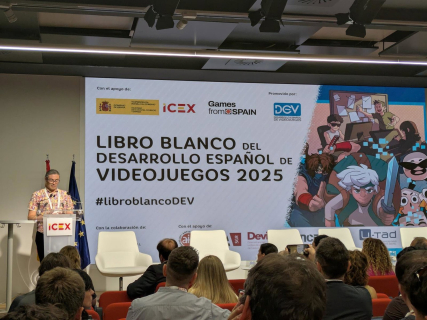

The video game industry in Spain closed 2024 with a turnover of 1,464 million euros and more than 10,500 direct jobs, consolidating itself as a stable sector that continues to grow, albeit with more moderate growth. This lower dynamism leads development studios to demand the implementation of a specific tax incentive for production to give new impetus to the sector.
In 2024, the turnover of Spanish video games increased by 2.7% compared to 2023, and forecasts point to an aggregate growth of 3.1% until 2028, a year in which it is estimated that revenues will exceed 1,650 million euros.
There are 820 active development studios operating in the country, although only 500 are formally constituted as companies. The business fabric shows a strong concentration: 56% of these companies earn less than 200,000 euros annually, while barely 1% exceed 50 million euros per year.
The sector generated 10,508 direct jobs in 2024, 2.4% more than the previous year, with 90 percent of permanent contracts, which shows a relatively stable labor market.
These indicators show that the Spanish video game industry has consolidated, but no longer maintains the expansion rates prior to the pandemic, when it grew at double-digit rates. Even so, it continues in an expansion phase, as highlighted by the president of DEV and director of The Game Kitchen Mauricio García, during the presentation of the "White Paper on Spanish Video Game Development 2025", prepared by the Spanish Association of Video Game and Entertainment Software Producing and Developing Companies and presented this Monday at the headquarters of ICEX Spain Export and Investments, in Madrid.
Catalonia and Madrid lead the video game map
The White Paper places Catalonia as the main video game hub in Spain, both by number of studios and by business volume. This community concentrates 31.3% of development studios and generates 54 percent of the total turnover. In second place is the Community of Madrid, which groups 25.6% of the studios. The report also highlights the growing presence of Andalusia (11.5%) and the Valencian Community (11%).
In terms of business maturity, these are mostly established studios: 72 percent have more than five years of experience and only 7 percent have been in existence for less than two years. Their activity focuses mainly on the development of proprietary IP (91%), self-publishing (56%), and work for third parties (35%).
Regarding platforms, most produce games for PC (92%), Android mobile (48%), and iOS mobile (42%). In the console arena, the most popular is Nintendo Switch (42%), which ranks ahead of PlayStation 5 (37%) and Xbox Series X/S (30%).
The sector is characterized by high qualifications: 75% of professionals have higher education. Among the most common profiles are programmers (24%), artists (14%), and designers (9%). Despite this, studios report difficulties in filling certain positions, especially logic and game programming profiles (44%), technology (28%), and backend (17%).
Use of Generative Artificial Intelligence
The use of generative artificial intelligence tools in the daily operations of studios has barely changed compared to the previous White Paper. 53 percent of studios state that they already use AI solutions in their daily work (compared to 54% in the previous report), while 35 percent declare that they not only do not use this technology but also have no intention of doing so.
43 percent of studios have not yet defined an internal policy on the use of AI, two points less than in the 2024 edition of the White Paper. 30 percent opt for allowing optional use of these tools, while 16 percent expressly prohibit them, a stance that has grown by two points compared to the previous year.
Perception of generative AI remains very divided among Spanish studios, with a slight majority leaning towards a negative view of its impact (46%) compared to those who view it positively (43%).
Funding and Measures to Strengthen the Sector
80 percent of development studios in Spain acknowledge that they need funding for their next project. 70 percent place this need at amounts up to 300,000 euros, with a main range between 50,000 and 150,000 euros.
To cover these needs, most resort to their own resources (78%) and self-financing (68%) as main avenues. Only 21% of studios have the support of a publisher to finance their productions, a percentage similar to that of companies that have accessed some type of public aid.
The White Paper also details the measures that DEV considers priorities for strengthening the video game industry in Spain, based on the opinions of studio managers. Among them are the creation of a specific tax incentive for video game production —which currently does not exist—, the granting of subsidies for projects, and support for the creation and consolidation of national 'publishers'.
In this regard, the Secretary General of DEV, Antonio Fernández, has recalled that current aid depends on budgetary availability and in recent years has been boosted by European funds, but these resources will be reduced in the future.
Therefore, Fernández emphasizes the urgency of establishing a stable tax incentive for the production and financing of video games, with the aim of strengthening competitiveness and ensuring sustainable growth of the sector, in addition to consolidating and expanding direct financing avenues through public instruments.
To this demand is added the need to facilitate the incorporation of graduates into development studios, in a context where the sector already has high training. To this end, greater impetus is called for in employment, continuous training, and the adaptation of talent to the real needs of companies.