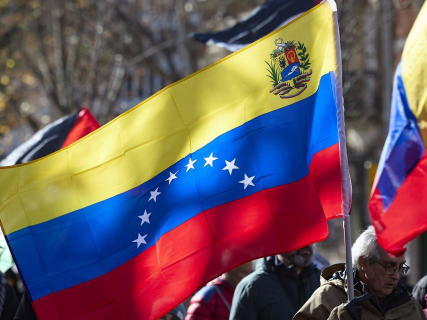










The Venezuelan Executive has placed its public debt at $237.5 billion (€216.595 billion) at the close of 2025, which represents around 242% of the national GDP, according to data released this Tuesday during the presentation of the “Plan Venezuela Renace”.
The official report highlights that “Venezuela’s public debt is in a situation of prolonged default and is unsustainable, reflecting the restrictions imposed by financial sanctions, the decline in revenues from hydrocarbons, and years of macroeconomic imbalances”. It also recalls that “since the default in 2017, arrears have continued to accumulate, including unpaid interest and penalties, while limited access to external financing has further restricted fiscal space”.
The Government, headed on an interim basis by Delcy Rodríguez, details that the ‘stock’ of liabilities is made up of 77.4% of commercial and non-financial obligations. Commercial obligations total $116.5 billion (€106.246 billion), 49.1% of the total, split between $110.1 billion (€100.409 billion) in eurobonds and $6.4 billion (€5.837 billion) in bank loans and lines of credit.
Non-financial obligations are concentrated in the state oil company Petróleos de Venezuela (PDVSA) and amount to $67.3 billion (€61.376 billion), equivalent to 28.3% of the debt. This block includes promissory notes, pending invoices with suppliers and joint ventures, investment certificates, promissory notes, and pension payment commitments. Arbitral debt represents 11.1% of the total, bilateral debt 9.8%, and the remaining 1.8% is multilateral debt.
From Caracas, it is emphasized that the “magnitude, diversity, and legal complexity [...] highlights the need to adopt an integrated approach” for the restructuring of liabilities. Along these lines, the document advances the implementation of a “credible macroeconomic stabilization program backed by strengthened institutional frameworks”.
Among the objectives are “supporting debt transparency, normalizing relations with external creditors, and resuming linkage with international financial institutions. In the absence of these measures, the current public over-indebtedness will continue to weigh on growth prospects and delay economic recovery”.
U.S. guardianship and a shift in the relationship with Washington
In the political sphere, it is recalled that U.S. President Donald Trump ordered, last January, the capture of the Venezuelan dictator Nicolás Maduro and his wife, Cilia Flores, to make them available to Justice in New York, where charges were brought against him for narco-terrorism, capital evasion, and crimes linked to arms trafficking.
After Maduro’s fall, power passed into the hands of Vice President Rodríguez, who assumed the head of state on a provisional basis. Since then, the link between Caracas and Washington has developed under a logic of tutelage, which has led to the opening of the Venezuelan energy sector to foreign investment.
Among the companies that benefited is North American Blue Energy Partners (Nabep), an oil company run by Venezuelan businessman Alejandro Betancourt, in which the Pentagon’s Office of Strategic Capital holds a 35% stake. Nabep gained particular notoriety when Trump signed with the company “the largest oil deal in world history” and granted it a concession to exploit 17 oil fields with proved reserves of 65,000 million barrels over 100 years.