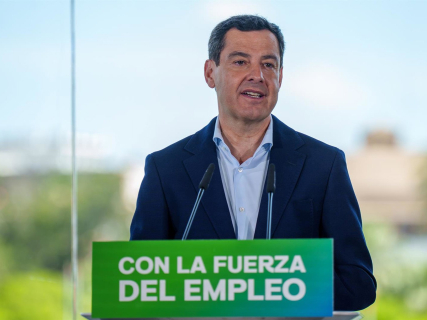

The latest polls for the Andalusian elections place Juanma Moreno's PP as the clear winner on March 17, but leave a decisive unknown: whether he will regain an absolute majority or if he will need Vox to govern.
The own average of the main polls published in the final stretch places the PP at around 42.7% of the votes and in a central range of 55-56 seats, just above the absolute majority of the Andalusian Parliament, set at 55 deputies.
An absolute majority without closing
One week before the Andalusian elections on May 17, all polls agree on the main data: Juanma Moreno would win again by a large margin over the PSOE. The doubt is no longer about who will come in first, but whether the PP will manage to govern alone or if it will have to open negotiations with Vox.
The Parliament of Andalusia has 109 seats and the absolute majority is set at 55 deputies. That number is currently the real border of the campaign: above 55, Moreno retains total control of the Andalusian Government; below, the legislature would be conditioned by Vox.
The average of the polls published in recent weeks leaves the PP in a very tight spot: around 55-56 seats. That is, absolute majority appears as a possible scenario, even probable, but not guaranteed. The difference between governing alone or depending on Vox could be one or two deputies.
For this analysis, the six polls published between mid-April and the first week of May have been taken as a reference:
The average leaves this central photograph:
| PARTY | SEATS | % OF VOTE |
| PP | 55-56 | 42,7 |
| PSOE | 27 | 22,6 |
| VOX | 16 | 14,8 |
| Por Andalucía | 6 | 8,1 |
| Adelante Andalucía | 4 | 6,3 |
The PP is at the high limit of governing alone; the PSOE remains far from disputing victory; Vox improves its role as a potential key; and the left to the left of the PSOE appears fragmented, but with clear options for representation.
The PP: clear first force, but pending a handful of seats
Juanma Moreno maintains a very wide advantage. No poll drops him from first place and all place him around 41%-44% of the votes. The problem for the PP is not victory, but the bar.
The GAD3 poll for ABC, Sur and Ideal placed the PP at 44.1% and between 56 and 58 seats, the most comfortable scenario for Moreno among recent polls. Sigma Dos for El Mundo placed it at 43.7% and between 55 and 57 seats, also in the absolute majority zone. SocioMétrica for El Español raised the PP to 58 deputies with 43.1% of the votes.
But other polls are tighter. IMOP Insights for El Confidencial placed the PP between 53 and 55 seats, right on the edge. Commentia for Grupo Joly placed it between 52 and 54, below the absolute majority. And CENTRA, the so-called Andalusian CIS, placed it between 53 and 56, a range that allows for both an absolute majority and a scenario of parliamentary dependence.
Absolute majority depends on the provinces
The delicate point for the PP is that absolute majority is not decided solely by the global percentage. In Andalusia, provinces, territorial distribution, and the D’Hondt law weigh heavily. A small vote shift can change the last seat in Córdoba, Huelva, Málaga, Jaén, or Granada and alter the entire reading of election night.
The PP is in an area where one deputy up or down has legislative value. The risk for Moreno has two directions. On the one hand, a rise of Vox at the expense of the PP can snatch decisive seats from it in competitive provinces. On the other hand, an improvement of the PSOE or the left-wing parties in certain territories can prevent the PP from converting its advantage into an absolute majority.
Vox: third, stronger than in 2022 and with the option to be a key player again
Vox appears as the third force in all polls. Its average is around 14.8% and about 16 seats, above the 14 deputies it achieved in the Andalusian elections of 2022.
The key is that Vox does not need a big leap to be decisive. If the PP stays below 55, Vox's votes would be enough to ensure a very broad right-wing majority. In that case, the debate would not be whether the right can govern, but how: PP solo government with external support, agreed investiture, or more demanding negotiation with Vox's entry or programmatic conditions.
The polls show relevant differences. GAD3 places Vox lower, between 13 and 14 seats; Sigma Dos places it between 14 and 16; SocioMétrica gives it 15; while Commentia, CENTRA and IMOP raise it to areas of 17-20 seats.
That dispersion is important. If Vox is closer to 13, Moreno has more options to absorb the useful vote of the bloc. If it gets closer to 18 or 19, the PP's absolute majority becomes much more complicated.
The PSOE: far from the PP and at risk of debacle
María Jesús Montero's PSOE clearly appears as the second force, but far behind the PP. The average places it at 22.6% and around 27 seats. This would leave the socialists well below the 2022 result despite having chosen one of the most well-known progressive politicians by the Andalusian and Spanish electorate as their candidate: María Jesús Montero.
The toughest poll for the PSOE is the CENTRA one, which places it at 20.1% and between 25 and 27 seats. Commentia places it at 21.6% and between 26 and 28. On the less negative side, GAD3, Sigma Dos and SocioMétrica attribute 23.5% to it,
The PSOE has a double problem. Not only is it far from the PP, but it also does not seem to be clearly absorbing all the votes to its left. This limits its options for substantial improvement and turns its campaign into a fight to avoid a bigger fall, rather than a real contest for the Junta.
For Andalusia and Adelante Andalucía: rise and fragmentation
The left to the left of the PSOE has a presence in all the polls, but divided. Por Andalucía appears around 8.1% and about 6 seats. Adelante Andalucía moves around 6.3% and about 4 deputies.
Fragmentation is once again key. Por Andalucía and Adelante can add up to about 10 seats, but their political impact depends heavily on provincial distribution. In a Parliament of 109 deputies, each tenth can determine whether they enter certain constituencies or not and whether the progressive bloc improves or is penalized for competing separately.
On average, Por Andalucía is positioned above Adelante, although the difference is not abysmal. Commentia, for example, places Por Andalucía at 9.1% and Adelante at 7.1%; CENTRA places Por Andalucía at 7.9% and Adelante at 6.9%; SocioMétrica gives a greater advantage to Por Andalucía, with 8.4% versus 5.2%.
SALF: Much Noise, But For Now Out of Parliament
Se Acabó La Fiesta appears in some polls, but does not manage to consolidate representation. Its average is around 2.2% and it does not reach a seat in the average of the analyzed polls.
The best data published for SALF is that of SocioMétrica, which places it at 2.9%. CENTRA and other estimates place it around 2%. IMOP left it at 1.6%.
The problem for SALF is the Andalusian electoral system. Having media presence or a visible regional percentage is not enough: it needs to overcome provincial barriers and concentrate enough votes. For now, the data suggests it may take votes away from the right-wing space, but not necessarily convert them into seats.
Comparison with 2022: Moreno holds on, Vox improves, and PSOE sinks
The PP won the Andalusian elections of 2022 with 43.1% and 58 seats. The PSOE obtained 24.1% and 30 deputies. Vox achieved 13.5% and 14 seats. Por Andalucía obtained 7.7% and 5 deputies, while Adelante Andalucía remained at 4.6% and 2 seats.
Compared to that photo, the PP maintains practically the same level of vote, but may lose seats due to the reordering of the bloc and provincial competition. Vox grows slightly in vote and seats. The PSOE drops notably compared to 2022. Por Andalucía and Adelante Andalucía improve overall, although divided.
This explains the central paradox of the campaign: Moreno may have a very similar percentage to 2022, but not have the same absolute majority guaranteed. The disappearance of Ciudadanos, the resistance of Vox, and the provincial distribution make the result less automatic than it seems.
What must happen for Moreno to keep the absolute majority
For the PP to retain an absolute majority, it needs three things. First, to maintain the useful vote of the right in the last week. Second, to prevent Vox from growing in provinces where the last seat can be decided. And third, to sustain its territorial advantage in medium and small constituencies, where the conversion of votes into deputies is more delicate.
The PP campaign is understood from there. Moreno does not compete only against María Jesús Montero; he also competes against the abstention of his own voters and against the flight to Vox. His message of stability seeks precisely to prevent a part of the conservative electorate from taking victory for granted and using their vote to pressure from the right.
What the PSOE needs to improve the result
The PSOE needs to mobilize its own vote, recover part of the lost ground and prevent the campaign from becoming a plebiscite between an absolute majority for the PP or dependence on Vox. If the election is read only in those terms, the useful vote for the right can strengthen Moreno.
For María Jesús Montero, the margin for growth passes through two avenues: attracting progressive voters who are undecided between PSOE, Por Andalucía, and Adelante, and recovering abstentionists from 2022. The problem is that polls do not yet show a sufficient comeback. Her realistic objective seems to be avoiding a historic low and remaining the main reference point for the opposition.
The last week can move the last seat
Polls show trends, not sentences. And in Andalusia, with eight provinces and a distribution of 109 deputies, the last seat can be moved by small differences. This makes it a final week of maximum tension: moving a seat between any of the three major groups can mean the difference between glory (absolute in the case of the PP, maintaining the 2022 result for the PSOE, or growing for Vox) and debacle.
The last week also arrives marked by several campaign factors: the electoral debate, the final mobilization, the useful vote, the effect of participation and the impact of agenda topics such as health, housing, employment, regional financing or security.