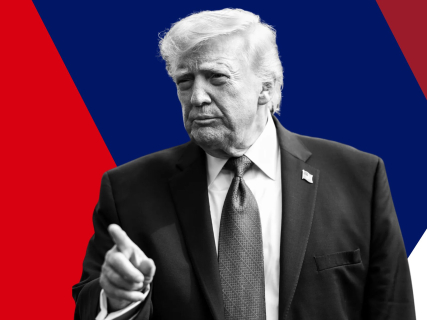
Trump revives the pulse with Europe by insisting on Greenland and threatening to withdraw all his troops

The US president arrives at the NATO summit in Ankara redoubling pressure on his allies, criticizing their stance on Iran and reviving his aspirations for the Danish island

3 minutes

6

6

Add DEMÓCRATA to Google

Ask FREN

Published

Last updated

3 minutes

Most read

From Ankara, special correspondent.– Everything was designed in the "image and likeness" of Donald Trump. The NATO Secretary General, Mark Rutte, had spent days trying to contain the differences between the allies so that every detail of the Ankara summit would respond to Washington's demands and avoid any surprises. Even the ambassadors of the member countries closed the last loose ends of the final declaration the previous week with the aim of preventing improvisations that could blow up the consensus that the Alliance hoped to exhibit to the world.

None of this has helped. Just a few minutes after landing on board his new presidential plane, the President of the United States, Donald Trump, has once again publicly shown his displeasure with the European allies for their refusal to support Washington's strategy in the war with Iran. Furthermore, he has gone a step further by threatening to withdraw all U.S. troops deployed in Europe if the partners do not assume greater commitment to the continent's security.

Criticism of allies before the summit

It was during a joint appearance with his Turkish counterpart, Recep Tayyip Erdogan, that Trump made it clear that his attendance at the summit was not guaranteed. As he explained, only the holding of the meeting in Turkey and his good relationship with Erdogan tipped the scales in favor of his presence.

"If the summit had not been held in Turkey, where my friend is a very strong leader, I might not have attended," the U.S. leader stated.

Trump's words highlight the tense atmosphere between Washington and several of its European partners. A discontent that U.S. diplomatic representatives to NATO had already hinted at days before, and which the president himself has now decided to verbalize publicly, just a few hours before meeting with the other heads of state and government of the Alliance.

The threat over Greenland returns

Just hours before the official start of the meeting, the Republican leader also revived one of the most controversial proposals of his previous term: the annexation of Greenland, an autonomous territory belonging to the Kingdom of Denmark.

An idea that seemed to have been buried since the beginning of the year, but which Trump has resurrected precisely as NATO prepares to redefine the role that Europeans should assume in defense and security matters.

"Denmark does not have the money to really help Greenland. It should be controlled by the United States", assured the US president, insisting that the island possesses enormous strategic value for Washington's military and economic interests.

The statements reopen a diplomatic front with Copenhagen and add a new element of uncertainty to a summit that was already marked by discrepancies between the United States and several European allies over the burden-sharing of military efforts, the future of the war in Ukraine, and the common strategy against Russia and Iran.

The threat of withdrawing troops from Europe

Along with his criticisms of the lack of support in the conflict with Iran and his insistence on controlling Greenland, Trump has also slipped in one of the most sensitive warnings for European partners: the possibility of withdrawing the US military contingent deployed in Europe if the allies continue to depend on Washington to guarantee their security.

The threat comes at a particularly delicate moment for NATO, immersed in a transformation process aimed at strengthening European military capabilities and increasing member states' defense spending. Precisely, this will be one of the main issues that will focus the leaders' conversations over the next few hours in Ankara, where the Alliance aspires to project an image of unity that, for the moment, has been seriously compromised by the US president's initial statements.

More key points, information and questions with FREN

AI-GENERATED CONTENT

What is the procedure for a NATO country to unilaterally withdraw its troops from another member country?

The North Atlantic Treaty and the available information do not allow, with the sources I have here, to precisely reconstruct the internal procedure step by step for a NATO country to unilaterally withdraw its troops from another member country. Furthermore, the information that is available refers to parliamentary functioning mechanisms (such as parliamentary control, budget veto, and majority systems), but does not go into detail about military missions or specific NATO agreements. Therefore, it is only possible to generally explain what types of decisions would be internal to the State, what kind of political control the parliament could exercise, and what types of rules might be involved, without going into the technical detail that a specialized legal opinion on NATO would have.

Internal decisions: Government and Parliament

The decision to deploy or withdraw troops abroad is part of the Government's action and, as such, is subject to parliamentary control. According to the available information, parliamentary control is the function by which legislative chambers supervise and oversee the Executive's actions, with instruments such as:

  • Oral or written questions to the Government in plenary or committee.
  • Interpellations, which lead to debates on government policy on a specific issue.
  • Motions, presented after an interpellation, for the Chamber to express itself or urge the Government to act.
  • Appearances of Government members or senior officials to report on relevant matters.
  • Investigation committees to analyze issues of special political or social relevance.
  • Requests for information and documentation addressed to the Executive.
  • Exceptional mechanisms such as the vote of no confidence or the question of confidence.

Applied to the case of troops deployed in another NATO country, unilateral withdrawal would be an Executive decision subject to this logic: the Government decides, but Parliament can demand explanations, politically condition that decision, or ultimately make it politically unfeasible through intense control instruments.

Budgetary conditions and the “Government veto”

Any deployment or withdrawal of troops has budgetary consequences (defense spending, logistics, infrastructure, etc.). In the Spanish legal system, the available information recalls that the Government has a key mechanism: the so-called “Government veto” in budgetary matters, established in Article 134.6 of the Constitution.

This veto allows the Executive to oppose the processing or approval of legislative initiatives (such as bills or amendments) that imply an increase in spending or a decrease in income. The scheme is:

  • The Government formally communicates its opposition to the Chamber's Board.
  • The Board admits the veto and the initiative cannot proceed while the Executive maintains it.
  • The Government can lift that veto at any time.

Translated to the field of military missions, this means that if Parliament tried to condition deployment or withdrawal policy through a rule with budgetary impact, the Executive could try to shield its room for maneuver using this veto. Again, this is not a specific NATO rule but an internal mechanism of power organization.

Laws, majorities, and internal legal limits

The available information also notes that some laws require qualified majorities or special procedures (organic laws, constitutional reforms, statutes of autonomy, etc.). Although the regulation of military missions is not explicitly mentioned, this allows understanding something important: if the Constitution or an organic law strictly regulates the external intervention of the Armed Forces, any fundamental change in that regime (for example, to drastically limit or condition the unilateral withdrawal of troops) could require:

  • An absolute majority or even three-fifths or two-thirds, depending on the type of rule.
  • In some cases, aggravated procedures such as those provided for constitutional reform.

This introduces an internal limit: even if the Government wants a rapid withdrawal, it could be conditioned by higher-ranking rules that establish procedures, prior authorizations, or reinforced parliamentary requirements. However, the available information does not detail whether this is the specific case in defense matters.

Limits of the available information on NATO

With the sources I have access to in this context, there is no specific data on:

  • The internal NATO rules regarding the withdrawal of contingents.
  • The specific role of the North Atlantic Council in the face of a unilateral withdrawal.
  • The content of status of forces agreements (SOFA) or bilateral agreements with host countries.

Consequently, it is not possible to rigorously explain whether prior authorization from the host country or NATO is required, nor the detailed deadlines and formal procedures. Nor is there more information in the consulted sources that allows specifying how the legal articulation, within NATO, of the balance between each State's sovereignty to decide about its troops and the commitments assumed in joint missions is structured.

What role does the Spanish parliament play in authorizing or supervising military missions abroad, including NATO missions? What political mechanisms could the opposition in Spain use if they disagree with the withdrawal or maintenance of troops in a NATO operation? What types of legal or constitutional reforms would be necessary in Spain to change the parliamentary authorization regime for international military missions?

What are the powers of the President of the United States in foreign policy and defense according to the U.S. Constitution?

According to the United States Constitution, the president holds a very strong role in foreign policy and defense, but always within a system of checks and balances with Congress. He is the commander in chief of the Armed Forces and the country's main international representative, with the capacity to direct diplomacy and negotiate treaties. However, the Senate must approve treaties and many key appointments, and Congress retains decisive powers regarding war and military funding. In practice, the combination of constitutional text and political practice has made the president the central actor, but not an unlimited power.

Basic constitutional framework

The presidential powers in foreign policy and defense are mainly found in Article II of the Constitution of the United States. This article defines the president as head of the Executive Branch and details several specific powers with direct impact on these matters. At the same time, Article I grants Congress key powers, such as declaring war, regulating foreign commerce, and approving the budget, which practically limits presidential action.

Commander in chief and defense power

The Constitution establishes that the president shall be “Commander in Chief” of the United States Armed Forces and of the state militias when called into federal service. This grants him:

  • Operational direction of military campaigns and overall defense strategy.
  • Authority to order deployments and troop movements in peacetime and conflict.
  • Capacity to respond quickly to emergencies and attacks without prior Congressional authorization.

However, the Constitution does not expressly grant the president the power to declare war. This power belongs to Congress, which also has the competence to raise and maintain armies, provide a navy, and fund the armed forces. In practice, presidents have initiated many military operations without a formal declaration of war, relying on Congressional resolutions or their authority as commander in chief, which has generated ongoing debate about the constitutional limits of this power.

Foreign policy powers

In international relations, the president plays the role of head of state and head of government, which the Constitution articulates in several key powers:

Negotiation and signing of treaties

Article II establishes that the president has the power to negotiate and sign treaties with other nations, but these only come into effect if they have the “advice and consent” of the Senate, that is, approval by a two-thirds majority of the senators present. This implies:

  • The president leads the diplomatic initiative, deciding with whom and what to negotiate.
  • The Senate acts as a filter and control, able to block or modify agreements.

Besides formal treaties, “executive agreements” have developed in practice, which the president can conclude without Senate ratification. They are not mentioned in the Constitution but have become a key instrument of foreign policy, although their internal legal rank is lower than that of a treaty.

Appointment and reception of diplomatic representatives

The president also has the power to appoint ambassadors and other high officials in the diplomatic field, “with the advice and consent of the Senate.” This reinforces his control over the foreign policy machinery, but subject to Senate approval.

Likewise, the Constitution states that the president shall “receive ambassadors and other public ministers.” This power of reception has historically been interpreted as the basis of the presidential power to recognize foreign states and governments, a central aspect of foreign policy.

Other relevant powers

Besides the express powers, the president has implicit powers derived from his position as head of the Executive:

  • Capacity to direct foreign policy through the State Department, the National Security Council, and other agencies.
  • Use of personal diplomacy, international summits, and messages abroad as instruments of strategic guidance.
  • Possibility to conclude military agreements (e.g., troop stationing, defense cooperation) combining his role as commander in chief and diplomatic leader.

Checks by Congress and the judicial system

Although the president is the most visible actor, the Constitution designs a balance:

  • Congress controls the defense budget and can limit operations through funding conditions.
  • The Senate approves or rejects treaties and diplomatic and national security appointments.
  • The courts, especially the Supreme Court, can review certain decisions when constitutional violations or conflicts of powers are alleged.

Overall, the U.S. Constitution configures a very powerful presidency in foreign policy and defense, but anchored in a system of separation of powers that requires, at least in theory, cooperation and mutual control among the different branches of government.

How are the powers to initiate and maintain a war exactly divided between the president and Congress according to recent practice in the United States? What legal differences exist between an international treaty and an “executive agreement” signed by the U.S. president? What role does the Senate play in evaluating and approving the appointments of ambassadors and national security officials proposed by the president?

What was Donald Trump's political and professional trajectory before becoming president?

Donald Trump became president of the United States in 2017 after a long career as a real estate businessman, media figure, and occasional political activist. Before becoming a candidate, he had never held an elected office but had built a very strong public image thanks to his businesses, television presence, and confrontational style. His definitive leap into politics was the announcement of his candidacy in 2015, supported by a nationalist and anti-establishment discourse that capitalized on his previous fame. His professional and media trajectory was, in practice, the central springboard of his political career.

Origins and education

Donald John Trump was born in New York in 1946, into a wealthy family dedicated to the real estate business. He studied at the Wharton School of the University of Pennsylvania, one of the most prestigious business schools in the United States, where he graduated in economics. That education provided him with the technical foundation and academic prestige that he later used as part of his narrative of business success.

Entry into the family real estate business

After graduating, Trump joined his father's company, focused on middle-class residential housing in New York neighborhoods. In the 1970s, he took on an increasingly relevant role and began reorienting the activity toward higher-profile and riskier projects, especially in Manhattan. In this stage, he positioned himself as an ambitious developer, willing to negotiate aggressively with banks and local authorities to obtain financing, tax exemptions, and urban permits.

Building a personal brand empire

In the 1980s and 1990s, Trump promoted a series of emblematic projects: skyscrapers, luxury hotels, and casinos, many of them with his surname as the central brand element. The Trump Tower building on Fifth Avenue became his most recognizable symbol. At the same time, he exploited licenses of his brand in very diverse fields (clothing, consumer products, golf courses, etc.), with mixed results but great media impact.

His business style combined the pursuit of high-profile projects, an intense relationship with the media, and a willingness to accept high debt. This also led him to several restructurings and business bankruptcies in the casino and leisure sector, although he personally managed to maintain his image as a successful businessman, partly thanks to very skillful use of communication.

Consolidation as a media figure

The big leap into global popular culture came with his role as host and producer of the reality TV show “The Apprentice,” which premiered in 2004. In this format, Trump built the image of a tough, decisive, and successful boss, reinforced by iconic phrases and an authoritarian style. This television persona consolidated his notoriety among broad layers of the population who did not follow the business world or traditional politics.

The mix of business, celebrity, and constant presence in tabloids and entertainment programs created informal political capital: an audience that knew him, recognized him, and associated him with the idea of a “winner,” even if that perception did not always match the reality of his business accounts.

Early political steps and positions

Although he did not hold public office before the presidency, Trump moved for decades in the political environment of New York and Washington, donating to candidates from both parties. Over time, he changed affiliation among Republicans, Democrats, and minor parties, reflecting pragmatism more than a systematic ideology.

In 1999–2000, he considered a possible presidential candidacy for the Reform Party but discarded it. During the 2000s and especially from 2011, he began gaining weight in conservative public debate by questioning President Barack Obama's legitimacy through the conspiracy theory about his birthplace. This campaign gave him great visibility among discontented Republican voters.

From media figure to presidential candidate

On June 16, 2015, he officially announced his candidacy for the presidency for the Republican Party. His launch speech, very tough on immigration and critical of political and economic elites, connected with a part of the electorate that felt marginalized by globalization and traditional parties. His campaign relied on his career as a businessman, presenting himself as someone outside the “establishment” and capable of “negotiating better deals” for the United States.

In summary, his rise to the presidency is explained by the combination of three previous dimensions: a business career focused on real estate and personal branding, massive media notoriety built on television and press, and growing political activism in a populist and anti-system key that culminated in his 2015 candidacy.

What role did the show “The Apprentice” play in building Donald Trump's political image? How did the crises and bankruptcies of his companies influence public perception of Trump before he became president? What political positions did Trump defend before his 2015 presidential campaign and how did they evolve?

Play

Test your knowledge with FREN!

How much do you know about this topic? Answer the following 3 questions.

What controversial proposal has Donald Trump revived during the NATO summit in Ankara?

Question 1 of 3

Why has Trump threatened to withdraw US troops from Europe?

Question 2 of 3

Which international leader influenced Trump's decision to attend the Ankara summit?

Question 3 of 3

Hola, soy Fren. ¿Cómo te ayudo?