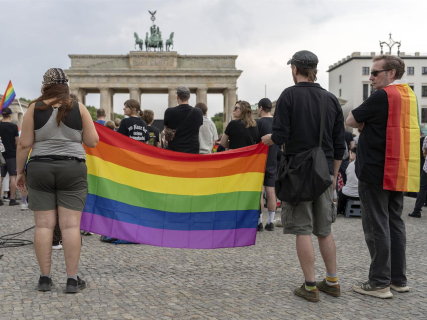
Who is Abdul Ballout, the alleged author of the Berlin Pride attack shot down by the Police

Abdul Ballout, a German citizen of Lebanese origin born in 2005, is identified by the authorities as the alleged responsible for the multiple run-over that occurred during the celebration of LGTBI Pride Day in Berlin. The suspect has been shot dead by the Police after a chase in Spandau.

1 minute

fotonoticia 20260726193646 1920

fotonoticia 20260726193646 1920

Add DEMÓCRATA to Google

Ask FREN

Published

Last updated

1 minute

Most read

The name of Abdul Ballout has come to occupy this Sunday the attention of Germany after the attack committed during the celebration of Pride Day in Berlin. The presumed author of the multiple hit-and-run, in which one person died and another 29 were injured, has died shot by the Police in the locality of Spandau, located in the west of the German capital.

The Minister of the Interior, Alexander Dobrindt, previously confirmed that the investigations point to an "Islamist attack." As he explained, the suspect burst in with a van against the attendees at the event held in Tiergarten park and subsequently attacked several people with a knife before fleeing.

A young German of Lebanese origin

According to the information provided by the German Ministry of the Interior, Abdul Ballout was a German citizen of Lebanese origin born in 2005.

The authorities maintain that he was already known to the security forces due to criminal records, a process of radicalization, and his connection to the Islamist environment. In fact, he had been sentenced in Berlin to one year and ten months in prison, although the sentence was suspended, a decision that the minister recalled had been adopted despite the opposition of the Prosecutor's Office.

The chase ended in Spandau

After the attack, the Police deployed a wide search operation in Berlin, as well as controls at airports, train stations, and border crossings.

Hours later, the suspect was located in Spandau, where he died shot during the police intervention, as confirmed by EFE.

An attack with one dead and 29 injured

The updated balance raises the number of injured to 29, several of them seriously, in addition to one deceased person.

The German government considers that all indications point to an attack motivated by Islamism, while the investigation continues to clarify whether the attacker acted completely alone or had some kind of support.

Berlin reinforces security

The mayor of Berlin, Kai Wegner, described the attack as "an attack against liberal democracy and coexistence" and announced an extraordinary security meeting.

In addition, the City Council has declared official mourning, with flags at half-mast and a religious act in memory of the victims.

More key points, information and questions with FREN

AI-GENERATED CONTENT

What competencies does the German Federal Minister of the Interior have regarding security and terrorism?

The German Federal Minister of the Interior (Bundesminister des Innern) appears in the available information as the political authority who directs the federal government's internal security policy: he promotes legal reforms, sets priorities against extremism and terrorism, orders the strengthening of the Federal Police, and coordinates with the federal states (Länder) and international partners. The consulted sources do not detail the specific legal bases or an exhaustive list of competencies, but it is clear that he concentrates the initiative on border control, protection of critical infrastructures, action against extremism, and police coordination. In counterterrorism matters, the minister leads regulatory packages, classifications of organizations as extremist, and cooperation with other countries.

General framework of internal security

In Germany, internal security is a shared responsibility between the Federation and the Länder, but the news shows that the federal Ministry of the Interior sets the strategy on the main axes of security policy. Thus, the Interior Minister describes security as an “absolute priority” and links his management to the fight against left-wing extremism, right-wing extremism, and hybrid threats against critical infrastructures, as reported by the newspaper Demócrata in the analysis of the legal toughening against extremism following a massive blackout in Berlin (toughening against extremism).

From this political position, the minister promotes specific laws (such as the so-called Kritis Law to shield critical infrastructures) and staff reinforcements in intelligence services and digital investigation units, always with discourse focused on protecting the “democratic order” and the continuity of essential services.

Relationship with the Federal Police (Bundespolizei)

Demócrata's information shows the Interior Minister as responsible for promoting legislative changes that expand the powers of the Federal Police. A report details that the German government has approved a regulatory update granting the Bundespolizei greater capacity to intercept and control drones, protect critical infrastructures and transport systems, and use its own drones to, for example, monitor demonstrations (drone threat).

The same text indicates that other powers are expected to be expanded: interception of communications, detention of foreigners in the process of expulsion, and “random checks without cause” in certain areas. All this is presented as part of a federal strategy to solve the fragmentation of competencies between regional and national levels in the face of technological threats such as drones.

Additionally, the minister is also the one who announces political decisions on land border controls within the Schengen area. Another piece reports that the Interior Minister communicates the six-month extension of these controls to strengthen security and contain irregular migration, a decision that Germany must notify to the European Commission (border controls).

Extremism, domestic intelligence, and public order

The Federal Office for the Protection of the Constitution (BfV, domestic intelligence) appears in several news items as a central piece in controlling extremism, although the sources do not explicitly state its organic dependence. It is noted that this Office classifies regional sections of the Alternative for Germany party (AfD) as extremist organizations and places them under surveillance, with explicit political support from Interior officials at the state level, who consider right-wing extremism “the greatest danger to society” (AfD in Lower Saxony and AfD in Bavaria).

Another report explains that an administrative court has provisionally halted the intelligence services from classifying the AfD as extremist at the regional level, highlighting how these classifications—and their judicial challenges—are part of the ordinary management of internal security (provisional veto on extremism label).

In the field of public order and prevention of Islamist terrorism, the Ministry of the Interior also decrees bans on organizations. An example is the declaration of illegality of the Islamist group Muslim Interaktiv for promoting the creation of a caliphate and for messages against Israel and the Jewish community; the note emphasizes that authorities will act against “any attempt to impose a caliphate or incite hatred,” accompanied by coordinated raids in several Länder (Muslim Interaktiv ban).

Fight against terrorism and international cooperation

The consulted sources do not detail specific antiterrorist coordination bodies, but they do show the Interior Minister articulating the response against terrorism and violent extremism through three channels: legislative changes, strengthening police and intelligence resources, and international cooperation.

Domestically, after an attack attributed to a far-left group that sabotaged a key electrical infrastructure, the minister announces more personnel, “more powers,” and “tougher laws” as a response to terrorism, and considers creating national reserves to face massive blackouts (extremism and sabotage).

On the external front, the minister signs a pact in Jerusalem with Israel to strengthen cooperation in cyber defense, protection of critical infrastructures, and the fight against antisemitism and terrorism, highlighting the need to rely on Israeli experience and technology in the face of increasing actors capable of attacking critical infrastructures (Germany–Israel pact). Another piece details the inauguration in Berlin of a joint drone defense center that, according to the Ministry of the Interior itself, “concentrates the technical expertise of the federal and state governments” and creates a pillar of the “security architecture” for hybrid threats and sabotage (joint drone defense center).

In summary, the news portray the German Interior Ministry as the political apex that drives the internal security strategy, coordinates with the Länder and other countries, and provides regulatory and resource coverage to the Federal Police and intelligence services in the fight against terrorism and extremism, although a detailed legal description of all its competencies is not available.

How do the German Ministry of the Interior and the Länder coordinate in practice when there is a specific terrorist threat? What specific legal reforms does the so-called Kritis Law include to protect critical infrastructures in Germany? What role does the German Federal Police play in the controls at the internal Schengen borders that the Interior Minister has extended?

What has been Kai Wegner's political trajectory before becoming mayor of Berlin?

According to the information available in the consulted sources, it can only be stated with certainty that Kai Wegner is a conservative leader of the Christian Democratic Union (CDU) and currently holds the Mayor-Governor position of Berlin (mayor-governor or Regierender Bürgermeister). However, the documentation does not detail his political trajectory prior to taking office: no dates, no specific previous positions, nor his internal evolution within the CDU are recorded. This greatly limits the possibility of rigorously reconstructing his political biography before becoming mayor. Additionally, my specialization is Spanish politics and, to a lesser extent, European politics; the politics of German Länder and cities is not my main focus.

What we do know: his role as mayor of Berlin

Recent news place Wegner as a prominent figure of German conservatism in the capital. In January 2026, the newspaper Demócrata explicitly mentions him as mayor of Berlin and CDU leader regarding sabotage against the city's electrical grid that left tens of thousands of homes without power. In that coverage, Wegner describes the attack not only as arson or sabotage but as “terrorism,” demanding the capture of the perpetrators and strengthening the protection of critical infrastructures. This position is described in a Demócrata report.

The same outlet reports in another piece that, after that sabotage, about 30,000 homes remained without power and again cites Wegner as mayor, insisting on the need to “strengthen protective measures,” install more cameras, and deploy more security in the electrical grid, emphasizing the vulnerability of Berlin's urban infrastructures. This context appears in another Demócrata report.

Outside Demócrata, the newspaper eldiario.es also places him as “mayor-governor of Berlin, the Christian Democrat Kai Wegner” in an April 2025 piece about the expulsion of foreign pro-Palestinian activists, where his support for that decision by Berlin authorities is recorded, which he describes as “correct and necessary” in defense of the German “reason of state” regarding Israel. This approach is detailed in the elDiario.es report on expulsions of pro-Palestinian activists.

Absence of reliable data on his previous career

Beyond this role as the top political leader of the city-state government, the consulted documentary bases—including the Demócrata archive, which does offer detailed profiles of other European leaders and foreign mayors—do not provide a biographical profile of Kai Wegner. There are no references to:

  • Specific positions he may have held in the Bundestag (Federal Parliament) or the Berlin regional parliament before becoming mayor.
  • Internal responsibilities within the Berlin CDU (e.g., regional presidencies, spokesperson roles, etc.).
  • His academic background, original profession, or first steps in local or district politics.

In contrast, for other German or European leaders, the same sources do offer complete political biographies. For example, Demócrata extensively details the trajectory of figures like Friedrich Merz, the current German Chancellor, or profiles of mayors of other capitals such as Emmanuel Grégoire in Paris or Zohran Mamdani in New York. The absence of equivalent treatment for Kai Wegner indicates that, at least in the databases I handle, no further biographical information on his stages prior to the Berlin Mayorship is available.

Limitations and warning about the information

Since the instructions under which I work prohibit filling gaps with information not supported by the provided sources, I cannot attribute specific previous positions (e.g., certain seats, exact years in the Bundestag, or internal CDU positions) even if such data may be found in other public biographies outside the set of documents I am authorized to use.

Moreover, my area of specialization is Spanish politics: parties like PSOE, PP, Sumar, Vox, or nationalist groups and their parliamentary and governmental dynamics. In matters of German politics—and even more so municipal or city-state politics as in Berlin—I am not specialized and depend on what the media and databases I have access to report. In this specific case, those sources only allow affirming with certainty Wegner's current role as mayor-governor of Berlin and his affiliation to the CDU, but not reliably and completely reconstruct his previous political trajectory.

In summary, based on the consulted documentation, one can portray Kai Wegner as a conservative CDU leader governing Berlin who has taken a firm stance on security, critical infrastructures, and public order issues, but it is not possible, with these sources, to rigorously describe his political career before attaining the Berlin Mayorship. Any detailed account of his previous trajectory would require consulting other biographies or specialized databases on German politics that are not part of this information set.

What weight does Kai Wegner's CDU have in the politics of the Berlin city-state compared to the SPD and AfD? How is the mayor-governor of Berlin elected and what institutional competencies does he have compared to a Spanish mayor? What position has Kai Wegner taken in other security episodes or protests in Berlin since becoming mayor?

What legal requirements exist in Germany to decree official mourning after an attack?

The available information does not contain any specific reference to German regulations on official mourning, Staatstrauer or Trauerbeflaggung, nor to which authority (Federal President, Federal Government, or Länder) exactly has the competence to decree it after an attack. Additionally, as an assistant, I specialize in the Spanish political and regulatory context, not the German one, so I cannot offer a reliable and detailed description of the specific legal requirements in Germany. It can be said, very generally, that in Europe these situations are usually regulated by rules on flag use and formal decisions by the head of state or government, but in the specific German case there are no precise normative data in the consulted sources. Below I explain the limit of the available information and, by way of comparison, how official mourning is ordered in Spain, which is well documented.

Limitations regarding Germany

No German law, regulation, or directive on official mourning appears in the research trail. There are no references to a federal Flaggenordnung, instructions from the Chancellery on Trauerbeflaggung, nor provisions from the Länder for half-mast flags after attacks.

Specific news about German mourning decisions after recent attacks (such as the cited attacks in Magdeburg, which are only mentioned commemoratively in this piece, without addressing the legal requirements of mourning) have not been found. Consequently, there is insufficient documentary basis to state, for example, whether official mourning for an attack is decreed by the federal president, the government, the affected Länder, or in a coordinated manner.

Since the instructions governing this response expressly prohibit “filling in” with undocumented data (laws, articles, competencies, or dates that are not in the sources cannot be invented), the only rigorous statement is that there is no specific German normative information available on your question.

What is known by comparison: the Spanish case

Where there is abundant detail is in the functioning of official mourning and half-mast flags in Spain, described in the Official State Gazette and numerous political chronicles from the newspaper Demócrata. Although not automatically transferable to Germany, it helps understand how these mechanisms are usually articulated in European systems:

  • State mourning for multiple victims: the central government decrees mourning by royal decree. For example, after the death of Pope Francis, Royal Decree 343/2025 required all official flags to fly at half-mast, including municipal ones, as reported by the Pamplona City Council in this note.
  • Autonomous mourning: autonomous communities can declare their own mourning, publishing it in their official gazette. The Junta of Andalusia, for example, decrees days of mourning and half-mast flags for major tragedies, such as the Los Gallardos fire (news in Demócrata) or the death of two civil guards in an anti-drug operation (link).
  • Mourning of specific institutions: parliaments or city councils can set their own mourning signs by regulation, as the Andalusian Parliament does in this regulation, or the Extremadura Assembly when it keeps flags at half-mast for the death of Guillermo Fernández Vara, according to this report.
  • European coordination: EU institutions also coordinate symbolic gestures with national mourning. After the Adamuz train accident, the European Parliament and Commission flew their flags at half-mast during the official mourning days decreed by Spain, as reported in this information.

Domestically, the use of flags and their obligations (presence, precedence, etc.) is developed in Spanish law, and Demócrata has explained it in an educational key in several pieces: for example, about municipal non-compliance in Catalonia in this analysis, or about the PP's initiative to sanction officials who “do not respect” the flag and anthem in this proposal and its subsequent debate in the Senate in this article and this other.

Conclusion

With the available documentation, it is not possible to seriously describe the specific legal requirements in Germany to decree official mourning after an attack (Staatstrauer, Trauerbeflaggung): neither the basic flag law, decision procedures, nor competent actors have been located. It can only be noted that, in comparable European systems, these decisions are usually linked to the regulation of flags on public buildings and formal acts by the head of state or government, and that in Spain it is clearly articulated through royal decrees and autonomous regulations as illustrated, among others, by the examples collected in Demócrata cited above. Beyond that general comparison, on Germany “no further information is available in the consulted sources.”

How is official mourning and half-mast flag use exactly regulated in Spain when there is a terrorist attack? What role do the central government and Spanish autonomous communities have in declaring days of mourning and tributes to victims? What recent political debates have there been in Spain about the use of the flag and other symbols in acts of mourning or democratic memory?

Play

Test your knowledge with FREN!

How much do you know about this topic? Answer the following 3 questions.

Where was Abdul Ballout shot by the Police?

Question 1 of 3

How many people were injured in the attack during the LGBTI Pride Day in Berlin?

Question 2 of 3

What was Abdul Ballout's nationality and origin?

Question 3 of 3

Hola, soy Fren. ¿Cómo te ayudo?