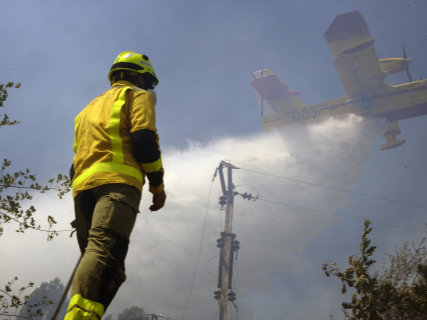

The European Union has mobilized four Canadair planes to reinforce the extinguishing of the fires that especially affect Madrid and Ávila this Saturday, July 25. Two aircraft are arriving from Italy and another two from Greece, while France is also receiving European planes and helicopters due to the forest emergency that forces the evacuation of tens of thousands of people.
Spain is receiving four Canadair planes sent by Italy and Greece this Saturday to reinforce the fight against the large forest fires that have put the Community of Madrid and the province of Ávila in emergency.
The European Commission activated the resources after the Spanish Government requested help through the European Union Civil Protection Mechanism. Italy is providing two aircraft and Greece another two, as confirmed by Brussels. It is expected that the four planes will arrive in Spain during this Saturday and will join the operation when the operational procedures are completed and they receive a destination from the emergency command.
Four Canadair to reinforce the operation
The European Commission has confirmed the deployment of four planes to support Spain.
Two of them are based in Greece and another two are stationed in Italy. Their arrival aims to expand the aerial attack capacity in fires that have forced the mobilization of numerous resources and that keep several affected areas on alert.
The Interior Ministry has informed Europa Press that three people will arrive “in advance” this Saturday morning on a commercial flight. For now, there is no specific time for the arrival of the requested aerial resources.
Copernicus is also activated
In addition to the planes, Brussels has mobilized the satellite imagery service Copernicus.
This tool allows obtaining updated information on the evolution of the fires, the affected areas, and the possible direction of the flames' advance. In forest emergencies, satellite images help plan evacuations, prioritize resources, and delineate perimeters.
The combination of aerial resources and satellite monitoring strengthens the response in a situation especially complicated by the extent of the fires and the weather conditions.
A prepared European reserve
The European Commission also keeps other community resources prepared in case Spain needs to expand the help.
Among them is a reserve of 777 pre-positioned firefighters in different member states, who could be deployed if the Spanish Government requests it.
This device is part of the community response to large-scale wildfires, which are becoming increasingly frequent and intense in southern Europe during episodes of extreme heat, wind, and accumulated dryness.
Madrid and Ávila, under pressure
The activation of the European mechanism comes after the fires in the Community of Madrid and Ávila reached a level of severity sufficient to require international support.
National and regional media continue to work on the ground, but the European air reinforcement will allow for increased discharge capacity and support containment efforts on the most complicated fronts.
In fires of this type, airplanes are especially useful for halting rapid advances, protecting inhabited areas, and facilitating the subsequent work of ground teams.
France also receives European planes and helicopters
Spain is not the only country that has requested help. France has also activated the European Civil Protection Mechanism in response to the fires affecting the areas around Bordeaux, Cap Ferret, Gironde, and Les Landes.
The coordinated device for France includes three airplanes and two European helicopters. The reinforcements come from countries such as Croatia, Portugal, the Czech Republic, and Slovakia, while the French authorities have also mobilized the Army to support evacuations and logistical tasks.
The situation in France is especially serious. Tens of thousands of people have been evacuated from tourist destinations on the Atlantic coast, and some departures had to be made by sea due to the proximity of the flames and the saturation of the roads.
The simultaneous emergency in Spain and France forces Brussels to distribute a limited European fleet among several large-scale fires.
How the EU Civil Protection Mechanism works
When a country considers that its resources may be insufficient, it requests help from the European Emergency Response Coordination Centre.
Brussels then consults the resources available in the participating states. If the national offers are not sufficient, it can mobilize rescEU, the European strategic reserve of airplanes, helicopters, and other emergency resources.
The European Commission coordinates the deployment and co-finances the transportation and operation costs. Once in Spain, the aircraft operate under the instructions of the device responsible for managing the emergency.
The system has 22 firefighting planes and five helicopters stationed in different countries this summer. There are also 777 European firefighters pre-positioned in areas considered high risk to reduce response times.