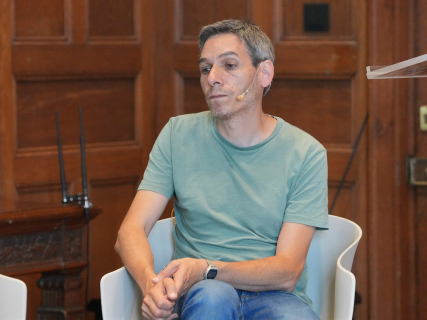

Sumar has presented an amendment in its entirety and has requested the return of the draft Budget Law of the Basque Country for 2027, understanding that the new accounts do not respond to the current needs of the population because they leave the housing allocations “practically frozen in the middle of a housing emergency”.
MP Jon Hernández has criticized that the “priorities” of the Executive formed by PNV and PSE-EE push the working class to “pay more and more for basic needs” and, in response to that approach, he has called for accounts that curb speculation, strengthen public services, and raise the tax burden on those who concentrate wealth.
“Every rent increase takes away part of the salary of whoever needs a home to live in and boosts the income of those who live off collecting that rent, and, in the face of that conflict, the Basque Government has decided to keep the Housing budget practically frozen,” he said.
Hernández detailed that the budget of the Department of Housing and Urban Agenda goes from the 502.2 million approved initially for 2026 to the 504.1 million planned for 2027, which represents an increase of 0.4%. At the same time, the Housing Social Fund is transferred to the Department of Finance and keeps the 20 million allocated in the previous fiscal year.
The MP emphasized that, for the Alianza Financiera Vasca, the Basque Government authorized 935 million in extraordinary borrowing in the 2026 accounts, while for the Housing Social Fund, “in the middle of a housing emergency, they repeat the same 20 million”.
Priorities of the Basque Government and fiscal criticism
Hernández reproached the PNV and the PSE that “when they consider business financing to be a priority, they find the formula to mobilize extraordinary resources,” but that they do not use that same mechanism in housing. For this reason, he has urged the Executive to “use that same capacity to guarantee the right to housing”.
Sumar has also demanded that the Government “specify who will be the owner of the homes, who will set the rents, and what return it will offer to private investors in the fund with which it aims to mobilize up to 2,000 million euros”.
In this line, he has warned that, if the Executive provides land and public resources, "it has to guarantee that housing remains in public hands permanently and that its rents are affordable for the people who live on their salary."
The amendment registered by Sumar proposes to finance the purchase and promotion of public rental housing, update the Housing Economic Benefit, whose cap "remains frozen at 300 euros per month," and strengthen the means to enforce limits on rent.
It also denounces the "scant ambition" of the fiscal pact of PNV and PSE-EE, since for the upper segment of accumulation a rate of 7 % is set in the Tax on Property Transfers, only three points above the general rate. "Whoever buys housing to live off the rent that others pay has to face a surcharge that truly prevents accumulation," he has said.
Sumar's alternative budget proposal
Jon Hernández has defended the drafting of "an alternative budget to redistribute wealth and guarantee rights," considering that the Government's accounts "are unfair as to who pays them and the priorities they finance." As he has denounced, PNV and PSE "maintain a taxation that places the burden on the working majority, leave the housing area virtually frozen, and continue to use public money to finance business investments."
Sumar's proposal involves "making those who concentrate benefits and wealth pay more and dedicating those resources to guaranteeing housing and public services."
Among its measures, training proposes increasing the effective contribution of large companies, income from capital, and large estates, as well as "taxing more forcefully the purchases of those who accumulate housing to make a business."
With those additional revenues, Sumar proposes to permanently expand the public rental pool, ensure compliance with price caps in strained areas, strengthen health centers and mental health care, recover public management of emergency ambulances, and provide more staff and resources to the public school.
In the field of care, training calls for the Basque Government to agree with provincial councils and town councils on an expansion of the public offering and progress toward direct management. The amendment also requires that companies that receive public funds assume commitments for stable employment, maintenance of activity in Euskadi, and reduction of polluting emissions, and that they repay the aid if they fail to meet these conditions.
Sumar has emphasized that "if society provides the money and assumes the risk, it must have the capacity to decide on the investment and participate in its benefits." For this reason, it calls for the return of the budget project "to exercise self-government in favor of the working majority," which, in its view, implies "placing limits on business with housing, strengthening the public sector, and making those who concentrate the most wealth contribute more."