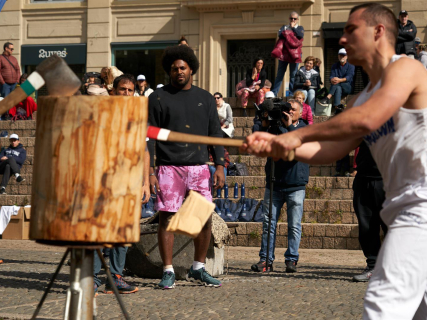

The European Union has urged this Friday to reinforce the protection and dissemination of traditional sports and games, including aizkolaritza, with the aim of safeguarding these practices as part of European cultural heritage and of boosting their presence among the younger generations.
Thus, the Twenty-Seven have agreed in conclusions approved after the Council of Ministers of Culture and Sport held in Brussels, in which they call on member States to give greater visibility to these disciplines, to make it easier for children and young people to be able to practice them, and to ensure their transmission between generations.
Among the examples included is aizkolaritza, a traditional Basque modality based on competitions of cutting logs with an axe, along with Ireland's "hurling," the Czech "nohejbal," a variant of football-tennis, and Finland's "pesapallo," similar to baseball.
"The traditional sports and games of Europe are a fundamental part of our shared cultural heritage. They reflect the history, the identity and the traditions of the communities of our entire continent," Charlie McConalogue, Ireland's Secretary of State for Sports, has emphasized; a country that holds the rotating presidency of the EU Council.
Along these lines, he has argued that increasing their public profile and encouraging more people to practice them will make it possible to ensure that these traditions "continue to thrive in the future."
The Twenty-Seven have also warned that many of these disciplines have problems attracting new practitioners due, among other reasons, to urbanization, the lack of economic and human resources, or their reduced visibility outside their territories of origin.
For this reason, they call on national governments to put in place measures to safeguard these sports, including incorporating them into national inventories of cultural heritage, and to support community associations and volunteer organizations that are responsible for keeping these practices alive.