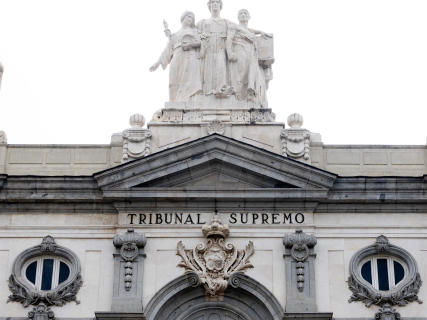

The Supreme Court has clarified this Friday that the precautionary suspension of the right to vote of those who were naturalized under the so-called grandchildren law also applies to those who reside in Spain. The decision, adopted at Vox’s request, obliges the Central Electoral Board (JEC) and the Office of the Electoral Census (OCE) to prevent those affected from participating in the general elections on next 29 November, even if they are registered in Spanish municipalities.
The Fourth Section of the Administrative-Contentious Chamber has issued an order in which it specifies that the measure includes 163,355 people who obtained Spanish nationality under the Law of Democratic Memory. Until now, judicial resolutions had focused on the census of Spaniards residing abroad (CERA), while doubts persisted regarding its application to those living within national territory.
The new resolution requires that these people cannot participate as voters either through the CERA or through the Electoral Census of Residents in Spain (CER). The exception applies to those who prove through a consular certification that their ancestors suffered exile for political reasons or other causes contemplated in the legislation.
Only 901 people have managed to meet the requirements to vote
The precautionary suspension includes an exception for 901 people who have already obtained the consular certification required by the Supreme Court. Those who manage to present that document before the election day of 29N will also be able to vote.
The origin of the controversy lies in the interpretation of the eighth additional provision of the 2022 Law of Democratic Memory, which opened a pathway to access Spanish nationality for descendants of exiles. Its application was developed through an administrative instruction that allowed the status of exile to be presumed for those who had left Spain between 1936 and 1955.
Precisely that presumption is one of the aspects questioned in the judicial procedure. The justices distinguish between people who documented their ancestors’ exile and those who obtained nationality by relying on the administrative interpretation.
However, the suspension applies as a precautionary measure to all those affected, unless they present the required certificate. The measure remains in place while the judicial procedure continues regarding the application of the rule.
Vox asked to extend the suspension to the resident register in Spain
The Supreme Court’s clarification responds to a request from Vox, which had asked for the scope of the precautionary measures to be clarified in order to prevent people registered in the ordinary register from being able to vote while the participation of residents abroad remained blocked.
Until now, there had been a difference between citizens who had obtained nationality through the same procedure. While those registered in the CERA had their right to vote suspended, those who resided in Spain could keep the possibility of voting by being included in the ordinary register.
The State Attorney’s Office had warned of that inequality in its briefs to the court. With the new order, the justices instruct that the same suspension be applied to both registers.
In addition, the Supreme Court questions the clarity of the documentation sent by the Administration to explain the implementation of the measures. In its ruling, it considers that the latest reports from the State Attorney’s Office and the Electoral Census Office are "hard to understand, as the Public Prosecutor’s Office rightly points out".
A decision nine days before the general elections
The judicial clarification comes when nine days remain before the general elections of November 29 and obliges electoral bodies to apply the suspension both to Spanish residents abroad and to those who live in national territory.
The Central Electoral Board and the Electoral Census Office must ensure that affected people cannot exercise their right to vote without the corresponding certification, regardless of where they reside.
The procedure has its origin in the appeals filed by Vox e Iustitia Europa against the electoral application of the regulations on nationality. The Supreme Court adopted the first precautionary measures in September and maintained them in subsequent rulings, before now specifying their extension to the residents register in Spain.
The suspension affects the exercise of the vote in these elections, while the dispute over the interpretation of the law relating to grandchildren continues pending a definitive ruling.