









The next Government will inherit a State Pact against Gender-Based Violence that includes 461 measures and has committed funding of 1.5 billion euros for five years. In February 2025, the Congress of Deputies approved its renewal with the only opposition of Vox.
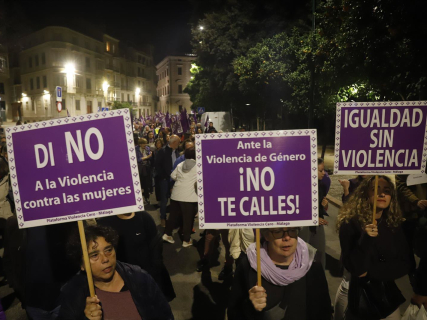
This year, feminist demonstrations on 25N coincide with the final days of an election campaign in which the parties have taken commitments regarding the financing of equality policies, the protection of victims, and the review of legislation against misogynistic violence.
In the election programs examined by DEMÓCRATA, the PP commits to reporting annually on compliance with the State Pact, and Frente Amplio wants to secure its funding. The PSOE claims the renewal of the agreement among the achievements of the legislature and proposes approving a new national strategy against misogynistic violence.
For its part, Vox devotes point 47 of its program to gender laws, which it attributes the release from prison of sexual aggressors and the failures in anti-abuse bracelets. It calls for their repeal and the approval of rules that protect all victims of violence, although it does not detail the legislative reforms it would carry out.
| Party | State Pact and legislation | Main measures |
|---|---|---|
| PP | Annual reporting on compliance with the pact. | Control of anti-abuse bracelets from the Ministry of the Interior and reinforcement of police units and specialized courts. |
| PSOE | New national strategy against misogynistic violence. | Law against vicarious violence, new digital crimes, and expansion of aid for orphans up to age 26. |
| Vox | Repeal of gender laws. | Approval of alternative legislation for protection for all victims of violence. |
| Frente Amplio | Multi-year funding for the pact’s structural allocations. | 10% annual increase of funds against misogynistic violence and priority access to public housing. |
| Podemos | Expansion of the legal definition of misogynistic violence in accordance with the Istanbul Convention. | Contingency fund of 1 billion euros, benefit equivalent to the SMI, and immediate accommodation for victims. |
Source: DEMÓCRATA’s own research based on the election programs for 29N.
The Ministry of the Interior would assume control of anti-abuse bracelets with the PP
The PP proposes to transfer to the Ministry of the Interior the management of the telematic devices that control compliance with restraining orders. Alberto Núñez Feijóo wants the security forces to permanently supervise their operation and that the recorded data be kept in full so that it can be used as evidence in court.
The conservatives also want to incorporate the support services of the autonomous communities and town halls into the VioGén system, improve the risk assessment for victims, and expand the resources of the specialized units of the National Police and the Guardia Civil.
For its part, the Frente Amplio proposes that VioGén incorporate a specific risk assessment for the children of women who have been abused. Podemos, on the other hand, wants to evaluate the operation of the 016 phone, the ATENPRO care and protection service, and the Cometa telematic monitoring system. It also proposes to open accompaniment offices for victims in the 17 autonomous communities.
A benefit for women who suffer mistreatment
If the proposal that Podemos includes in point 151 of its electoral program were to succeed, victims of gender-based violence would receive a benefit equivalent to the minimum wage interprofessional for six months renewable. The amount would increase depending on the number of people supported by the beneficiary.
Along with this aid, the training proposed by Irene Montero calls for immediate accommodation for victims and their children with regard to their abusers, as well as equalizing certain specific aids to those received by victims of terrorism.
To fund policies against gender-based violence, Podemos proposes creating a contingency fund of 1,000 million euros through a reform of the General Budgetary Law.
Frente Amplio puts the figure at a 10% annual increase in the resources that should be devoted to combating gender-based violence. It also intends to set by law a minimum of 5% of the non-financial budget of the State for all policies on equality between women and men.
Reforms of the Criminal Code
The PSOE undertakes to approve an organic law against vicaring violence and to extend to 26 years the aid received by orphans of gender-based violence. It also proposes to create specialized units to provide care to the relatives of victims of femicide.
In addition, the Frente Amplio wants to establish the automatic precautionary suspension of the visiting, staying and communication arrangements of the parents investigated for machismo-related violence, vicarious violence, crimes against sexual freedom, or serious violence against minors. The suspension would be maintained while the risk persisted.
Finally, Podemos demands reparation measures for the mothers whom it considers unjustly judged when trying to protect their children. Both this formation and Frente Amplio include in their programs measures to prevent the use in the courts of the so-called parental alienation syndrome, which lacks scientific backing.
Discrepancy over the abolition of prostitution
Among the legislative initiatives that are taking PP, PSOE, Frente Amplio and Podemos to the polls is a comprehensive law against trafficking in human beings. However, there is no agreement among the left-wing formations on the abolition of prostitution.
The Socialists maintain their intention to pass an abolitionist organic law that prohibits pimping in all its forms. Frente Amplio advocates eliminating the provisions that penalize people who engage in prostitution and recognizing them labor rights and rights to access Social Security.
Podemos, in contrast, proposes facilitating the administrative regularization of foreign women in prostitution contexts who find themselves in a situation of extreme vulnerability, even when they have not been identified as trafficking victims.