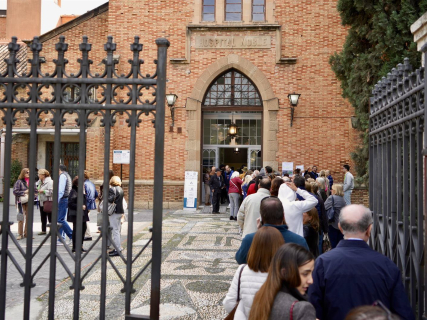
Five keys to read the participation of 29N at 18.00

The participation of 29N rises in 46 of the 50 provinces, with increases in Madrid that the PP won, in Barcelona that the PSC won, and in the two territories where the PNV and EH Bildu won in 2023. At 6:00 p.m. there will be a first figure to look at: 58.40% would keep intact the morning advantage over 23J

fotonoticia 20261129153407 1920

fotonoticia 20261129153407 1920

Add DEMÓCRATA to Google

Ask FREN

Published

Last updated

4 minutes

Most read

Escrutinio provisional del Ministerio del Interior; se actualiza cada minuto. Mapas: Instituto Geográfico Nacional (es-atlas, CC BY 4.0). Demócrata.

By two in the afternoon, 16,447,546 people had voted in Spain, 2.22 million more than at the same time in the July 2023 elections. The first update from the Ministry of the Interior placed turnout for the 29N at 45.75% of the census. The second will make it possible to know whether that increase was concentrated in the morning or if also between two and six more voters than three years ago have gone to the polls, proportionally.

The Spanish average hides differences of more than twelve points between provinces. In Bizkaia, turnout grows by 10.70 points over the 23J. In Jaén it falls back by 2.05. Between these two extremes there are territories with similar income levels that behave differently and provinces with different political winners that today move in the same direction. These are the five comparisons that are worth having on hand when the 18.00 data arrives.

1. 58.40% will say whether the advantage over July 2023 is maintained

In the general elections of the 23J, turnout went from 40.48% at 14.00 to 53.13% at 18.00. In those four hours, the equivalent of 12.65% of the census was added to the voting. If this afternoon the same pace were repeated, Spain would move from 45.75% to 58.40%. Above that figure, the advantage of 5.27 points that the 29N brought at midday would be extended. Below it, it would narrow.

There is a second reference that is especially valuable for a November election. The 10N of 2019 had voted fewer people at two than in the summer of 2023, but by six it had already voted more. That afternoon added 18.93 points in four hours. To preserve the 7.83-point advantage that the 29N has over November 2019, the second update would have to reach 64.68%.

The two figures that serve to read the 18.00 update
Election 14.00 18.00
November 2019 37.92% 56.85%
July 2023 40.48% 53.13%
November 2026 45.75% Pending

2. The gap between high- and low-income provinces is only 0.41 points

The Demócrata analysis that cross-references turnout with income per inhabitant makes it possible to distinguish how much attendance at the polls has increased and to what level each group has reached. In the provinces with higher income, turnout has risen on average by 6.98 points since the 23J. In those with lower income, 1.94. Even after removing Catalonia, the Basque Country, and Navarre from the calculation, the increases continue to be different: 5.27 and 2.03 points, respectively.

The novelty is in the point of arrival. In July 2023, the provinces with lower income were ahead by 4.63 points over those with higher income at midday. This Sunday, those with high income have gone ahead by only 0.41 points: 46.30% versus 45.89%. At six o’clock it will be possible to check whether that small gap widens or if the two groups remain practically tied. They are averages of provinces, each with the same weight. The Interior data do not identify the incomes of those who have come closer to vote.

How much turnout has increased in each income group

Average provincial variation at 14.00 compared with 23J, in percentage points.

Low income+1,94
Lower-middle income+4,11
Upper-middle income+5,45
High income+6,98
Scale from 0 to 8 points. Source: prepared by Demócrata with data from Interior and the INE for the 50 provinces.

3. Madrid, Barcelona, Bizkaia and Gipuzkoa put reading by blocks to the test

Four provinces, four different winners in the last general elections, and four rises above the Spanish average. In Madrid, where the PP was the leading force in 2023, turnout increases by 6.37 points. In Barcelona, where the PSC won, the jump is 8.57. In Bizkaia, which gave victory to the PNV, it reaches 10.70. And in Gipuzkoa, where EH Bildu prevailed, it arrives at 9.75 points.

That turnout grows in territories where the right, the socialists and two different nationalist formations won makes it possible to talk about a rise that is spread across the political map. For the afternoon, there is a more precise comparison: whether Barcelona and the two Basque provinces continue expanding their advantage over 2023 or whether Madrid closes the distance. The ballot paper that voters in each territory have chosen will only be known with the count.

It also matters which election is taken as the reference. Catalonia rises by 8.44 points and Galicia by 4.78 compared with July 2023. If the comparison is made with the midday of November 2019, the order is reversed: Galicia wins almost twelve points and Catalonia, around five. The change of reference alters the interpretation even before talking about parties.

4. Jaén, Córdoba, Cáceres and Badajoz are the four exceptions

Of the 50 provinces, 46 increased their 23J mid-day turnout. Jaén recorded the largest drop, of 2.05 points, followed by Córdoba, with 1.23. In Cáceres and Badajoz, on the other hand, the falls were only 0.26 and 0.15 points, respectively. In these last two, a difference of a few tenths in how the afternoon went compared with 2023 would be enough to change the sign of the comparison.

The four are among the provinces with the lowest income, but Almería also belongs to that group, where turnout rises 5.44 points. Between Jaén and Almería, therefore, there are 7.49 points of difference in the evolution of the morning within the same community. This Andalusian contrast allows the afternoon to be followed in greater detail than a single percentage for the whole region.

5. The million votes by mail that will continue to be outside the advance

Correos has 1,012,033 admitted votes for 29N. The figure corresponds to ballots already deposited. In July 2023 they were 2,471,932 and in November 2019, 929,674, according to the comparative series from the public company. There are almost 1.46 million fewer postal votes than three years ago and about 82,000 more than in the previous November general elections.

The polling stations add those envelopes to the ballot box once the in-person voting has finished. That is why comparing 18:00 with that July postal record leaves out part of the electorate of very different size in each election. The difference in postal votes is known. It is unknown how many of those voters have voted in person this time and at what time they did so.

Interior has planned the appearance at 18:30, peninsular time, regarding the second update. In the live broadcast of the general elections of 29N, the update will be followed. The first scrutiny results will be released from 21:00 peninsular time, after the expected closing of polling stations in the Canary Islands.

More key points, information and questions with FREN

AI-GENERATED CONTENT

What are the parliamentary procedures required for the official validation of the results of general elections in Spain?

In Spain, there is no parliamentary vote that globally ratifies the results of general elections. It is necessary to distinguish the electoral proclamation and its possible judicial review from the procedures that allow the Chambers to be constituted and the office to be exercised. The constitutive session does not make Parliament the judge of its own elections.

1. Electoral proclamation and judicial control

The proclamation of representatives corresponds to the electoral Administration, not to the Congress or the Senate. The credential issued by the competent electoral body is precisely the document that accredits the representative's election before the Chamber.

If an election is challenged, control corresponds to the courts through contentious-electoral appeals. The Congress Rules reflect this separation: it requires reporting pending appeals at the start of the legislature and contemplates the loss of the seat by a final judicial decision annulling the election or proclamation. Therefore, the Chamber receives and applies the electoral result; it does not confirm it through a political decision.

2. Accreditation and full acquisition of office

In the Congress, Article 20 of its Rules requires fulfilling three requirements jointly to acquire full status as a deputy:

  • Submit the electoral credential to the General Secretariat.
  • Complete the declaration of activities provided for in electoral legislation.
  • Take an oath or promise to uphold the Constitution at the first plenary session attended.

These requirements affect the individual exercise of the office, not the general validity of the elections. The Rules recognize rights and prerogatives from the proclamation, although they establish their suspension if three plenary sessions pass without completing those requirements, until they are fulfilled.

3. Holding the constitutive session

According to Articles 1 to 4 of the Congress Rules, the session is held on the day and time set in the royal decree calling the election. Its development follows this sequence:

  • Provisional presidency: presided over by the oldest elected deputy present, assisted by the two youngest as secretaries.
  • Initial reading: the call decree, the list of elected members, and the contentious-electoral appeals filed are read, indicating who they might affect.
  • Election of the Board: the Plenary elects the governing body of the Congress, composed of the Presidency, four Vice Presidencies, and four Secretariats.
  • Oath or promise: the elected Presidency takes constitutional allegiance and requests it from the remaining deputies by alphabetical roll call.
  • Declaration of constitution: the Presidency declares the Congress constituted and subsequently communicates it to the Crown, the Senate, and the Government.

This declaration constitutes the Chamber, it does not approve the scrutiny. The existence of pending appeals is expressly foreseen in the session itself.

4. Subsequent verifications and effects of rulings

The Statute Commission examines incompatibilities and submits its proposals to the Plenary. If an incompatibility is declared, the deputy has eight days to choose between the seat and the incompatible office. It is a control over their personal situation, not a review of the votes.

Furthermore, if electoral rulings change the ownership of more than 10% of the seats, Article 36 requires re-electing the Board when the new deputies have fully acquired their status. The solemn opening of the legislature also does not constitute electoral validation.

In conclusion: a parliamentary ratification of the results is not necessary. The parliamentary steps described correspond specifically to the Congress; they should not be automatically transferred to the Senate, whose procedure is governed by its own Rules. The Congress Rules can be consulted.

What powers do the Provincial Electoral Boards have regarding the control and supervision of the electoral process?

The Provincial Electoral Boards (JEP) supervise the legality of the electoral process within their province and contribute to ensuring its transparency, objectivity, and equality among candidacies. They do not organize all elections by themselves: they exercise the functions attributed to them by electoral legislation, coordinated with the Central Electoral Board (JEC), the zone boards, and, when applicable, the autonomous boards.

1. Direction and oversight in the province

Their role is mainly one of guarantee and control. They resolve inquiries from the zone boards, unify criteria within their territory, and review their decisions when appropriate. They must also comply with the instructions of the JEC and may refer matters beyond their competence to it.

This supervision does not mean they replace the electoral tables or the municipalities, the Electoral Census Office, or the services responsible for logistics. Each body retains its functions. For example, maintaining order inside the polling station corresponds to the presidency of the table.

2. Candidacies and proclamation of elected members

In elections to the Congress and the Senate, they intervene in the presentation, verification, and proclamation of candidacies in their constituency. They review legal requirements and allow correcting rectifiable irregularities through the corresponding procedure.

Once the scrutiny is completed and the pertinent claims resolved, they are responsible for proclaiming the elected candidates and issuing their credentials. It is important to distinguish these two actions: proclaiming a candidacy allows participation; proclaiming elected members identifies those who have obtained representation.

The distribution changes depending on the election. In the European elections, the provincial boards carry out the territorial scrutiny, but the allocation of seats and the proclamation of MEPs correspond to the JEC, as stated in STC 148/2022. In regional elections, the electoral legislation of each community must also be considered.

3. Campaign, propaganda, and media

They control, within their powers, compliance with the rules on campaign and electoral propaganda. They may hear claims regarding actions that compromise the neutrality of public powers or equality among candidacies and adopt legally appropriate agreements.

They also intervene in matters of informational coverage, advertising, and electoral spaces when they have the attributed competence. However, not every controversy about media corresponds to the provincial board: the scope of dissemination and functions reserved for other electoral bodies influence this.

4. General scrutiny and claims

One of their central tasks is the general scrutiny: verifying and aggregating the results documented by the tables, examining incidents, and resolving claims and protests legally foreseen. This does not equate to freely repeating the entire vote nor to unlimitedly reviewing each table's decisions.

STC 159/2015 expressly includes the doctrine attributing to the provincial boards the general scrutiny and resolution of their claims, subject to Articles 105 and 106 of the LOREG and the interpretation of the JEC.

5. Infractions, appeals, and limits

They may correct infractions and exercise sanctioning power within legal limits. If the facts could constitute an electoral crime, their response does not replace the action of criminal courts.

Their agreements are subject to review through the corresponding appeals: before the superior electoral body or the courts, depending on the matter. Candidacies, scrutiny, and proclamation of elected members have specific channels. In short, their function is to ensure that the provincial result is obtained according to the law, without concentrating all the powers of the electoral Administration.

What were the official results and composition of the Congress of Deputies after the July 2023 general elections?

The general elections of July 23, 2023 resulted in a Congress of 350 deputies, with no absolute majority for any party. The Popular Party obtained the highest number of votes and seats, with 137 deputies, followed by the PSOE, with 121. The absolute majority was set at 176 seats, so the results required seeking agreements among several formations.

Results and seat distribution

Eleven candidacies obtained representation. The final distribution was as follows; vote percentages are rounded to one decimal place for ease of reading:

Electoral participation

24,952,447 voters participated, with a total turnout of 66.59% and abstention of 33.41%. There were 264,360 null votes and 200,673 blank votes. These figures describe overall participation: they should not be confused with participation advances disseminated during the day nor with percentages calculated over a different census. (Results and participation).

What majorities did that composition allow?

The four parties with the most representation gathered 322 seats; the other seven candidacies summed the remaining 28. Although fewer in number, those deputies were decisive to complete a majority, because none of the main sums among parties reached 176 seats alone.

In short, it is important to distinguish winning the elections from having a parliamentary majority: the PP came first, but its 137 deputies were not enough to reach an absolute majority. The described distribution corresponds to the electoral result of July 2023, not to subsequent changes in deputies' affiliation during the legislature.

Play

Test your knowledge with FREN!

How much do you know about this topic? Answer the following 3 questions.

How many people had voted in Spain by 2:00 PM on November 29th?

Question 1 of 3

In which province did participation increase the most compared to the July 23rd elections?

Question 2 of 3

How many postal votes had been accepted for November 29th according to the Postal Service?

Question 3 of 3