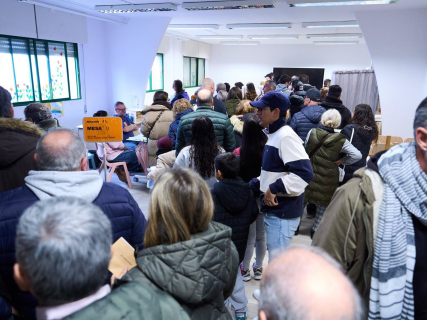

Not all territories are mobilizing with the same intensity this 29N. While Spain is registering a historical participation record at 14:00, in some of the traditional PSOE electoral strongholds the turnout barely increases and even goes backwards compared with the general elections of July 2023.
A large part of the increase in participation in the constituencies where the left achieved better results three years ago is concentrated in Catalonia, the Basque Country and Navarre. If these territories are analyzed separately, where nationalist formations carry special weight in the electoral struggle, the relationship between the ideological orientation of the provinces and the increase in participation is reduced.
Catalonia and the Basque Country, a mobilization from lower levels in 2023
Three years ago, both Catalonia and the Basque Country recorded at 14:00 a turnout below the national average. In Catalonia, 36.78% of the electorate had voted and in the Basque Country, 37.20%, compared with 40.48% for the whole of Spain.
This Sunday, turnout reaches 47.39% in the Basque Country (+10.19 points) and 45.22% in Catalonia (+8.44 points). Between the two communities, they add up to more than 3.3 million voters during the first hours of the election day.
This increase cannot be interpreted exclusively in terms of left-wing mobilization. In both communities, in addition to competition between parties with a national scope, there is a dispute for the nationalist and independence electorate.
In the Basque Country, the biggest increase is recorded in Bizkaia (+10.70 points), where the PNV won in 2023. Next are Gipuzkoa (+9.75), where EH Bildu prevailed, and Álava (+9.36), where the socialists won.
In Catalonia, where the PSC won in all four provinces three years ago, participation increases by between seven and nine points in all constituencies. In Barcelona, where most of the Catalan electorate is concentrated, the rise reaches 8.57 points.
Navarre (+7.80 points) also stands out, where the PSN competes for the vote with formations such as EH Bildu, UPN and the PP.
Socialist strongholds, where participation increases the least
Outside Catalonia, the Basque Country and Navarre, the most striking figure in the first advance is found in those municipalities where the PSOE obtained its best vote percentages in 2023.
In the group of municipalities with the highest Socialist implantation, where the PSOE obtained an average of 45% of the votes three years ago, participation increases by barely half a percentage point. In the groups of municipalities with lower Socialist implantation, the increases range between 3.7 and 5.1 points.
This pattern is reflected in the provincial map. In Jaén (-2.05 points), Córdoba (-1.23), Cáceres (-0.26) and Badajoz (-0.15), a smaller percentage of the electorate has gone to vote than at the same time on 23J.
Although the PP managed to wrest first place from the PSOE in Jaén and Córdoba in the last general elections, the socialists remained the most voted-for force in 66 of the 97 municipalities in Jaén and in 48 of the 77 in Córdoba.
In Extremadura, where Sánchez won in both provinces in 2023, participation falls back 0.19 points. It is the only autonomous community that records a decline.
Nor in Seville, the only Andalusian province in which the socialists won in the last general election, does the increase approach the national average. There it rises 2.35 points, compared with 5.27 points for Spain as a whole.
The strongholds of the right keep the pressure up
In some of the constituencies in which the PP obtained its best results in 2023, the increase in participation exceeds the national average.
This is the case of Madrid (+6.37 points), where Feijóo secured more than 1.4 million votes three years ago, or of Zaragoza (+7.70), where practically half of the electorate has already gone to the polls.
The same intensity, however, is not reproduced in other territories where the right predominates. In Murcia, where PP and Vox together won more than half of the votes in 2023, participation increases 3.43 points; in Ávila, one of the main popular strongholds, just 1.40 points.
In general terms, once Catalonia, the Basque Country and Navarre are excluded, differences in participation between territories where the right predominates and those in which there is greater competition between blocs are less pronounced than those observed in municipalities with the highest Socialist implantation.
The question mark of the postal vote and afternoon participation
With the second advance of participation still lacking, definitive conclusions cannot be drawn about which parties are benefiting from the higher turnout at the polls.
In July 2023, coinciding with the summer holidays, more than 2.4 million voters voted by mail. These ballots are not counted in voter turnout figures, so part of the increase recorded this Sunday may be due to a change in the voting method and not necessarily to the addition of voters who abstained three years ago.
It also remains to be determined whether the high turnout this morning is due to an advance in voting that usually concentrates during the afternoon or to an effective reduction in abstention. The next update, corresponding to 18.00 hours, will make it possible to check whether the territorial differences persist.