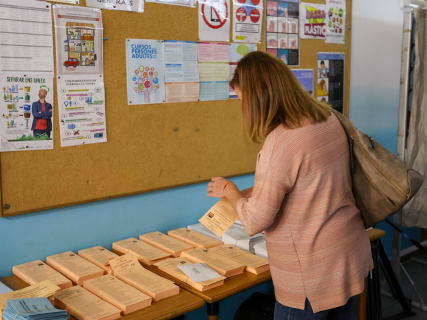

Imagine that you open the results of the general elections at nine o’clock and your town already appears at 100%, while in the capital of your province there are barely any votes. Both figures can be correct. In a municipality with a single polling station, one document is enough to complete the map. In a city, the first document is only one among hundreds. And when Interior starts to publish, part of the work is already done.
This lag marks the first hour of the count of the 29N. Then two more questions will be weighed: in which provinces the last seat in Congress is still changing hands, and how many of those changes would be needed to alter a majority. This guide walks through the day in that order. The data can be followed on the live coverage of the general elections of Demócrata.
| Hour | What data arrives |
|---|---|
| 10:30 | First appearance expected regarding the constitution of the polling stations. |
| 14:30 | First participation update, with data up to 14:00. |
| 18:30 | Second update, with data up to 18:00. |
| 20:00 | Polling stations close in the Peninsula, the Balearic Islands, Ceuta and Melilla. Those who are still waiting their turn vote. |
| 21:00 | Closing in the Canary Islands, where it is 20:00. The publication of provisional results begins. |
| Around 22:30 | Government appearance regarding the results, according to the pace of the count. |
| 4–7 December | General count in the provincial boards and inclusion of the vote of residents abroad. |
14:00 and 18:00. With which figure to compare turnout
To find out whether this Sunday is seeing more people voting than on July 23, 2023, the useful comparison is the same time. The figure for two in the afternoon is compared with the advance for two o’clock in 2023; the one for six is compared with the advance for six. That is why it matters to distinguish the cutoff time from the press conference time. Demócrata details the schedule of the turnout updates and the Government’s briefing.
At closing there is another difference that on 23J surpassed three points. That Sunday, around 70.4% of the census residing in Spain voted. In the final figure, which incorporated residents abroad, turnout stood at around 66.6%. The two figures describe the same election with different rolls. And no turnout figure, by itself, says which party benefits: to know that, the ballot boxes will have to be opened.
From 20:00 to 21:00. The counting time you still don’t see
When the voting ends, each table incorporates the envelopes received by mail that corresponds to admit and begins counting. In the general election, the Congress is scrutinized first and then the Senate. Once the recount of the table is completed, the result is communicated. During much of that first hour, voters are still voting in the Canary Islands.
That is why at 21:00 the scoreboard can start above 0%. Interior begins to disseminate the results it has already received and is incorporating new tables. There is no minimum percentage announced for the first update. You also don’t have to wait for the 22:30 appearance to consult the results map of the 29N by municipalities and provinces.
21:00. Why can a town go to 100% when Madrid has barely started
There is no official schedule that gives preference to towns. A table with few envelopes usually ends sooner. If it is the only one in the municipality, as soon as it communicates the record, all its result is closed. A city can have many tables working at the same time and contribute votes from the beginning, even if it takes longer to complete its scrutiny.
The 23J left a precise reference. At 21:52, Soria had about 50% scrutinized and Madrid, 12.68%, according to what Newtral reconstructed. The same minute offered two very different pictures. And even with a lower percentage, Madrid could contribute many more votes to the national total. Looking at municipalities colored on the map is also not enough to know who wins Spain.
There is a comparison that is more informative than seeing how a party’s total goes up or down: opening a municipality that is already complete and comparing it with its own 23J result. Then, check whether that movement repeats in capitals and metropolitan areas as their tables come in. The guide for consulting results in real time explains how to drill down to the municipality that interests you.
The first hour. Which provinces to look at before considering the national sum as good
Congress distributes its 350 deputies across 52 constituencies. A party can add thousands of votes in a province where it already has its last seat secured and continue with the same seats. A much smaller difference in another province can change at the same time the scoreboard of two candidacies.
| Where to look | What’s at stake |
|---|---|
| Madrid, Barcelona and Cádiz | Madrid goes from 37 to 38 deputies and Cádiz, from nine to eight. Barcelona elects 32. Only Madrid and Barcelona bring together 70 seats, one fifth of the Congress. |
| Córdoba and Girona | Each one gets six. In Córdoba it matters whether the three-way tie between the blocks of 2023 is broken and what effect the divided offer to the left of the PSOE has. In Girona, whether the PP or Vox reach the quotient that gives access to the last seat. |
| Lugo, Ourense, Burgos and La Rioja | All elect four. In Lugo and Ourense, the reference for 23J is the 3-1 of the PP against the PSOE. In Burgos and La Rioja, the starting point is the two-way tie. |
| Soria and Valladolid | In Soria it is checked whether the PP and the PSOE keep one of the two seats each. Valladolid allows following another breakdown from 23J: two from the popular party, two socialists and one from Vox. |
| Ceuta and Melilla | Each city elects one deputy. It is enough to be ahead of the second, even by a single vote. Here the percentage of the winning candidacy can vary a lot without changing the seat allocation: one seat for the first. |
To follow those moves, Demócrata has two complementary readings: the weight of Madrid and Barcelona in the first map and tracking of the last seat in each province.
D'Hondt law: how votes can go up without seats going up
In the provinces, the D'Hondt formula divides the votes of each candidacy by one, two, three and so on. The seats correspond to the highest quotients. The important threshold is the last one that obtains representation: in Soria only two quotients fit; in Madrid, 38. There is much of the difference in proportionality between the two.
There is another difference before the count. Each province starts with two deputies and the rest of the provincial seats are distributed according to population. That gives more representation per inhabitant to some less-populated provinces. The political effect depends on which parties end up first and second in them. A party formation with votes concentrated in a few constituencies can win more seats than another with a similar national support but very dispersed.
That is where the debate about the useful vote comes from: a voter may prefer one candidacy and choose another nearby because they attribute to it more options for obtaining the last seat in their province. The legal threshold for entering the seat allocation is 3% of the valid vote in the constituency. In a province with three or four deputies, usually quite a bit more is needed to win a seat. In Madrid or Barcelona, however, a few tenths around that 3% can matter a lot.
Blank votes count as valid and are included in the base on which the threshold is calculated. Null votes are left out. None is awarded to the most voted list. For a candidacy that hovers around 3%, the indicator that matters is its provincial percentage of valid votes, even if its national percentage is very different.
Seat 176. At what time will it be known who wins the 29N
The 29N may have a party winning in votes, a very tight seat distribution, and an open investiture. In the 23J, the PP was the leading force and won 137 seats. With Vox’s 33, it added up to 170. Sánchez ended up being invested. The distance between those two headlines explains why tonight it is worth looking as much at the first position of the PP and PSOE as at the support each one can gather.
There is no national percentage that guarantees an absolute majority for PP and Vox. The same percentage can result in 175 or 177 seats depending on where the votes fall. The PSOE could also overtake another candidacy in votes and still end up behind in seats. The answer is built province by province, especially where the two last quotients are very close.
There is a simple way to measure uncertainty. If a bloc figures at 176 seats and the last one in a province swings between that bloc and the other, a single seat can leave the total at 175. If the bloc appears with 180, losing that same seat would leave it at 179. In the second situation, the name of the last elected candidate will remain undecided even if the majority holds on to that change. You can test both calculations with the Demócrata electoral tools.
That is why 21:30 can offer a trend and 22:30 a provisional balance, but neither of the two is a guaranteed time to know the next president. If no one gathers 176 supports, the position of parties such as Junts will depend on the specific arithmetic. In a second investiture vote, more yeses than noes are enough: then an abstention can decide as much as a vote in favor.
While Congress moves forward, the Senate makes another calculation
If the Senate screen is behind, there is a practical reason. The tables count the Congress first and in the Senate ballot they must add the marks of individual candidates. In a mainland province, four senators are elected and each voter may indicate up to three names, even from different lists. The four most voted get the certificate. The frequent allocation of three seats for one force and one for another depends on the votes each candidate receives.
This year it matters to look at the names. The Senate candidacy of Progreso brings together socialists and left-wing forces in a large part of the territory. PP and Vox have also coordinated candidacies in different constituencies. Those agreements refer to the Upper House: transferring to the Senate the percentages from the Congress ballot would give a misleading image.
The novelty is seen especially well in the Balearic Islands. For the first time, Ibiza and Formentera each elect their own senator after the 2026 constitutional reform. In Mallorca, Gran Canaria and Tenerife three are elected and up to two names can be marked. On the islands that elect one, one is marked. Ceuta and Melilla elect two each and allow two marks. In total, 209 senators are elected directly, in addition to those designated by the regional parliaments.
From Sunday to Friday. What could still change with overseas voting
On Sunday night, the votes sent by mail from Spain and accepted at the tables will already have been counted. A different operation remains: incorporating the votes of Spaniards registered in the Electoral Census of Absent Residents, the CERA. The provincial boards begin the general count on Friday 4 December. The calendar runs until Monday 7.
The most immediate precedent is in Madrid. In 2023, the last deputy that the election night corresponded to the PSOE ended up in the hands of the PP after the overseas count. In the 2012 Asturian regional elections, emigrant voting had already moved a Foro deputy to the PSOE and made UPyD decisive for the majority. To gauge the risk this Sunday, you have to look at the provincial margin and how many votes remain to be incorporated there. The overall size of the Spanish overseas census says little about a specific seat.
29N adds a judicial matter. As a precautionary measure by the Supreme Court concerning a group of naturalized people under the protection of the Democratic Memory Law, the documentation of those affected is collected separately and is held in custody. While the suspension remains in force, those envelopes are not opened or added to the ordinary count. The measure affects the group identified in the resolution, not the entire set of Spaniards who vote from abroad.
Vox has raised the possibility of challenging the process. A political statement, a claim filed, and a resolution that modifies an outcome are three different facts. The Central Electoral Commission already rejected before the vote complaints about alleged irregularities in the vote from abroad. The next verifiable milestone will be the minutes of the provincial boards. Demócrata explains when the vote from abroad is counted and under what conditions it can move the last seat.