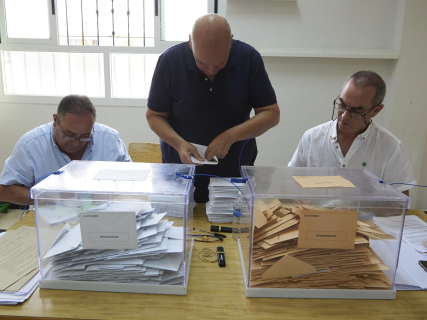
The Government confirms the constitution of 100% of the polling stations and a start on 29N without relevant incidents

More than 1.6 million new voters are called to the polls in a day in which Villarroya (La Rioja) has again been the first municipality to complete voting. A polling station in Barbate will extend its opening hours by half an hour.

fotonoticia 20261129083045 1920

fotonoticia 20261129083045 1920

Add DEMÓCRATA to Google

Ask FREN

Published

Last updated

3 minutes

Most read

Escrutinio provisional del Ministerio del Interior; se actualiza cada minuto. Mapas: Instituto Geográfico Nacional (es-atlas, CC BY 4.0). Demócrata.

The general elections of 29N have started without incidents of relevance and with the 100% of the 61,033 polling stations established and operating. This has been confirmed by the Secretary of State for Communication and the Undersecretary of the Ministry of the Interior during the first appearance of the day from the National Data Center, set up in IFEMA (Madrid).

"I think the best news is that we have few news to tell. Absolute normality," the Undersecretary of Interior has said, who has assured that no incidents have been recorded outside the usual ones on an election day.

The Secretary of State for Communication, Maíllo, has called for massive participation in elections that she has described as crucial for the country. "Every vote is decisive," she has conveyed to citizens in her first appearance this Sunday.

The 22,493 polling premises enabled across Spain have opened their doors at nine in the morning on the Peninsula, the Balearic Islands, Ceuta and Melilla, and one hour later in the Canary Islands. A total of 1,615,034 new voters, most of them young people, are called to take part in these elections, whose register includes 2,663,407 Spaniards living abroad.

From the ballot boxes will come the 350 deputies who will make up the next Congress and the 209 senators chosen by direct election.

Burriana and Villarroya, the earliest risers of 29N

The absence of significant incidents has allowed the Interior Ministry to focus part of its first appearance on the anecdotes of the day. The first polling station to communicate its formation across Spain has been one installed in the municipal sports center in Burriana (Castellón), which transmitted the information at precisely eight o'clock in the morning.

Villarroya (La Rioja), for its part, has once again become the first municipality in Spain to complete voting. However, on this occasion it has not managed to beat its own record. The existence of a postal vote has delayed the closing of voting in the Rioja town by a few minutes.

"Once again, they have been the fastest in all of Spain," the Undersecretary of Interior has highlighted.

A polling station in Barbate will close half an hour later

Interior has confirmed that one of the polling stations of Barbate (Cádiz) will have to extend its voting hours by half an hour. The decision has been adopted by the Area Electoral Board and, as the undersecretary has explained, it responds to logistical issues and not to a serious incident.

Throughout the day, the electoral boards will be operational, tasked with resolving any incidents that may arise during the course of voting. In addition, the Government has deployed a security device integrated by more than 100,000 agents of the Forces and Security Corps.

Interior has also informed that three members of polling stations with hearing disabilities have requested the assistance of sign language interpreters. The three will be able to access this service during the day in the municipalities of El Astillero (Cantabria), Leganés (Madrid) and Murcia.

The first figures on voter turnout, at 2:30 p.m.

The next official report from the Government will arrive at 2:30 p.m., when the Secretary of State for Communication and the undersecretary of Interior will appear again before the media to provide the first voter turnout figures for the general elections of 29N.

The second appearance is scheduled for 6:30 p.m., with a new advance in turnout that will make it possible to know how turnout at the polls is evolving, with one and a half hours remaining before the ordinary closing of polling stations on the Peninsula.

It will be around 10:30 p.m. when the Minister of Interior and the Government spokesperson minister will appear from the National Data Center to provide information on election results.

More key points, information and questions with FREN

AI-GENERATED CONTENT

What is the parliamentary procedure for the official proclamation of the general election results in Spain?

In Spain, the official proclamation of the results is not a parliamentary procedure: it corresponds to the electoral Administration, not to the Congress or the Senate. The Chambers receive those who have been proclaimed elected and then constitute themselves. Therefore, three moments must be distinguished: determining the electoral results, proclaiming the elected persons, and completing the requirements to fully exercise the parliamentary office.

1. Scrutiny and electoral proclamation

The electoral procedure includes the general scrutiny, the determination of the results, and the proclamation of the elected by the competent electoral boards. These actions belong to the scope of electoral legislation, not parliamentary regulations. The provincial electoral boards intervene in the general scrutiny; it is not a commission of the Congress that counts the votes or decides who obtains the seat.

The proclamation officially identifies the elected persons. The official publication of the results and the issuance of credentials are part of that electoral scope and must be distinguished from the subsequent parliamentary activity. There is no vote by the Congress or the Senate to ratify the ballot results.

It is also advisable to avoid confusion: the rules for the proclamation of elections to the European Parliament should not be automatically transferred to the Spanish general elections. They are different processes, although both are regulated by electoral legislation.

2. What does the Congress do with the results?

The Congress Regulations assume that the proclamation has already taken place. Its article 20 expressly refers to the "deputy proclaimed elected" and requires presenting the credential issued by the corresponding electoral Administration body.

According to article 1, the Congress meets in a constitutive session on the day and time indicated in the royal decree of convocation. In that session, article 3 establishes this sequence:

  • The royal decree of convocation is read aloud.
  • The list of elected persons is read.
  • Information is given about contentious-electoral appeals filed and persons whose election could be affected.
  • The Board of the Congress, its governing body, is elected.

This reading does not constitute a new proclamation nor a political approval of the results: it allows organizing the Chamber based on the election made.

3. Full acquisition of office

Article 20 requires jointly presenting the credential, completing the declaration of activities, and taking an oath or promise to uphold the Constitution in the first plenary session attended. These are requirements to fully acquire parliamentary status, not to reassign seats.

According to article 4, after the votes for the Board and the oath to the Constitution, the Presidency declares the Congress constituted. Then it communicates this constitution to the Crown, the Senate, and the Government. This communication also does not turn the Senate into an instance that confirms the Congress results.

4. Appeals and subsequent acts

The proclamation may be subject to judicial review through contentious-electoral appeals. Parliament does not replace the courts: article 22 contemplates loss of office when a final judicial decision annuls the election or proclamation.

Additionally, article 36 requires re-electing the Board if electoral rulings change the ownership of more than 10% of the seats. Finally, the solemn opening of the legislature is another distinct act: article 5 places it within fifteen days following the constitutive session, counted according to parliamentary rules. Neither the constitution nor the solemn opening are acts of electoral proclamation.

What are the powers and functions assigned to the Secretary of State for Communication and the Undersecretary of the Ministry of the Interior according to Spanish legislation?

The main difference is that the Secretary of State for Communication has a role focused on the Government's information and communication policy, while the Undersecretary of the Interior combines the administrative management of the Ministry with specific responsibilities in elections, traffic, civil protection, and other matters. The powers correspond to the bodies and are exercised by their holders, regardless of who occupies each position.

1. Secretary of State for Communication

The reference organizational norm is Royal Decree 676/2025, of July 28, which approves the structure of the Presidency of the Government. Its article 1 expressly includes the Secretary of State for Communication among the senior and management bodies of the Presidency, and its article 14 contains its specific regulation.

As an explicit normative antecedent, the sole article of Royal Decree 772/2002, of July 24, defined its role as "the execution of the Government's action in information and communication policy." This formulation allows identifying its material scope but does not replace the specific distribution of functions of the subsequent structure.

Therefore, its responsibility must be distinguished from the general administrative management of a ministry. It must also be differentiated from the functions of the President's Cabinet: Royal Decree 676/2025 regulates both bodies separately. The consulted text does not allow reproducing precisely the complete catalog of article 14; it would not be correct to attribute specific powers not verified.

2. Undersecretariat of the Ministry of the Interior

Its powers are mainly articulated through article 63 of Law 40/2015, of October 1, on the Legal Regime of the Public Sector, and article 9 of Royal Decree 207/2024, of February 27, which develops the basic organic structure of the Ministry of the Interior.

Under the superior authority of the Minister, it exercises the ordinary representation of the department, directs its common services, and directs, promotes, and supervises the directly dependent bodies. Its main functions are:

  • Administrative and legal management: technical and legal advice, regulatory policy, preparation and processing of provisions, administrative appeals, ex officio review, patrimonial liability, and relations with courts.
  • Personnel and organization: senior personnel management, human resources and remuneration planning, selection and provision of positions, appointments within its competence, inspection and disciplinary power, except dismissal.
  • Budgets and resources: budget preparation and monitoring, economic management, credits and expenses within legal limits, subsidies, assets, real estate, works, and general services.
  • Elections and participation: ministerial powers over electoral processes and direct consultations to the electorate; registry, subsidies, and financing of parties; state associations and declaration of public utility.
  • Protection and road safety: coordination and promotion of traffic and road safety, civil protection and emergencies, attention to terrorism victims, international protection, statelessness, and temporary protection.
  • Coordination and modernization: relations with autonomous communities and Government Delegations in their scope; citizen attention, transparency, archives, publications, digital transformation, telecommunications, data protection, and evaluation of public policies.

Important limitation: functions over common services are exercised when not expressly attributed to other bodies. When they are, the Undersecretariat is responsible for departmental coordination. Also, its specific powers are understood without prejudice to those of the Secretary of State for Security and the General Secretariat of Penitentiary Institutions.

Which political party does the current Undersecretary of the Ministry of the Interior belong to and what has been her previous professional trajectory?

The current Undersecretary of the Ministry of the Interior is Susana Crisóstomo Sanz. In the public sources consulted, there is no record of her belonging to a political party, so it is not correct to attribute a specific affiliation to her. Her documented career is that of a career civil servant who has held advisory and management positions in various ministries and in the General Council of the Judiciary.

Political affiliation: what is accredited

The official biography from the Interior Ministry identifies her as a member of the Senior Corps of State Civil Administrators and records her professional path but does not mention membership in any political party. Nor has a public source been found that accredits party membership.

It is important to distinguish between holding a trusted or management position in a ministry and belonging to the Government's party. Having directed the Minister of the Interior's Cabinet does not, by itself, prove political affiliation. Therefore, the precise answer is not that she belongs to a specific party, nor that it is accredited that she lacks affiliation, but that her membership is not publicly recorded.

Previous professional trajectory

According to the biography published by the Ministry of the Interior, her career prior to the Undersecretariat includes the following stages, ordered chronologically:

  • Ministry of Justice, between 1994 and 2005. She held various positions: coordinator of the Support Unit of the Director General of Relations with the Administration of Justice, advisory member of the minister's cabinet, and advisory member of the Technical Cabinet of the Undersecretariat. This first documented stage includes support and advisory responsibilities at different levels of the department.
  • Ministry of Industry, Tourism and Trade, between 2005 and 2008. She was an advisory member of the cabinet of the Secretary of State for Telecommunications and the Information Society. Her path thus moved from the Justice field to the department then responsible for telecommunications and information society.
  • Ministry of Education, since April 2008. She served as head of the Technical Cabinet of the Undersecretariat. The information consulted places the start of this responsibility in that month; later, her trajectory appears again linked to the Ministry of Justice.
  • Ministry of Justice, between 2012 and 2015. She held the position of Director of the Cabinet of the Secretary of State for Justice. This was a new stage in the same department where she had worked between 1994 and 2005, this time leading the Secretary of State's cabinet.
  • General Council of the Judiciary, since March 2015. She joined the governing body of judges and, in 2019, was appointed director of the Cabinet of the President of the Supreme Court and of the General Council of the Judiciary itself. Her biography distinguishes, therefore, between joining the institution and the later appointment as director.
  • Ministry of the Interior, since October 2020. She was director of the Minister's Cabinet before accessing the Undersecretariat. This is the position immediately prior recorded in her official biography and the direct antecedent of her current responsibility within the department.

Overall, her previous experience covers Justice, Industry, Education, the General Council of the Judiciary, and Interior. What is accredited is a career in advisory and administrative management; this professional path does not allow deducing party membership that the consulted sources do not document.

Play

Test your knowledge with FREN!

How much do you know about this topic? Answer the following 3 questions.

How many polling stations have been established and operational at the start of the 29N voting day?

Question 1 of 3

Which locality was the first to report the establishment of its polling station on 29N?

Question 2 of 3

How many new voters are called to participate in the general elections on 29N?

Question 3 of 3