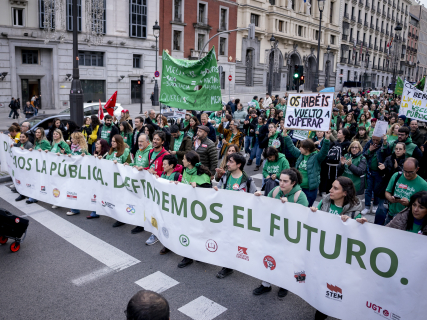
Thousands of teachers take Madrid’s Gran Vía against Ayuso’s order to maintain “neutrality” in the classrooms

The green tide is mobilizing again in defense of public education and is demanding the resignation of the advisor Mercedes Zarzalejo. Teachers reject the restrictions to report on the strike and are calling for more resources and a negotiation with the regional Government.

EuropaPress 7930622 decenas personas manifestacion educacion convocada frente consejeria (1)

EuropaPress 7930622 decenas personas manifestacion educacion convocada frente consejeria (1)

Add DEMÓCRATA to Google

Ask FREN

Published

Last updated

3 minutes

Most read

Elecciones 29N · Encuestas

La media de las encuestas

Media a 20 de noviembre de 2026 · 19 institutos

  • PP31,0 %
  • PSOE27,9 %
  • Vox19,0 %
  • Frente Amplio6,2 %
  • ERC2,5 %
01020304050ene 2024jul 2024ene 2025jul 2025ene 2026jul 2026

Media del último estudio de cada instituto en 30 días y su evolución semanal desde el 23J. Partidos con al menos un 2 %.

Todas las encuestas

Elecciones generales del 29 de noviembre · Demócrata

Thousands of teachers have once again dyed the streets of central Madrid green this Friday to protest against the education policy of the Government of Isabel Díaz Ayuso and the new instructions from the Department of Education that require maintaining the "neutrality" in classrooms during the teachers' strike. The rally fully occupied Madrid’s Gran Vía, interrupting traffic while the demonstrators called for more resources for public education and the resignation of the education minister Mercedes Zarzalejo.

The demonstration took place amid criticism of the regional executive and chants in defense of teachers’ freedom of expression. "They silence the teachers, we give you our voices" and "The teacher fighting is also teaching" were some of the messages shouted during the march.

Among the participants, shouts of "Zarzalejo, resignation" and "The struggle continues no matter what it costs" were also heard, along with ironic references to the president of Madrid: "Ayuso’s playground is private; if you don’t have money, you can’t enter".

Ayuso’s order that has intensified the education conflict

The protest is being held after the Ministry of Education, Science and Universities, headed by Mercedes Zarzalejo, sent public schools instructions to ensure the duty of neutrality during the stoppages that Madrid teachers have been keeping since October 14.

The document forbids using classes, official communication platforms, and educational facilities to promote the strike or seek support. It also prevents encouraging students to take part in gatherings and mobilizations related to the conflict.

From the regional executive, they justify these restrictions by the need to preserve neutrality in schools and avoid any political use of teaching activity. "Its function is to educate, not indoctrinate", argues the Department.

The instructions nonetheless distinguish between activities promoting the strike and the use of personal symbols. Wearing green T-shirts, badges, or ribbons is not prohibited, as long as they are not used to carry out proselytizing actions aimed at students.

School directors reject accusations of indoctrination

The order has prompted rejection from the management teams of public high schools in Madrid, who deny that there is political indoctrination in the classrooms and question assigning them oversight functions over teachers’ demonstrations.

The association of Secondary school principals has shown itself "consternated" by the instructions and has rejected any insinuation that teachers use their position to impose certain political ideas on students.

The unrest has also spread to trade union organizations, which consider that the limitations affect freedom of expression and the exercise of trade union rights. Teachers’ representatives argue that providing information about the reasons for a strike and its consequences for the educational community is part of trade union activity.

The strike committee has announced this Friday that it will appeal to the High Court of Justice of Madrid (TSJM) the neutrality instructions and the new minimum services, requesting the most urgent precautionary measures to suspend their application.

More resources and negotiation for public education

Beyond the new restrictions, the mobilization responds to a labor conflict that has been ongoing since mid-October. Teachers are calling for a reduction in teaching hours, fewer students per classroom, pay improvements, strengthening of staffing levels, and greater resources to address diversity.

The convening organizations also denounce the bureaucratic burden borne by teachers and the deterioration of educational facilities, while also calling for direct negotiation with the Ministry to allow progress on their demands.

During the march, slogans such as "We lack resources in education" and "Teachers and students, united and forward" were repeated, while the demonstrators insisted that they will maintain the mobilizations until they obtain a response from the regional government.

This Friday’s protest adds to the gatherings and demonstrations held over the last few weeks in Madrid, in a conflict that remains open between public education teachers and the department headed by Mercedes Zarzalejo.

More key points, information and questions with FREN

AI-GENERATED CONTENT

What parliamentary phase is the processing of the order of neutrality in classrooms currently in, and what steps must it follow for its final approval?

No specific regulation allowing to place the so-called "order of neutrality in classrooms" in a concrete parliamentary phase has been identified in the sources consulted. Furthermore, there is an important distinction: an order and a law follow different procedures, so it would not be correct to attribute an amendment process or a parliamentary vote without knowing its official name and the Administration promoting it.

What can be stated about its status

With the provided reference, it is not known which body is processing that order, its date, or if there is a published text. Therefore, it is also not known if it is pending debate in committee, a vote in a plenary session, or final approval. This does not mean the measure does not exist: it means that a sufficiently precise correspondence with the indicated name has not been located.

The decisive issue is to determine whether "order" really describes the type of regulation or if it is being used as an informal name for another initiative. That difference changes both who must approve it and the steps it would have to overcome.

If it is indeed an order

Its administrative drafting should not be confused with the parliamentary processing of a law. In this case, it is not appropriate to present the pending steps as passing through the Congress and the Senate. To establish its specific path, the project and the rules applicable to the responsible Administration would have to be identified.

The milestones of interest to check are the following, without assuming that this measure has already passed any of them:

  • Existence of a text: distinguish between a political announcement and a drafted regulatory project.
  • Public participation: check if a consultation or hearing has been opened to receive contributions and if that period is still open or has already ended.
  • Reports and legal review: identify the required reports and if they have been issued before the final decision.
  • Approval and publication: locate the final act and the corresponding official bulletin, as well as the date from which it is applicable.

This enumeration serves to organize the verification; it does not prove that all these procedures are mandatory or that they are pending in the order you ask about.

If it is actually a bill

The process would be different. In the state legislative procedure, a bill is the text that the Government approves and sends to the Cortes. A private member's bill, promoted by other legitimized subjects, must initially overcome the consideration phase: the parliamentary decision to start processing it.

Then the possibility of presenting amendments opens, that is, proposals for modification. The text is studied in a working group and committee, a report is prepared, and it is submitted for the corresponding approval. After its approval in the Congress, it goes to the Senate, which can approve it without changes, modify it, or veto it. If it introduces changes or a veto, it returns to the Congress to resolve them. Finally, sanction, promulgation, and publication follow.

This itinerary explains how a law is approved but does not demonstrate that it is applicable to this order. To give you a definitive answer about its current phase and the steps it really has left, please indicate the autonomous community, the promoting body, or share the link to the news where it is mentioned.

What are the legal competencies of the Minister of Education, Science and Universities of the Community of Madrid?

The head of the Ministry of Education, Science and Universities is assigned the general direction, coordination, and control of the regional policies on education, universities, artistic teachings, scientific research, and technological innovation. It is necessary to distinguish between her personal powers as a member of the Government and the functions executed by the deputy ministries and general directorates under her direction.

1. Main attribution and legal basis

Article 1 of Decree 248/2023, of October 11, expressly entrusts her with "the general development, coordination, and control of the execution of Government policies" in those five areas. It includes technological innovation mainly supported in the digital context and refers to the general powers of article 41 of Law 1/1983.

Therefore, it is not that the minister personally resolves all educational matters: she exercises the senior management of the department, while other bodies have assigned specific execution responsibilities.

2. General government powers

Law 1/1983, on Government and Administration establishes, for ministers as members of the Government Council, the following powers:

  • Ensure compliance with laws and resolutions of the Assembly in the matters of her department.
  • Propose regulations: submit draft bills and draft decrees on her competencies to the Government Council, and countersign the latter once approved.
  • Propose appointments and dismissals whose approval corresponds to the Government Council.
  • Plan actions: prepare and propose the Ministry's action program.
  • Prepare the budget: formulate the department's annual draft and prepare the draft annual program of the affected economic public sector.

These proposal powers do not equate to unilaterally approving laws, decrees, or the regional budget.

3. Material areas under her direction

Decree 248/2023 and its amendment through Decree 28/2024, of April 24, distribute policy execution among subordinate bodies. Under the minister's direction are:

  • Non-university education: general regime teachings, Vocational Training, and special regime; attention to individual differences; pedagogical and professional guidance; educational compensation and relations with municipalities.
  • Centers and educational opportunities: criteria for legal, economic, and administrative organization of centers, private education and educational agreements, scholarships, and study aids.
  • Quality and digitalization: educational innovation and internationalization, system evaluation, continuous teacher training, and digital competencies and platforms.
  • Educational organization: programming of infrastructures and equipment, policy on non-university teaching staff and inspection function, respecting the competencies of Finance and Public Function.
  • Universities, science, and innovation: university institutional relations; improvement and evaluation of the university system; research and technological innovation programs; scientific and technological entrepreneurship; and coordination with the Madrimasd Knowledge Foundation and IMDEA institutes.
  • Artistic teachings: are expressly part of her material scope and have a specific general directorate.

4. Limits and responsibility

Article 29 of the Statute of Autonomy assigns Madrid legislative development and execution of education, but requires respecting the Constitution, organic educational laws, state competencies, and the High Inspection. These are competencies of the Community: not all correspond personally to the minister.

Additionally, she must appear when the Assembly requests it, attend its control instruments, and provide information. She is directly responsible for her management, without prejudice to the Government's joint responsibility before the Assembly.

How many teacher strikes have been called in the Community of Madrid in the last legislature and what have been their results?

There is no complete count that allows giving a closed figure for the entire legislature. It is known that, until April 2025, the teaching movement had led up to seven strikes; later there were new calls, including the indefinite strike started on October 14, 2026. The most concrete result was the April 2025 agreement, with reductions in hours and staff reinforcements, but without resolving all demands.

I interpret "last legislature" as the regional one started after the May 2023 elections, still open as of November 20, 2026. It is important to distinguish between calls, days, and partial stoppages: an indefinite strike is a call, even if it lasts weeks; two unions can call separately for the same dates.

Which strikes and results are documented
  • Mobilizations before April 4, 2025: up to seven strikes. The balance published by elDiario.es attributes that figure to the Less Teaching protest cycle, some shared with the unions that ended up signing the agreement. Their main demand was to reduce class hours. The information does not break down the seven dates, so it does not allow reconstructing an exhaustive calendar or attributing an independent result to each stoppage.
  • April 28 and 29, 2025: new educational strike. STEM, CGT, and CNT called on the 28th from Early Childhood to university; in Primary and Secondary the stoppages extended to the 29th. The blackout on the 28th altered its development and forced the demonstration to be moved to May 13. There is no record in that information of a labor agreement that closed the call. The date change affected the demonstration, it did not mean a pact was reached, according to the conflict report.
  • From October 14, 2026: indefinite non-university strike. It was promoted by CCOO, UGT, STEM, CGT, CNT, and Workers' Solidarity, along with teaching platforms. They demanded 17 teaching periods in Secondary and Vocational Training, 22 in Primary, fewer students per classroom, more staff, and an additional 600 euros per month. As of November 19, it remained open: teachers went to the Territorial Area Directorates to demand a meeting. No closing agreement is recorded, according to Demócrata.
  • Independent CSIF call in October 2026. It included three full days, from the 14th to the 16th, and subsequent partial stoppages announced until December. It added the request for a capitality allowance. It should not be confused with the indefinite strike, although they initially coincided. No specific agreement derived from these stoppages is recorded; Demócrata explains both calls.
  • November 4 and 5, 2026: differentiated university strike. Public universities completed two days of stoppage over funding and resources. Its end did not close the indefinite strike of schools and institutes. The information consulted does not record an exit pact, according to Demócrata's report.
What was actually achieved

The April 4, 2025 agreement, signed by Education, CCOO, ANPE, CSIF, and UGT, reduced weekly teaching hours in Secondary, Vocational Training, and Baccalaureate from 20 to 19 for the following school year. It planned to reach 18 for tutors in 2027-2028 and for all in 2028-2029. In Primary, it maintained 25 teaching hours, although it reduced one hour of permanence.

It also included lower ratios and reinforcements estimated at 750 teachers and 850 masters over three years. It is a negotiated advance after the mobilizations, not a result attributable to a specific strike. The balance is, therefore, partial improvements and persistent conflict; the seven strikes cited do not equal the total of the legislature.

Play

Test your knowledge with FREN!

How much do you know about this topic? Answer the following 3 questions.

What do the new instructions from the Ministry of Education prohibit teachers from doing during the strike?

Question 1 of 3

What action did the strike committee announce regarding the neutrality instructions?

Question 2 of 3

What main demands do teachers raise besides rejecting the new restrictions?

Question 3 of 3