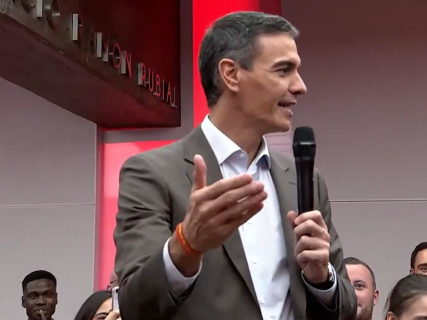
The PSOE cuts by seven tenths its distance with the PP while Vox falls to 17.1%, according to the 40dB daily tracking

The socialists rise by one point after the face-to-face between Sánchez and Feijóo, although the PP retains first place with 31.9%. The combined total of PP and Vox falls to 189 deputies, thirteen above the absolute majority

fotonoticia 20261120005447 1920

fotonoticia 20261120005447 1920

Add DEMÓCRATA to Google

Ask FREN

Published

Last updated

3 minutes

Most read

Elecciones 29N · Encuestas

La media de las encuestas

Media a 20 de noviembre de 2026 · 19 institutos

  • PP30,8 %
  • PSOE27,9 %
  • Vox19,0 %
  • Frente Amplio6,3 %
  • ERC2,5 %
01020304050ene 2024jul 2024ene 2025jul 2025ene 2026jul 2026

Media del último estudio de cada instituto en 30 días y su evolución semanal desde el 23J. Partidos con al menos un 2 %.

Todas las encuestas

Elecciones generales del 29 de noviembre · Demócrata

The PSOE reduces to seven tenths its lead over the PP in the ninth daily 40dB tracking for EL PAÍS and Cadena SER, released this November 20, after the electoral face-off between Pedro Sánchez and Alberto Núñez Feijóo. The conservatives remain in the lead with 31.9% of the vote, versus 31.2% for the socialists, while Vox retreats half a point and stands at 17.1%. The combined total of PP and Vox would be 189 deputies, thirteen more than the 176 needed for an absolute majority.

GENERAL ELECTIONS 29N · 40dB · 20 NOVEMBER

The PSOE moves to within seven tenths of the PP

Vote intention estimate from the ninth daily tracking. The provided source does not include all historical percentages, so the current measurement is shown without interpolating previous values.

0,7Points between PP and PSOE
189PP + Vox seats
176Absolute majority
VOTE ESTIMATE · 0–35% SCALE
PP
31,9%
PSOE
31,2%
Vox
17,1%
Broad Front
3,8%
Other left-wing coalitions
1,8%
Podemos
1,1%

Broad Front, other territorial left-wing coalitions, and Podemos appear separately. PP includes UPN-PP in the seat allocation.

Party Vote Seats Range
PP 31,9% 133 127–137
PSOE 31,2% 124 121–129
Vox 17,1% 56 50–60
Broad Front 3,8% 5 5–6
Other left-wing coalitions 1,8% 3 3–5
Podemos 1,1% 0 0–1
Other parties — 29 29–31

Source: 40dB for EL PAÍS and Cadena SER, 20 November 2026. Estimates, not election results.

The PSOE gains one point and Vox moves back half a point

Compared with the previous release, the socialists gain one point and reduce the gap with the PP to 0.7 points. Feijóo’s candidacy keeps first place with 31.9%, while Vox drops to 17.1%. In the distribution of deputies, the PP loses one and ends up with 133, the PSOE adds four and obtains 124, and Vox gives up two, to 56.

PP and Vox combine for 189 seats, thirteen above the absolute majority. The central estimate gives 124 to the PSOE, five to Broad Front, three to other left-wing coalitions, and none to Podemos. The remaining 29 correspond to other political forces.

The debate: more respondents give the victory to Feijóo

The release published after the electoral face-off includes an assessment of those taking part. According to 40dB, 43% believe that Feijóo won the debate, compared with 33.3% who point to Sánchez. Another 16.4% identify neither of the two as the winner. The PSOE’s rise in vote intention coincides with the publication of this assessment, although the available data do not allow attributing a causal relationship to it.

Sánchez leads the presidential preference

Asked who they prefer as head of Government, 32.5% of those surveyed choose Pedro Sánchez, compared with 23.1% who opt for Alberto Núñez Feijóo. Santiago Abascal gets 16.7%; Ada Colau, 4.6%; and Irene Montero, 2.9%.

How the rest of the seats are distributed

Among the 29 deputies grouped under «others», the estimate assigns ten to ERC, seven to EH Bildu, three to Junts, three to the PNV, three to Adelante Andalucía, two to the BNG and one to Coalición Canaria. In the section on other left-wing coalitions, Compromís–Front Valencià concentrates the three estimated seats.

The survey distinguishes between Frente Amplio, Podemos and the regional left-wing coalitions. The comparison with the 2023 elections must take into account that separation, because Sumar is presented in the historical chart only as a reference for those elections.

More key points, information and questions with FREN

AI-GENERATED CONTENT

In what stage of parliamentary processing is the electoral reform in Spain?

The general electoral reform promoted by the Government reached the amendment phase in the Constitutional Commission of the Congress, but it should not be presented as an initiative that is currently progressing: with the dissolution of the Cortes for the November 29 elections, its processing expired. It must be distinguished from the reform related to Formentera, which did complete its parliamentary process in June 2026.

The general reform: reached commission and amendments

The Organic Bill modifying the Organic Law of the General Electoral Regime was presented on July 9, 2025, and classified on July 22. Its processing was placed in the Constitutional Commission, in the amendment phase since July 24, 2025. This is the last parliamentary milestone identified for the project in the Congress information.

Amendments are the proposed changes presented by parliamentary groups. Being in this phase does not mean having an approved reform, nor even a definitive text agreed upon by the commission. The consulted sources do not indicate that this project had passed the preparation of the report, the commission's opinion, or the approval of the Plenary before the dissolution.

The temporal distinction is important: the amendment phase describes how far it got, not its current legal status. Since it was a bill still pending in the Cortes, it expired with its dissolution. To recover that reform in the next legislature, a new initiative will be necessary; it does not automatically continue from where it left off.

What did it intend to change?

The project's background was linked to the Action Plan for Democracy. During its public hearing, open until June 26, 2025, it included changes regarding electoral media coverage, debates, and the transparency of polls. Demócrata explained these proposals when they were still in governmental preparation.

Among them were the holding of at least one debate on public media and the mandatory attendance of certain candidacies, except for justified cause. These provisions should be understood as content of a proposal: their presentation and subsequent processing did not by themselves make them legally binding obligations.

The Formentera reform did finish

The case is different for the modification of the LOREG to adapt the Senate election to the constitutional recognition of Formentera as its own constituency. This reform did complete its processing, with the following milestones:

  • May 19, 2026: the Congress agreed to begin processing the proposal.
  • May 28: it agreed on a single reading, a procedure that allows debating the text directly in the Plenary.
  • June 18: the Congress approved the reform and sent it to the Senate, according to its official communication.
  • June 24: the Senate definitively approved it, according to the official Plenary report.

In short, there is not a single electoral reform with only one phase: the general proposal reached amendments and expired; the one related to Formentera completed its parliamentary process. Confusing both would lead to describing as pending a reform already approved, or as active another whose procedure ended with the legislature.

What are the main powers and functions of Pedro Sánchez as President of the Government according to the Constitution?

The Spanish Constitution does not define "personalized" powers for Pedro Sánchez, but for the figure of the President of the Government, regardless of who holds the office. His functions focus on the direction of the Government and general policy, coordination of the Executive, relations with the Cortes Generales, and certain powers in situations of crisis or political change.

1. Direction of domestic and foreign policy (art. 97 CE)

The core of his powers is in Article 97 of the Constitution, which attributes to the Government the direction of domestic and foreign policy, civil and military administration, and the defense of the State. The president exercises this function personally as head of the Executive:

  • Sets the main lines of government action (legislative priorities, economic, social, foreign, security orientations, etc.).
  • Coordinates and directs the ministers' actions so that Government policy is coherent and unified.
  • Defines the Executive's position in international relations (summits, treaties, positions before the EU or other organizations, always within what the Constitution and laws allow).
2. Direction of the Government itself and appointment of ministers (art. 98 CE)

As President of the Government, he also has internal powers over the Executive's structure:

  • Proposes to the King the appointment and dismissal of ministers. The Constitution establishes that the King appoints and removes Government members at the president's proposal. This gives the president decisive power to configure and reshape his team.
  • Can create, suppress, or reorganize ministries and senior officials through normative provisions of the Government itself, within the framework of the law.
  • Calls and presides over the Council of Ministers, setting its agenda and directing its deliberations.
3. Political relationship with the Cortes Generales

The President of the Government has a central role in relations with the Congress and the Senate, especially the former, which grants and can withdraw confidence:

  • Vote of confidence (art. 112 CE): he can present it to the Congress to support his program or a decision of special importance. If lost, the Government must resign.
  • Motion of censure (art. 113 CE): although the initiative is from deputies, the president is the target of the censure. If it succeeds, he ceases and is replaced by the alternative candidate.
  • Political responsibility: appears before the Chambers, answers questions and interpellations, and accounts for government action.
  • Legislative initiative: leads the political decision to present bills (art. 88 CE) and to use instruments such as royal decree-laws (art. 86 CE), which are approved by the Government but require Congress validation.
4. Proposal for dissolution of the Chambers and calling elections (art. 115 CE)

One of the most relevant functions is to propose to the King the dissolution of the Congress, the Senate, or both Chambers and the calling of general elections. This power is subject to limits:

  • It cannot be exercised while a motion of censure is in process.
  • It cannot be repeated before one year has passed since the previous dissolution, except in specific cases (for example, failure to invest within the deadline).

Although formally dependent on the King's signature, the initiative is the president's, who decides the political moment of the electoral call within those margins.

5. Powers in states of crisis (art. 116 CE)

In constitutionally defined crisis situations (state of alarm, exception, and siege), the Government, under the president's direction, proposes or agrees on these measures, which must then be authorized or controlled by the Cortes Generales. The president:

  • Promotes the declaration of the state of alarm (by the Government) and the request for authorization from the Congress for extensions or for states of exception and siege.
  • Politically directs the State's response during these extraordinary situations.
6. Representation and other functions

Additionally, the Constitution and laws assign him other relevant functions:

  • He is the highest representation of the Government in its relations with the King, autonomous communities, other States, and international organizations, without prejudice to the State representation that corresponds to the Crown.
  • Signs together with the King certain key decisions (appointments, normative provisions requiring royal sanction), assuming political responsibility for those acts.
  • Plays an essential role in coordination between territorial levels of the State (sectoral conferences, conferences of autonomous presidents, etc.) as configured by laws.

In summary, according to the Constitution, the President of the Government — currently Pedro Sánchez — is the head of the Executive Power, ultimately responsible for the country's political orientation, coordination of the Council of Ministers, relations with the Cortes Generales, and the use of instruments such as the dissolution of the Chambers, the vote of confidence, or direction of the response in crisis situations.

Could you detail how the President of the Government is elected and dismissed according to the Spanish Constitution? What differences does the Constitution establish between the functions of the President of the Government and those of the King? How is the political performance of the President of the Government controlled in the Congress and the Senate?

What results did the PP obtain in the last general elections prior to this survey?

The PP obtained 137 seats and 33.1% of the votes in the general elections of July 23, 2023, with a total of 8,160,837 votes. It was the most voted party and the one that obtained the most deputies, although it did not reach an absolute majority. That is the electoral reference to use if the survey you mention is after those elections; your message does not identify its date. (2023 Results).

The reference results

To compare a survey with elections, it is advisable to separate three magnitudes: votes, percentage, and seats. All three describe the result, but they do not mean the same nor allow exactly the same comparisons.

  • Votes: 8,160,837. This is the number of ballots the PP received in the final count of the July 2023 general elections. It serves to know its electoral support in absolute terms. (2023 Results).
  • Percentage: 33.1%. This is the national proportion of votes obtained by the party, expressed with one decimal. Demócrata also uses this percentage as a reference from 23-J when analyzing the subsequent evolution of surveys. (Demócrata Analysis).
  • Deputies: 137 out of 350. This is the representation it obtained in the Congress. To reach the 176 deputies of the absolute majority alone, it lacked 39 seats. (Election summary).
How it changed compared to November 2019

In the general elections of November 10, 2019, the PP had obtained 5,047,040 votes, 20.8%, and 89 deputies. The comparison with July 2023 shows an increase both in its support in votes and in parliamentary representation. (November 2019 Results).

  • Gained 3,113,797 votes: it went from just over five million to just over eight million ballots. (Electoral comparison).
  • Rose approximately 12.3 percentage points: it went from 20.8% to 33.1%, using percentages rounded to one decimal. (Electoral comparison).
  • Added 48 deputies: increased its representation from 89 to 137 seats. (Electoral comparison).
How to read the comparison with the survey

If the poll offers a vote estimate, the figure you should take as a starting point is 33.1%. The difference is expressed in percentage points, not in votes or deputies. For example, one percentage point above that reference would be 34.1%; one point below, 32.1%. These are calculation examples, not results of the survey you mention.

If the survey publishes a seat forecast, the comparison should be made with the 137 deputies obtained in 2023. A vote percentage and a seat forecast are different indicators: a percentage variation should not be interpreted as automatically implying the same change in representation.

In short, the reference is 33.1% and 137 seats, accompanied by the 8,160,837 votes of the final count. Without the date and specific figures of the survey, it is not appropriate to attribute an increase or decrease compared to that result. (Reference results).

Play

Test your knowledge with FREN!

How much do you know about this topic? Answer the following 3 questions.

What percentage of votes does the PP obtain according to the ninth daily tracking by 40dB?

Question 1 of 3

Who leads the presidential preference according to the 40dB tracking?

Question 2 of 3

How many seats does Vox obtain in the central estimate published by 40dB on November 20, 2026?

Question 3 of 3