

The employers' association of the digital industry AMETIC has brought a ten-point list of proposals to political parties for incorporation into their electoral programs with a view to the general elections of 29 November. Among its main demands are the creation of a Government vice presidency dedicated to Digital Transformation, the increase in public investment linked to the digital roadmap to 2.68% of GDP, and the commitment to allocate more than 3% of GDP to research, development, and innovation (R&D+i) before 2030.
The proposals form part of the document Accelerate digital transformation to generate growth and prosperity, in which the organization calls for a State technology policy that goes beyond legislative terms and has capacity for coordination between ministries. Its roadmap includes ten commitments for the next Government, accompanied by quantifiable objectives for 2030 and the 218 measures developed in its Digital Agenda 2026-2030.
According to the figures provided by AMETIC, the Spanish digital technology sector billed 146.660 billion euros in 2025 and generated 842,596 direct jobs. The employers' association believes that growth in activity must be accompanied by greater industrial capacity, investment in innovation and development of own technologies to improve productivity across the economy as a whole.
A digital vice presidency and more public investment
The first demand of AMETIC involves raising digital policy to the highest level of the structure of the Executive. To this end, it proposes a Vice presidency for Digital Transformation and Public Function with executive powers, tasked with coordinating innovation, industry, technology, and administrative modernization policies.
This institutional reorganization would be accompanied by an increase in the public budget associated with the digital roadmap to the 2.68% of GDP in 2030, one percentage point above the 1.68% that the organization takes as a reference for 2025.
In terms of research and innovation, it proposes to exceed 3% of GDP in investment in R&D+i and to ensure that Spain is among the top five countries in the European Union. To this end, it advocates greater collaboration between companies, universities, and technology centers, as well as stable financing instruments that facilitate the transfer of knowledge to the productive fabric.
It also calls for strengthening the investing role of the Public Administrations. In particular, it proposes increasing at least by 15% its investment in information and communication technologies (ICT) with respect to 2025, a year in which, according to its data, it rose to 6,018 million euros, 7.2% less than the previous year.
Artificial intelligence, SMEs and data centers
Artificial intelligence occupies another of the central axes of the document. AMETIC proposes that Spain become one of the five EU countries with the highest percentage of companies using this technology, especially by promoting its implementation in small and medium-sized enterprises.
Among the specific measures, it includes a National Plan for the Adoption of Artificial Intelligence for SMEs, with public-private financing, technical assistance, and access to data, platforms, and computing capacity.
The employers’ organization also sets as a goal that 90% of SMEs will have a basic level of digital intensity by 2030, compared with 75.4% recorded in its 2025 diagnosis. The document warns that the deployment of advanced technologies remains uneven, with the use of artificial intelligence at 20.3% among Spanish companies and 13.4% among microenterprises.
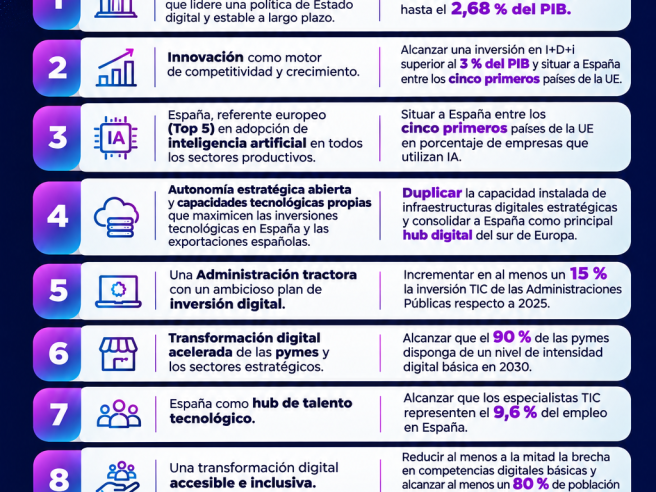
At the same time, it calls for doubling the installed capacity of strategic digital infrastructures and consolidating Spain as the main digital hub in Southern Europe. To achieve this, it considers it necessary to establish a stable regulatory, administrative, and energy framework for data centers, with conditions that favor investment and access to electricity, connectivity, and land.
In this area, it argues that new projects should meet requirements for energy and water efficiency, incorporate renewable energies, and allow the country’s computing capacity to be increased.
Doubling the weight of technology employment
Specialized talent also occupies a prominent place among the industry’s priorities. The organization intends for ICT professionals to move from 4.8% of total employment to 9.6% by 2030, doubling their weight in the labor market.
To achieve this, it proposes strengthening technological qualifications, adapting vocational and university training to business needs, and expanding programs for the updating and reskilling of workers in view of the extension of artificial intelligence and automation.
AMETIC recalls that Spain recorded 37,183 TIC graduates in 2024, nearly double that of 2019, although the weight of technology specialists in employment continues to remain below the EU average.
Digital transformation must also extend to the entire population. The employers’ association aims for at least 80% of citizens to have basic digital skills by 2030, compared with 66.5% in 2025, and proposes reducing generational and territorial differences in effective access to new technologies.
Fewer regulatory obstacles and a sustainable digital transition
On the legislative front, AMETIC asks to simplify administrative obligations and avoid duplication between Spanish and European rules, especially in artificial intelligence, cybersecurity, data protection, and digital infrastructures.
Its quantifiable goal is to reduce the deficit in transposition of Single Market directives from 2.6% to 1.3% or less by 2030. The organization also calls for a harmonized application of EU legislation that provides legal certainty to companies without adding national requirements that hinder investment.
Finally, the ten-point plan includes a commitment to link digitalization and sustainability. AMETIC proposes that at least 40% of Spanish companies with ten or more workers use technological solutions to reduce their energy consumption by 2030, compared with 28.3% that did so in 2025.
The organization calculates that every euro invested in the digital technology sector generated an aggregate economic impact of 2.99 euros in Spain during 2024—an estimate it uses to argue for a greater presence of the technology industry in the economic priorities of the next legislature.