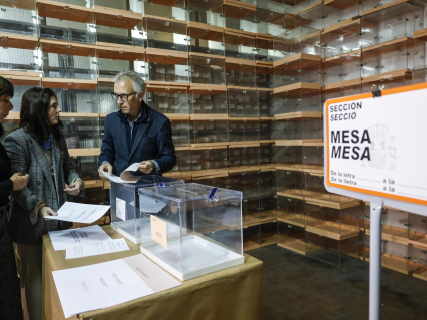

Spain faces this Sunday, 29 November, a new electoral day with 38,616,949 people called to the polls to elect 350 deputies of the Congress and 209 senators. The organization of the elections requires a broad deployment of human, material and technological resources, with a public budget of 243.4 million euros. From the opening of the polling stations at nine o’clock in the morning until closing at eight o’clock in the evening, 61,033 polling tables will be distributed across 22,493 premises throughout the country.
The event includes some new features, such as the possibility of identifying oneself before the table with the digital ID through the MiDNI application and the home delivery of voting kits in braille. Security and coordination mechanisms against possible physical and digital threats have also been strengthened, while the provisional results will be transmitted via more than 22,000 mobile devices. These are some of the figures and key points of the device prepared for 29N.
More than 38.6 million voters and 350 deputies at stake
Of the total number of people called to vote, 35,953,542 live in Spain and 2,663,407 are part of the census of Spaniards living abroad (CERA). In addition, 1,615,034 electors will be able to participate for the first time in a general election since the most recent elections, held on 23 July 2023.
The Congress will keep its 350 seats, distributed among 52 constituencies. Madrid will be the province with the greatest representation, with 38 deputies, followed by Barcelona, with 32. Valencia will elect 16 representatives, while Alicante and Seville will have 12 each.
In the Senate, 209 representatives will be elected, one more than in the 2023 general elections. The Upper House has 60 constituencies, including provincial and island constituencies and those corresponding to Ceuta and Melilla.
61,033 polling tables and more than half a million people appointed
The election day will have 61,033 polling tables distributed across 22,493 polling premises and 36,761 sections. To set them up, 183,099 presiding members and 366,198 substitute members have been appointed. In total, 549,297 people are part of the device planned for the polling tables, although not all of them will have to effectively perform that role: substitute members will only act when it is necessary to replace one of the presiding members.
The Administration has distributed approximately 210,000 ballot boxes, 86 million envelopes, and 930,000 instruction manuals for those who will serve on the polling stations. The schools will remain open between 9.00 and 20.00 hours.
243 million euros to organize the elections
The budget allocated for the elections amounts to 243,408,647.68 euros. The most important item corresponds to the postal operator, with 104 million euros, 42.73% of the total. This is the main expenditure of the apparatus, in which the activity related to the management of postal voting is included.
The most important item corresponds to the postal operator, with 104 million euros, 42.73% of the total
Public administrations will receive 89.5 million euros, equivalent to 36.78% of the budget. Election logistics will have another 36 million (14.81%), while the dissemination of the provisional count and telecommunications will account for almost 11 million (4.52%). The remaining 2.8 million are reserved for unforeseen circumstances.
More than 100,000 personnel and a cybersecurity apparatus
Security for the day will be handled by a police operation that the Ministry of the Interior estimates at 100,727 personnel. The deployment includes 30,036 members of the National Police and 50,373 of the Civil Guard, in addition to regional and local police. However, the Ministry warns that it does not have data on the deployment of the Ertzaintza or on the local police of the Basque Country.
In addition to the physical protection of schools and electoral documentation, monitoring possible digital threats is added. The Ministry of the Interior activated on November 4 the Coordination Network for Security in Electoral Processes, an organization created in 2019 to anticipate risks and coordinate the response to possible attacks on the voting and counting system.
In this network participate bodies such as the Department of National Security, the National Intelligence Centre (CNI), the National Cryptologic Centre (CCN), the Joint Command of Cyberspace, and the National Institute of Cybersecurity (INCIBE), among others. Its protocol includes four areas of action: transparency of the process, protection of personal data, physical security and cybersecurity, and detection and response to disinformation.
The digital DNI reaches the ballot boxes for the first time
One of the main novelties of these elections will be the possibility of identifying oneself to the polling station board using the digital DNI. The Junta Electoral Central authorized the use of the official MiDNI application last November 6, so voters will be able to prove their identity from a mobile phone without needing to present the physical document.
To do so, they must open the application in front of the members of the board and generate a temporary QR code that will allow the authenticity of their data to be checked. Interior will distribute more than 60,000 reading devices, which will be delivered through Correos and will be equipped with the necessary verifier to validate the codes.
The system has been evaluated and certified by the National Cryptologic Center. However, those who prefer can continue using traditional means: the physical DNI, the original passport, or the original driving license, even if they are expired. Photocopies will not be valid.
More facilities for voting for people with disabilities
The voting device also includes measures aimed at improving accessibility and making it easier for people with disabilities to exercise their right to vote autonomously. One of the novelties affects voters with visual disabilities: for the first time, accessible voting kits in Braille have been able to be sent directly to the homes of those who requested them, thanks to collaboration between Interior and the ONCE and authorization from the Junta Electoral Central.
The voting device also incorporates measures aimed at improving accessibility and making it easier for people with disabilities to exercise their right to vote autonomously
The measure received 3,552 requests, 167% more than in the 2023 general elections and 253% more than in the 2024 European elections. Of these, 3,388 corresponded to home deliveries and 164 to picking up the kit at the polling station board. The material makes it possible to identify the ballots autonomously and preserve the secrecy of the vote.
Cognitive accessibility is another of the areas in which improvements have been introduced. In collaboration with Plena Inclusión España, the Ministry of the Interior has installed signage pictograms in polling premises in 155 municipalities, including provincial capitals and cities with more than 50,000 inhabitants. The estimated reach of this measure is about 18 million voters. Materials in easy reading have also been produced for the electoral website and for the manuals for the polling stations.
In addition, people with hearing disabilities who have been designated as members of a polling station, either as principal or alternate, may request free of charge a sign language interpreter and a magnetic loop service. In cases of visual disability, deaf-blindness, or intellectual disability, the supports will be determined by the corresponding Local Electoral Board.
The polling station manual also includes a care protocol for voters with disabilities. Although these voters may attend accompanied by a trusted person if they need help, the members of the polling station must always address the voter directly, since the vote is personal and non-transferable. The document is available in easy reading and in all official languages.
More than 22,000 devices to transmit the results
Technology will also play a prominent role in collecting and disseminating participation data and the provisional count. The Ministry of the Interior will use 22,716 mobile devices to electronically transmit the information from 56,654 polling stations to the center in charge of centralizing and disseminating the results.
In another 4,358 polling stations, which represent 2.2% of the electoral roll, the data will be communicated by telephone. In both cases, the aim is to transmit the provisional information of the day and not to replace the manual counting of ballot papers carried out in each polling station.
Citizens will be able to follow progress in participation and provisional results through the official website and the mobile application '29N General Elections 2026', available for iOS and Android devices. The National Broadcast Center will also have a screen 14.5 meters wide and four meters high to project electoral data and provide institutional television signaling to the media.