
The day after the midterms, Santiago Abascal said in Ciudad Real that he was “quite busy” with the elections of 29N to worry about the US. A statement that essentially sums up what flags Vox has decided to exploit in this campaign, among which foreign policy is not found, except when it is about the neighboring country Morocco.
That said, Abascal continues to brag about international networks. Javier Milei, Marine Le Pen or Giorgia Meloni are part of his circle of allies and he has made a point of doing so during this pre-campaign. However, these meetings have not translated, in practice, into specific commitments on foreign policy with European partners or countries with historical ties such as Argentina, on his way toward Moncloa.
The reality is that the electoral program for this 29N has left out some of the international proposals it defended in the elections of July 23, 2023. Although it maintains its discourse on national sovereignty and the need to protect Spanish interests against decisions by international organizations, Abascal’s party no longer includes express commitments to negotiate a new European Union treaty, recover unanimity in certain European Union decisions, or strengthen its political alliances in Latin America.
While in the 23J, Vox devoted two full chapters to the European Union and the “Ibero-sphere”, with 26 numbered proposals, it now lacks specific sections on these matters and distributes its international commitments among migration policies, border protection, trade and defense. “It is a program for a national emergency situation and an existential crisis,” sources from the party tell this outlet.
No news from the TFUE
In the 2023 elections, Vox defended a transformation of the Community institutions by negotiating a new European treaty that would return “prominence” to the member states and their parliaments.
It also proposed defending the primacy of the Spanish Constitution over European law in matters that affected the general interests of the State, reforming the European arrest warrant and recovering the unanimity rule in those European decisions that could compromise the sovereignty of the member countries. None of these initiatives appears developed in the 2026 electoral document.
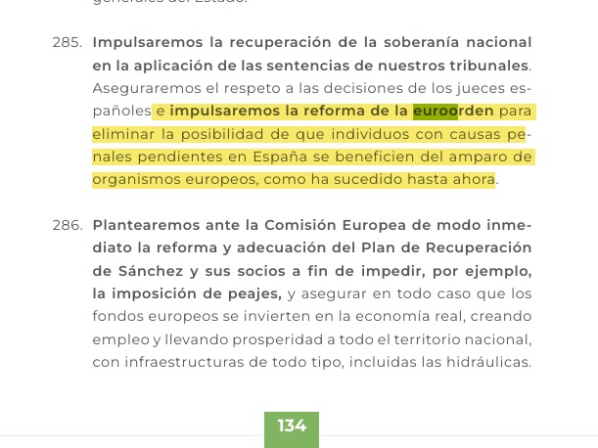
Sources from the party consulted by this outlet reject this interpretation and emphasize that this program "collects more concrete and forceful proposals developed in its own chapters on the economy, industry, energy, deregulation, immigration, and the primary sector".
In this sense, they highlight "putting an end to the impositions of the European Green Deal and the 2030 Agenda, reversing restrictions on the combustion engine, recovering our energy sovereignty, rejecting Mercosur and the trade agreements that harm our producers, defending the CAP and eliminating the bureaucracy that suffocates families and businesses".
Latin America loses its own chapter
Another of the most visible changes affects policy toward Latin America. Under the concept of "Iberosfera", Vox devoted in 2023 a chapter to the political, economic, and cultural relations between Spain and the Ibero-American countries.
what are we talking about:
The "Iberosfera" is a concept promoted by Vox that encompasses Spain and the countries of Hispano-America, with a more secondary presence of Portugal and Brazil.
The term also gives its name to a project of political cooperation between far-right parties and leaders on both sides of the Atlantic.
Vox introduced it into the Spanish parliamentary debate during the failed motion of censure against Pedro Sánchez in 2020 and since then has promoted it as one of the pillars of its international strategy.
Thus, among its commitments were the dissemination of the Charter of Madrid, strengthening alliances against the Foro de São Paulo and the Grupo de Puebla, and support for the political opposition in countries such as Venezuela, Cuba, and Nicaragua.
It also advocated boosting the Ibero-American Summits or protecting Spanish investments in Hispano-America. The 29N program no longer includes these initiatives or dedicates a specific section to relations with Hispano-America.
Nonetheless, since the formation of Abascal they deny to DEMÓCRATA that they have renounced their alliances in these territories and they assure that these relationships are today "much more consolidated". As an example, they claim the continuity of Foro Madrid and the Charter of Madrid, as well as contacts with opposition leaders in the region. Specifically, they highlight the recent trip to Venezuela by Hermann Tertsch and Jorge Martín Frías, during which, on behalf of the party, they met with María Corina Machado.
Morocco gains prominence
As specific proposals about Hispano-America disappear, all eyes in Bambú turn to Morocco. For the far-right formation, the entry into Ceuta of thousands of migrants in an irregular manner represented a turning point in its work as an opposition.
Since then, they have opted to place the situation of the autonomous city at the center of the political agenda, and with the electoral call, this work has intensified. Without going any further, on the day of the National Holiday, Abascal was in Ceuta together with Joan Bardella, president of the French party Agrupación Nacional, denouncing the “inaction” of the executive of Pedro Sánchez.
So strong has been the commitment that the party has decided that the first chapter of its program for this 29N will be “Ceuta and Melilla”. In this sense, they expressly incorporate the possibility of pushing for sanctions, suspending international agreements and reviewing diplomatic relations with Morocco until “the borders and Spanish sovereignty are respected”.
The 2023 program already called for protecting the autonomous cities from the migration pressures attributed to the Moroccan Government and reinforcing the resources of the security forces in both cities.
Gibraltar, Spanish?
But not everything changes. In the face of the modifications introduced in other areas, the claim of Spanish sovereignty over Gibraltar remains.
In 2023, Vox rejected any pact between the European Union and the United Kingdom, or between Spain and the United Kingdom, that did not respect the “Spanish sovereign rights” over the Rock. The 2026 proposal preserves the demand to exert international pressure to recover Gibraltar, although it no longer explicitly reproduces the rejection of bilateral or European agreements.
Over these three years, the situation on the rock has also changed. Last July, the agreement that removes controls at the border with La Línea entered into force and establishes a new framework for economic, customs and fiscal cooperation after Brexit.
On international cooperation
According to the Ministry of Foreign Affairs, European Union and Cooperation, Spain exceeded €4,550 million in Official Development Aid (ODA) in 2025. A figure that places it at the top of the sector.
In this sense, three years ago Vox proposed reviewing aid allocated to Spanish-speaking countries to prevent them from contributing to the maintenance of authoritarian regimes or from violating human rights. It also advocated eliminating funding for projects linked to the Agenda 2030 and to movements it described as "indigenist" or related to gender ideology.
The 2026 program introduces a different criterion in its measure: "to withdraw aid and cooperation funds from countries that do not cooperate in the management of migration flows".
What happens with the great powers?
Neither are there any express mentions of the international great powers, such as the United States, China, or Russia, in the 29N program, nor any concrete proposals on the main international conflicts.
China did appear in the 23J program, although only to demand that the European Union pay more attention to Latin America, rather than focusing its foreign policy on the Asian giant.
NATO also disappears from the document, despite the fact that in 2023 Vox argued for explicitly including Ceuta and Melilla under the umbrella of protection of the Atlantic Alliance.