Abascal meets with Meloni and showcases his European alliances ahead of the 29N

The leader of Vox claims the Italian model for Spain after meeting in Brussels with the former Hungarian prime minister and the French leader, who has conveyed her electoral support to him. The round of contacts began in Ceuta alongside Jordan Bardella.

WhatsApp Image 2026 10 15 at 17.19.35

WhatsApp Image 2026 10 15 at 17.19.35

Add DEMÓCRATA to Google

Ask FREN

Published

Last updated

4 minutes

Most read

The president of Vox and candidate for the Presidency of the Government, Santiago Abascal, met this Thursday in Brussels with the Italian Prime Minister, Giorgia Meloni, whom he has put as an example of the political change he advocates for Spain ahead of the general elections on November 29. The meeting concludes a week of international contacts in which the leader has held meetings with the former Hungarian Prime Minister Viktor Orbán, the leader of National Rally, Marine Le Pen, and the head of the Czech Government, Andrej Babis, in addition to sharing an agenda with Jordan Bardella in Ceuta and Madrid.

"In Brussels, fruitful meeting with my friend Giorgia Meloni," Abascal announced through his X account, where he took the opportunity to highlight the management of the Italian Prime Minister and advocate for a political change in Spain.

"The West is going through a decisive moment and Europe cannot continue to govern itself from resignation. Italy chose another path and today is a stronger and more respected nation. Spain can also choose it," affirmed the president of Vox, who concluded his message by publicly thanking Meloni for her friendship.

The meeting with the Italian leader takes place in the midst of the pre-campaign for the general elections. Although he did not detail the issues discussed with the Italian leader, the meeting adds to a succession of contacts with European leaders of the same ideological spectrum.
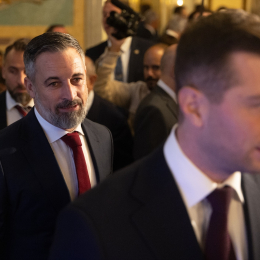
Orbán and Le Pen, protagonists of the agenda in Brussels

The meeting with Meloni comes a day after Abascal held several meetings in Brussels with leaders of Patriots for Europe, the European political family to which Vox belongs.

Among them, Viktor Orbán, former Prime Minister of Hungary and one of the main references of this political alliance, stood out, with whom Abascal met on Wednesday. The Spanish leader also held contacts with the Czech Prime Minister, Andrej Babis, and with the president of National Rally, Marine Le Pen.

According to sources from the party, the leaders participated in a joint meeting focused on their shared priorities regarding borders, security, economic competitiveness, and national sovereignty.

The day also left an explicit electoral endorsement from Le Pen to the Vox candidate. The French leader wished him "all the success he deserves" ahead of the elections on November 29 and highlighted that the Spanish formation has managed to "conquer the hearts of the Spaniards."

Le Pen also raised the possibility of Vox participating in a future Government and claimed the role of Spain in the political project that both formations share in Europe: "Spain occupies an essential place in Europe: its voice matters to defend the sovereignty of our nations and the freedom of our peoples."

From Ceuta to Brussels, a week alongside the European far-right

The international agenda of Abascal began on Monday in Ceuta, where he received the president of National Rally, Jordan Bardella, on the occasion of National Day. Both leaders visited the autonomous city after the entries of immigrants recorded during the summer, a situation that Vox has placed among the main issues of its electoral discourse.

On Tuesday, they met again in Madrid, during an informational breakfast organized by Nueva Economía Fórum, where Abascal introduced Bardella and defended the political collaboration between both formations.
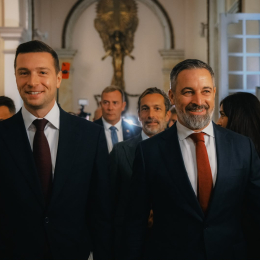
During his speech, the leader of Vox accused the Government of Pedro Sánchez of provoking a "terrible call effect" with the regularizations of immigrants and linked these policies with the difficulties of access to housing and the pressure on public services.

"The southern border of Spain is also the southern border of France, it is the southern border of Europe," Abascal stated, who thanked Bardella for his visit to Ceuta and defended that the migratory situation of the autonomous city has consequences for the whole continent.

The president of Vox also claimed his alliance with the French leaders, despite acknowledging that there may be differences between their respective formations. "I believe that the France that Marine Le Pen and Jordan Bardella want not only does not represent any threat to Spain, but also constitutes a great opportunity for our people," he asserted.

This Thursday's meeting with Meloni caps off four days of international meetings in which Abascal has sought to strengthen his relationships with various leaders of the European far-right seven weeks before the polls open in Spain.

More key points, information and questions with FREN

AI-GENERATED CONTENT

What parliamentary phase is the Patriots for Europe coalition currently in within the European Parliament, and which parties make it up?

Patriots for Europe is not in a “recognition” or formation phase: it is already a fully recognized and operational political group in the European Parliament for the 2024‑2029 legislature. It is among the official groups of the Eurochamber and acts as the third largest group, with more than 80 MEPs from various member states.

According to information from the European Parliament itself about recognized political groups, Patriots for Europe (PfE) meets the requirements of the Internal Rules (at least 23 MEPs from seven countries) and is already constituted as a political group for all purposes, on equal formal footing with the European People's Party, Socialists and Democrats, Renew, Greens/EFA, European Conservatives and Reformists, The Left, and Europe of the Sovereign Nations (organization of political groups).

Specialized press and the group itself describe it as the heir to the former Identity and Democracy group from the previous legislature, reorganized after the 2024 European elections. In the “anatomy” of the new Eurochamber, the newspaper Demócrata notes that Patriots for Europe is the third largest group, includes the six MEPs from Vox, and is chaired by the French Jordan Bardella, from Rassemblement National (Demócrata, 08/02/2024).

Furthermore, press releases from the European Parliament itself already position Patriots for Europe as a group that presents initiatives and participates in ordinary parliamentary work, for example as a promoter of motions of censure against the Commission (note from 10/09/2025) or current debates in the Plenary (EP Today, 04/29/2026). That is, the “parliamentary phase” of Patriots for Europe is that of a group already constituted and fully exercising its functions:

  • It participates in the allocation of seats, committees, and reports.
  • It can present motions of censure, resolutions, amendments, and request debates.
  • It is represented in the Conference of Presidents through its presidency.
Parties that make up Patriots for Europe

The specific composition of the group has been detailed in communications from the parties themselves and in press analyses. A note from Vox about the official constitution of the group in Brussels (July 8, 2024) offers an explicit list of delegations and member parties (Vox, 07/08/2024), which matches the map of the European far-right made by Demócrata (Demócrata, 09/07/2026).

According to these sources, Patriots for Europe includes, among others, the following national parties (some in coalition with smaller partners in their country):

  • Rassemblement National (France) – the group's main delegation and party of Marine Le Pen and Jordan Bardella.
  • Fidesz – Magyar Polgári Szövetség and the Christian Democratic People's Party (Hungary), the political family of Prime Minister Viktor Orbán.
  • Lega per Salvini Premier (Italy), Matteo Salvini's League.
  • ANO 2011 (Czech Republic), the party of Andrej Babiš, along with the small Czech parties Oath and Motorists.
  • Freiheitliche Partei Österreichs (FPÖ) (Austria), Freedom Party of Austria.
  • Partij voor de Vrijheid (PVV) (Netherlands), Geert Wilders' party.
  • VOX (Spain), whose six MEPs are integrated into Patriots for Europe.
  • Vlaams Belang (Flanders, Belgium), Flemish nationalist party.
  • Chega! (Portugal), Portuguese national-populist formation.
  • Dansk Folkeparti (Denmark), the Danish People's Party.
  • Foní Loyikís / Voice of Reason (Greece), literally “Voice of Reason.”
  • Latvia First (Latvia), cited by Vox as the Latvian delegation of the group.

Demócrata's analysis of parties comparable to AfD adds that Patriots for Europe groups the main forces of the European national-populist right – RN, Vox, Fidesz, FPÖ, PVV, Vlaams Belang, Chega, Lega, Danish People's Party, ANO 2011, and Foní Loyikís – as opposed to other formations positioned even further to the right, integrated in Europe of the Sovereign Nations (Demócrata, 09/07/2026).

The number of group members may fluctuate slightly during the legislature due to individual affiliation changes, but the above list reflects the stable core of parties that make up Patriots for Europe in the European Parliament as of today.

What are the main powers and functions of the president of Vox according to Spanish legislation?

In the Spanish legal system, the figure of the president of a political party like Vox is framed within a mixed framework: on one hand, the general rules on parties (Constitution and Organic Law on Political Parties) and, on the other, the internal statutes of the party itself. The law sets principles and minimum requirements, but it is Vox's statutes that specify almost all of its powers and functions.

1. General legal framework

The Spanish Constitution, in its article 6, establishes that political parties express political pluralism, participate in the formation and expression of popular will, and are a fundamental instrument for political participation. It adds that their internal structure and functioning must be democratic. From there, Organic Law 6/2002 on Political Parties develops:

  • The obligation for parties to have registered statutes defining their governing and representative bodies.
  • The need for democratic procedures for the election and dismissal of such bodies.
  • The legal responsibility of the party through its legal representatives.

However, this law does not detail the specific powers of a party “president”: it only requires that the statutes define the bodies, their composition, and functions. Therefore, the specific powers of the president of Vox mainly derive from its internal statutes, always within these principles of internal democracy and legal responsibility.

2. Presidency of Vox as a governing and representative body

In legal and organizational terms, the president of Vox is the highest political authority and, usually, the main legal representative of the party. His functions can be grouped into several blocks:

a) Institutional and legal representation
  • Legal representation of the party: generally acts as the person representing Vox before all kinds of public and private bodies, courts of justice, and administrations, unless the statutes or a collegiate body agreement designate another person for a specific matter.
  • Signing agreements and relevant acts: usually responsible for signing coalition pacts, electoral agreements, important judicial appeals, or documents that politically commit the party, according to what is authorized by superior collegiate bodies (for example, the executive committee or equivalent body).
b) Political and strategic leadership
  • Setting the general political line: within the framework approved by the party congresses and its collegiate bodies, the president promotes and guides the political strategy, major messages, and priorities of Vox in the various institutions.
  • Leading institutional action: politically coordinates the party's top officials in the Congress, Senate, regional parliaments, or local corporations, ensuring coherence with the official position.
  • Negotiation with other actors: is the central figure (though not necessarily the only one) in negotiations of investitures, coalition governments, parliamentary agreements, or programmatic pacts with other parties.
c) Internal organizational powers
  • Calling and presiding over internal bodies: normally calls and presides over meetings of the national executive body or equivalent, as well as other bodies assigned by the statutes (steering committee, board of directors, etc.), moderating debates and ensuring the execution of adopted agreements.
  • Promotion and supervision of territorial structure: exercises leadership over regional and provincial structures, being able to propose appointments, dismissals, or coordinations, according to statutory procedures.
  • Appointment of internal positions: according to the statutes, usually has the power to propose or designate, with ratification by the corresponding collegiate body, part of the leadership team (spokespersons, sectoral heads, internal committees).
d) Role in internal and external electoral processes
  • Election and dismissal: the president himself must be elected through an internal procedure established in the statutes (congress, vote of members or delegates, etc.), which derives from the principle of democratic functioning required by the Party Law.
  • Influence in candidate selection: usually plays a decisive role in shaping the party's electoral lists and in designating lead candidates, although formal decisions correspond to collegiate bodies.
  • Direction of electoral campaigns: usually assumes political leadership of campaigns, setting messages and priorities of Vox in general, regional, local, and European elections.

3. Limits and controls

All these powers are exercised within the limits set by the Constitution, the Organic Law on Political Parties, and especially the internal statutes and regulations of Vox. These must guarantee:

  • The existence of collegiate bodies that can control, moderate, or revoke the president's decisions.
  • Clear procedures for internal political responsibility and, if applicable, substitution or dismissal.
  • Respect for members' rights and internal participation.

In summary, the president of Vox concentrates the highest representation and political leadership of the party, but his specific powers do not derive from a specific law on his office, but from Vox's statutes, framed within the general principles imposed by Spanish legislation on political parties.

What were Vox's results in the last general elections in Spain and how many seats did it obtain in the Congress?

In the last general elections held in Spain, on July 23, 2023 (23J), Vox obtained approximately 3.06 million votes, which amounts to around 12.4 % of the valid vote, and secured 33 seats in the Congress of Deputies. With this result, it positioned itself as the third force in the Lower House, behind the People's Party and the PSOE. These data coincide both with the official publication of results and with subsequent analyses by media such as Demócrata and various aggregated polls (40dB comparative analysis; average polls and 2023 reference).

Detailed results of Vox in the 23J 2023 general elections

More specifically, the main data of Vox's result in those elections were as follows:

  • Votes: around 3,057,000 ballots, according to the official count later released and collected by various specialized media (equivalent to 12.38 % of the valid vote, usually rounded to 12.4 %).
  • Vote percentage: around 12.4 % nationwide, a figure clearly below its previous maximum, reached in the November 2019 general elections.
  • Seats in Congress: 33 deputies. This is the key figure in terms of parliamentary representation and the one usually used to describe Vox's strength in the XV Legislature.
  • Position in the party system: third national force in the Lower House, behind the PP (137 seats) and PSOE (121), and ahead of Sumar (31) and other smaller or regional parties (Demócrata, 23J analysis).

The PP–Vox combination reached a total of 170 deputies in Congress (137 from PP and 33 from Vox), according to the summary of results reproduced in Demócrata's analysis comparing polls and the final 23J result. That sum was six seats short of an absolute majority, set at 176 deputies, which prevented that bloc from forming a government on its own.

Comparison with previous general elections

The 2023 result represented a significant setback for Vox compared to its previous electoral ceiling, achieved in the general elections of November 10, 2019. Various electoral tracking analyses recall that:

  • In November 2019, Vox had obtained 52 seats and around 15.2 % of the votes, its historical maximum to date (Demócrata, average polls with 2019 reference).
  • In 23J 2023, it dropped to 33 seats, implying a loss of 19 deputies.
  • In terms of votes, it went from around 15.2 % to the cited 12.4 % approximately, a drop of nearly three percentage points.

Several subsequent electoral analysis articles emphasize this double reading: on one hand, Vox remained a relevant actor in Congress and a key piece in the parliamentary arithmetic of the right; on the other, its 2023 result was significantly worse than in 2019, both in seats and vote percentage, and conditioned the possibilities of an absolute majority together with the PP.

Summary

In summary, in the last Spanish general elections, held on July 23, 2023, Vox achieved:

  • About 3.06 million votes, approximately 12.4 % of the total.
  • 33 seats in the Congress of Deputies.
  • The status of third parliamentary force, although with a clear setback compared to the 52 deputies and 15.2 % obtained in November 2019.

If you need, I can break down those 33 seats by constituency or compare them with Vox's evolution in regional and municipal elections to provide a more complete picture of its recent trajectory.

Play

Test your knowledge with FREN!

How much do you know about this topic? Answer the following 3 questions.

Which leader did Santiago Abascal meet with in Brussels on the Thursday before the November 29 elections?

Question 1 of 3

What issue has Vox placed at the center of its electoral discourse in the pre-campaign?

Question 2 of 3

Who publicly expressed their electoral support for Santiago Abascal ahead of the general elections?

Question 3 of 3