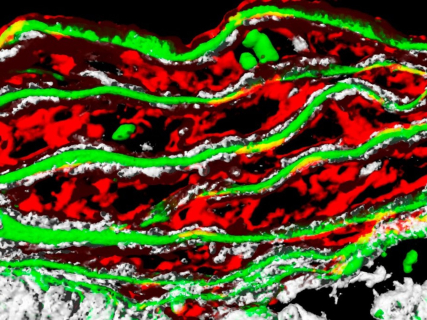

A group of scientists from the Severo Ochoa Center for Molecular Biology (CBM-CSIC-UAM), together with specialists from the National Center for Cardiovascular Research (CNIC) and the Cardiovascular Diseases area of the Center for Biomedical Research Network (CIBERCV), has managed to describe a cellular mechanism that favors the appearance of aortic aneurysms in Marfan syndrome.
The work, published in the journal "Nature Communications", offers unprecedented data on the processes involved in the progressive deterioration of the aortic wall in patients with Marfan syndrome, a complication for which there are still no specific pharmacological therapies, so preventive surgery remains the main available strategy.
The authors have found that the accumulation of fibronectin (FN) protein induced by versican in the aortas of patients triggers a signaling cascade that leads to the overexpression of the AKT-NOS2 pathway and, ultimately, aortic disease.
The team details that the origin of this damage lies in alterations of the material that surrounds and supports the cells of the aortic wall, which triggers a series of anomalous cellular signals that end up compromising the normal functioning of this large blood vessel.
This mechanism was observed both in experimental models and in samples from people with Marfan syndrome, thanks to the collaboration with clinical teams from several hospitals. This cooperation allowed confirming the results in aortic tissue of patients with different mutations in FBN1 and highlighting its importance for understanding the disease.
Thus, the study details "for the first time" the key stages of this pathological process and contributes to clarifying the origin of aneurysms that can develop in those affected by Marfan syndrome, a rare hereditary pathology that lacks truly effective treatments.
Possible targets for new treatments
The researchers show that modulating this pathway in experimental models improves parameters linked to vascular function and largely reverses aortic damage. These findings suggest that the identified elements could become therapeutic targets in the future to address Marfan syndrome.
"The results reinforce the idea that intervening on the molecular mechanisms involved could have a relevant impact on the evolution of the disease," highlighted CBM researcher Juan Miguel Redondo.
The data obtained open new lines of work aimed at designing pharmacological strategies to slow or modify the progression of aortic disease in Marfan syndrome. "These types of studies are essential to advance towards future therapeutic options that improve patient prognosis," emphasized CBM researcher Miguel R. Campanero.
The project has been financed by the "la Caixa" Foundation; the Ministry of Science, Innovation and Universities and the State Research Agency, with ERDF funds; the CSIC; the Pro CNIC Foundation; the La Marató Foundation; and the CIBERCV.