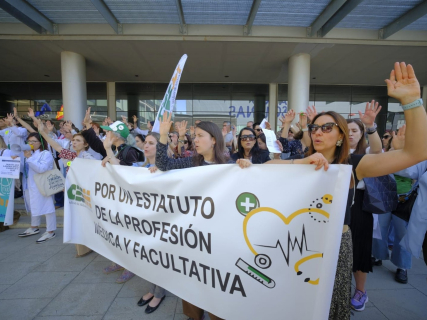

The doctors' strike returns this Monday in a new week of stoppages within the calendar of mobilizations called against the Ministry of Health, in a conflict that remains open with no agreement between both parties and no clear signs of immediate de-escalation.
The protest thus enters its fourth major week of mobilizations this year, after the stoppages already held in February, March, and April. The calendar approved by the strike committee contemplates full-week mobilizations distributed over several months, with a new round of stoppages starting this May 18 and another already scheduled for June if there are no advances.
The conflict revolves around the reform of the Framework Statute for healthcare personnel promoted by the Ministry of Health, a regulation that governs the working conditions of the public system and whose revision has provoked the frontal rejection of medical organizations such as the State Confederation of Medical Unions (CESM) and other unions in the sector.
What doctors are demanding
The unions maintain that the draft promoted by Health does not respond to the particularities of medical practice and demand a specific negotiation framework that recognizes the singularity of the profession.
Among their main demands are a specific statute for doctors and physicians, changes in the on-call system, improvements in working hours, greater professional recognition, and modifications in remuneration and retirement matters.
The strike committee maintains that the current model does not correct structural problems of healthcare overload nor sufficiently improve the working conditions of the group.
Furthermore, the organizers have repeatedly denounced the lack of real progress in negotiations and have called for direct dialogue with the Government to try to de-escalate the conflict.
The Ministry of Health's position
The Ministry of Health, for its part, defends that the reform of the Framework Statute seeks to update a model that affects the entire public healthcare system and maintains that some of the demands made by the unions exceed its competencies or depend on the autonomous communities.
Health has also defended changes in the on-call system within the negotiation process, although it maintains discrepancies with the organizers regarding the real scope of possible reforms.
Minister Mónica García has previously accused the convening unions of conveying messages that, according to the Department, do not correspond to the actual content of the negotiation.
The weeks ahead
The medical strike does not end this week unless there is a last-minute agreement. The calendar communicated by the strike committee included stoppages from February 16 to 20, March 16 to 20, April 27 to 30, May 18 to 22, and June 15 to 19.
That leaves another week of mobilizations already called. With the conflict entrenched and no agreement reached, public healthcare faces a new week of care tension while unions and the Ministry maintain distant positions.