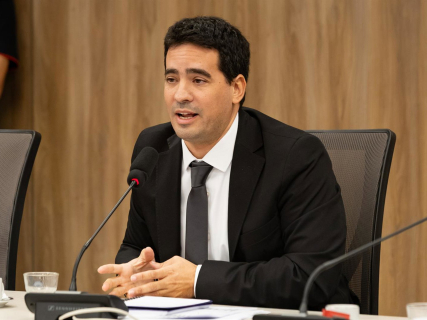

The presidential spokesperson of Argentina, Adrián Ravier, highlighted this Saturday that the new tariff strategy announced by the United States "fully and without exception" respects the Reciprocal Trade and Investment Agreement signed between both countries last February, which allows Argentina to maintain the lowest tariff rate in all of South America.
"Every tariff point defines who sells and who is left out. Argentine production today enters the largest market in the world in the best position in the region," the spokesperson pointed out in a publication shared on his social media, emphasizing the relevance of this situation for national exports.
Ravier linked this favorable scenario to "Argentina's favorable position" "in line with the excellent moment" that bilateral relations are experiencing, "driven" by the president of Argentina, Javier Milei, and his U.S. counterpart, Donald Trump.
According to the spokesperson's explanations, the White House will impose a tariff of "up to 10%" on Argentine products, a level lower than that faced by regional partners such as Chile, Colombia, Peru, and Uruguay (12.5%), and clearly more advantageous than that of Brazil, whose goods will pay tariffs of up to 37%.
"All our regional competitors moved to the high tier. Argentina did not. And compared to Brazil, which did not sign a reciprocity agreement, the difference reaches 27.5 points (...) Argentina has consistently maintained this level of 10%, a level that it has now breached in a significant number of positions," Ravier pointed out, highlighting the competitive gap that opens up against the main Mercosur partner.
From the Argentine Government, they emphasize that the decision of the U.S. Administration keeps out of the new tariff the 1,675 products that were exempted in February and also incorporates 93 positions with a 0% tariff exclusively for Argentina.
"The 1,675 products that the agreement freed from tariffs in February remain exempt from the new tariff, without a single exception. Also, the measure includes 93 positions at a 0% tariff only for Argentina. The quota of 100,000 annual tons of beef remains intact while the final negotiation continues," the spokesperson added, referring to the importance of the meat sector in foreign sales.