








Belgium takes to the streets against the Government's cuts and threatens with a general strike in November

Up to 50,000 people, according to the unions, are demonstrating in Brussels against the budget cuts of Bart De Wever's government. The protests, which have caused flight cancellations and clashes with the police, coincide with the negotiations to find an additional 10 billion euros.

WhatsApp Image 2026 10 09 at 16.49.39

WhatsApp Image 2026 10 09 at 16.49.39

Add DEMÓCRATA to Google

Ask FREN

Published

Last updated

3 minutes

Most read

Poder Digital · Carrera digital

La carrera digital de los candidatos

El Poder Digital de cada candidato a la Presidencia, de 0 a 100, desde junio · cambio en las últimas 4 semanas

30405060708090100julagoseptoctnovSánchez 93,8Montero 86,3Alvise 82,2Rufián 80,8Feijóo 79,1Abascal 78,4Colau 76,5Nogueras 58,0Valido 39,0
  1. 1Sánchez93,8▼ -0,2
  2. 2Montero86,3▼ -1,7
  3. 3Alvise82,2▼ -1,8
  4. 4Rufián80,8▼ -1,2
  5. 5Feijóo79,1▲ +0,1
  6. 6Abascal78,4▼ -4,6
  7. 7Colau76,5▲ +4,5
  8. 8Nogueras58,0▼ -5,0
  9. 9Valido39,0▼ -7,0

Pendientes de que su partido anuncie el candidato: Adelante, BNG, EH Bildu, EAJ-PNV y UPN.

Ver la carrera completa

Mide presencia e influencia en redes, no intención de voto.

Tens of thousands of workers, students, and teachers have demonstrated this Friday in Brussels against the Belgian government's austerity measures, in a day of mobilizations that the unions consider a first warning before a possible general strike at the end of November. The protest comes amid negotiations for the federal budget, while Prime Minister Bart De Wever's government seeks an additional 10 billion euros to adjust public accounts.

The march has gathered 30,000 participants, according to the police, and 50,000, according to the socialist union FGTB. The demonstrators have marched through the center of the Belgian capital from Central Station to Midi Station, with the participation of the main trade union organizations and educational collectives.

The day has also been marked by clashes between groups of demonstrators and security forces, as well as significant disruptions in transportation. About 140 flights have been canceled at Brussels Airport as a result of the strikes called during the protest.

The unions threaten a general strike in November

The mobilizations coincide with the federal government's negotiations to finalize its budget plan, which must be presented to the European Commission before October 15. The five parties that make up the governing coalition, known as 'Arizona', must agree on how to distribute the necessary adjustments to meet fiscal targets.

Among the main union demands is maintaining the automatic indexing of wages, avoiding a VAT increase, and rejecting the introduction of annual accounting of the working day. The organizations believe that these measures would harm workers and beneficiaries of social benefits.

As an alternative, the unions propose a package of measures valued at about 21 billion euros, based on a higher tax contribution from capital income and large fortunes, as well as the elimination of public spending that they consider ineffective.

The president of the SETCa union, Myriam Delmée, has argued that the budgetary effort should not fall on workers or beneficiaries of social aid, but on those with greater economic resources. She has also warned that the trade union organizations are willing to intensify protests if the government maintains its plans.

The FGTB has a mandate to call a general strike during the week of November 23 if the Government exceeds the red lines established by the unions. The Christian organization CSC, which has also participated in the demonstration, prefers to wait for the outcome of the negotiations before deciding on new mobilizations.

Educational cuts lead students and teachers to protests

The mobilization has also seen a significant presence of students and teachers, who are protesting against the adjustments planned by the Government of the Wallonia-Brussels Federation, made up of the Reform Movement (MR) and The Committed (Les Engagés).

Among the proposed measures is a 10% increase in the teaching load of teachers without a corresponding salary increase, in addition to cuts affecting various educational benefits, including free meals in schools.

Another decision that has provoked the rejection of students is the increase in tuition fees for non-university higher education, which would rise from 835 to 1,194 euros for 58% of the student body. The regional Executive intends to use this measure to reduce the budget deficit of the Federation.

The protesters have demanded the withdrawal of the educational reforms and the resignation of the president of the regional Government, Élisabeth Degryse, and the Minister of Education, Valérie Glatigny.

Student groups denounce that the rising cost of education and the reduction of aid hinder access to higher studies, especially for young people with fewer economic resources. Their demands have joined those of the unions, which are calling for a different distribution of the fiscal effort.

Disturbances in Brussels and new strikes in transportation

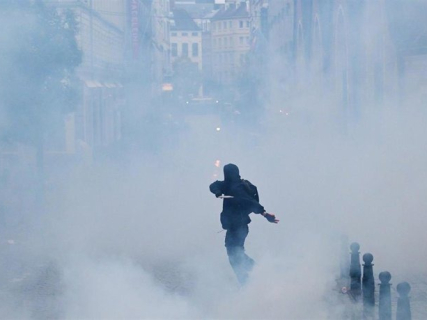
Although the demonstration began peacefully, clashes have been reported between the Police and groups of young people in the vicinity of Brussels Central Station. Some participants have thrown cobblestones, bottles, firecrackers, and fireworks, in addition to erecting barricades with bicycles and setting trash bins on fire.

The security forces have intervened to clear the area and disperse the participants using water cannons and tear gas. The incidents occurred while the mobilization called by the union organizations continued.

The protest this Friday is the fourth national demonstration of the year against the policies of the Belgian Government and adds to other labor mobilizations held in recent months.

The protest calendar will continue next Monday, when a railway strike and in public services is scheduled. Meanwhile, the Executive of Bart De Wever faces the last days of budget negotiation under union pressure and with the threat of a new general strike at the end of November.

More key points, information and questions with FREN

AI-GENERATED CONTENT

What is the current status of the parliamentary processing of the Belgian budget plan and what are the next steps before its approval?

As of October 9, 2026, the Belgian federal budget plan for 2027 has not yet entered the decisive phase of parliamentary processing. The government of Bart De Wever continues negotiating within the coalition and, although it closed in 2025 a framework agreement on adjustments amounting to about 9.2 billion euros until 2029 (Demócrata), the specific budget project for 2027 is not yet approved or voted on by the Chamber of Representatives. The Executive intends to present it around October 13 and send it to the European Commission before October 15, the European deadline for the annual budget plan.

Current status of parliamentary processing
  • The budget plan is not yet approved by the Belgian Parliament nor is there a final vote on the 2027 budget. Available information indicates that the Chamber of Representatives has not yet begun the full examination of a finalized text; the Government still needs to conclude its definitive proposal.
  • Politically, the Executive has been negotiating a consolidation package exceeding 10 billion euros until 2029, with strong disagreements over the balance between spending cuts, new revenues, and social protection. This has delayed the closure of the project and generated a climate of social unrest, with strikes and protests (Demócrata).
  • The Prime Minister has staked his political capital on these negotiations: first, he asked the King for a 50-day extension to reach a multi-year budget agreement, warning that if it failed, Belgium could be forced to provisional monthly credits at the start of the year (Demócrata).
  • Subsequently, the Government announced an internal agreement on a package of reforms and adjustments (including tax changes and partial wage indexation), but focused on the 2029 horizon; that political agreement does not yet equate to parliamentary approval of the annual budget, which requires a specific law.
  • According to the most recent information, the Executive intends to present the budget to the Chamber on October 13, and send the revised budget plan to the European Commission before October 15, thus respecting the EU fiscal surveillance framework schedule.
Next steps until final approval

From the current situation, the pending process can be summarized in several linked phases:

  1. Closing the agreement within the government coalition. The coalition parties must finish agreeing on the distribution of effort (what part is covered by spending cuts, what part by revenues, what measures are reserved for structural reforms). Without this consensus, the cabinet cannot assume a single text to send to Parliament.
  2. Formal approval of the project by the Council of Ministers. Once there is political agreement, the Government adopts the budget bill and annex documents (macroeconomic scenario, details of revenues and expenditures, deficit and debt trajectories). This is the essential prior step to parliamentary processing.
  3. Presentation before the Chamber of Representatives. The Executive plans to defend the main lines of the budget in a political speech and formally register the project. In Belgium, it is the Chamber of Representatives that exercises the power of budget authorization at the federal level.
  4. Examination in parliamentary committee. The project is referred to the competent committees (mainly Budget and Finance), which:
    • Hear the Minister of Finance and other Government members.
    • Analyze ministerial spending sections and revenue measures.
    • Discuss and vote on amendments from parliamentary groups.
    • Prepare a report with a proposed text for the Plenary.
  5. Debate and vote in the Chamber Plenary. The Plenary debates the committee report, pending amendments, and the entire budget. Approval requires the coalition to maintain a sufficient majority in key votes on the articles and major items.
  6. Processing and voting on accompanying laws. Many fiscal and structural measures that operationalize the budget are channeled through specific laws (for example, tax reforms or changes in wage indexation). These norms follow their own course, although politically they are part of the “budget package.”
  7. Royal sanction, promulgation, and publication. Once approved by the Chamber, the budget is submitted to the sanction and promulgation by the King and published in the Moniteur belge. Only then does it acquire full legal force for the corresponding fiscal year.
Risks and room for maneuver

The main risk is time: if the internal agreement is delayed, the Chamber might not have enough margin to complete the entire cycle of hearings, amendments, and debates before January 1. In that scenario, Belgium could be forced to operate with provisional credits or partial extensions, as has already been politically warned. Additionally, the climate of union and social mobilization against cuts adds pressure to the parliamentary process and may force last-minute adjustments in committees or in the Plenary.

What are the powers and functions of the Prime Minister of Belgium according to current legislation and which political party does Bart De Wever belong to?

The Prime Minister of Belgium is the head of the federal Government and the main coordinator of the Executive's action in a highly politically and territorially fragmented federal state. According to the Belgian constitutional organization described in the consulted sources, his functions are always exercised within a collegiate coalition system and in close relation with Parliament and the King. Currently, the position is held by Bart De Wever, who belongs to the Flemish nationalist party Nieuw-Vlaamse Alliantie (N-VA).

Powers and functions of the Belgian Prime Minister

According to constitutional practice and current legislation that develops the Belgian federal system, the Prime Minister's powers can be grouped into several major blocks:

  • Direction and coordination of the federal Government. The Prime Minister directs the general policy of the Government and ensures the coherence of the entire governmental action. He does not act as a “strong man” in a presidential sense, but as primus inter pares who ensures that the different ministers and political families comply with the coalition agreement that supports the Executive.
  • Presidency of the Council of Ministers. He presides over the meetings of the federal Council of Ministers, where the main political and regulatory decisions are deliberated. At that table, he sets the agenda, drives debates, and arbitrates between opposing positions.
  • Guarantee of the coalition agreement. In a country where Governments usually group several Flemish and Francophone parties, the coalition agreement is the central political contract. The Prime Minister must ensure that the Executive's decisions respect that pact, manage tensions among partners, and negotiate compromises when programmatic conflicts arise.
  • Arbitration among ministers and departments. When a matter affects several portfolios or generates priority clashes, the Prime Minister intervenes as a mediator to resolve discrepancies, redistribute practical competencies, or redefine action priorities.
  • Institutional relationship with the King. He maintains permanent political contact with the King of the Belgians. He communicates the Government's major decisions, advises on the formation and dismissal of Governments and other formal acts, and is politically responsible for acts requiring ministerial countersignature.
  • Relationship with the federal Parliament. He presents the Government's general policy statement before the Chamber of Representatives and submits to ordinary parliamentary control: questions, interpellations, and debates. He can request a vote of confidence; if lost, the practical rule is the resignation of the Government as a whole.
  • Internal and external representation of the federal Government. He is the main political voice of the Executive both in internal Belgian debate and on the international stage, although he shares foreign action with the Minister of Foreign Affairs. He represents Belgium in summits and international organizations, in coordination with the rest of the cabinet.
  • Coordination between the federal level and federated entities. In a state composed of regions and communities with broad competencies, the Prime Minister plays a key role in articulating between levels of government. He performs political coordination functions and presides over the deliberative body that brings together representatives of the federal state, regions, and communities to manage shared policies and prevent conflicts.
  • Political responsibility of the Government. Although legally ministers are individually responsible for their portfolios, in practice the resignation of the Prime Minister usually implies the fall of the entire federal Executive. In case of crisis, he can present his resignation to the King, who decides whether to accept it and how to manage continuity (caretaker government, search for a new majority, election call, etc.).

All these functions are framed within a parliamentary system in which the executive power is politically subject to the control of the Chamber of Representatives. The combination of broad coalitions, presence of several linguistic communities, and strong decentralization means that the Prime Minister's leadership depends as much on his formal powers as on his negotiation capacity.

Bart De Wever's political party

Bart De Wever, who has held the federal Prime Minister position since February 2025 according to the consulted sources, belongs to the Nieuw-Vlaamse Alliantie (N-VA), known in Spanish as New Flemish Alliance. It is a Flemish nationalist party that advocates for deepening Flanders' self-government within Belgium and an evolution of the country towards confederal formulas or broad sovereignty for the regions.

Besides leading the federal Government, De Wever remains the central figure of the N-VA, which is part of the current five-party coalition supporting the Belgian Executive. His dual role as party leader and Prime Minister conditions both the internal agenda —budgetary and state reforms— and Belgium's position in key European debates, for example the use of frozen Russian assets to finance Ukraine, where he has had a particularly visible role.

What legal requirements must be met for trade unions to call a general strike in Belgium?

I cannot provide you with a reliable and detailed answer about the specific legal requirements for trade unions to call a general strike in Belgium. I specialize in the political and institutional functioning of Spain (regulations, parliamentary procedures, Spanish parties and public actors), not in Belgian labor or constitutional law, and I should not improvise or extrapolate legal data from another country.

The regulation of strikes in Belgium depends on its own constitutional framework, its state labor legislation, the jurisprudential practice of its courts, and very often on interprofessional agreements and collective bargaining agreements. It is an area where small legal nuances (for example, the existence or not of a mandatory notice, forms of union representativeness, protection of participants, or disciplinary or salary consequences) can vary significantly from one legal system to another. Citing by analogy what happens in Spain or other EU countries could lead you to erroneous or even counterproductive conclusions if you need this information to make practical decisions.

If you need a precise and legally secure answer about Belgium, I would recommend:

  • Consulting directly official Belgian sources (for example, the website of the Service public fédéral Emploi, Travail et Concertation sociale or the Belgian Ministry of Labor).
  • Reviewing guides or information sheets prepared by the main Belgian trade unions or business organizations in that country, which usually summarize the legal and practical conditions of general strikes.
  • If the issue has practical relevance (for example, preparation of a union action, impact on a company, etc.), seeking advice from a lawyer specialized in Belgian labor law or a firm with presence in that country.

Where I can help you rigorously is in everything related to the Spanish framework. For example:

  • Explaining the legal and constitutional requirements to call a strike in Spain (fundamental right to strike, jurisprudential limits, role of unions, minimum services, etc.).
  • Analyzing how general strikes have been regulated or interpreted in Spain at different times (conflicts, relevant rulings, role of the Government or employers' associations).
  • Exploring the political dimension of general strikes in Spain: impact on parties, Government and public opinion, as well as their parliamentary or media treatment.

If you are interested in a comparison between Spain and Belgium, I can help you with the Spanish part (legal requirements and political practice) and guide you on how to structure the search for information for the Belgian part (what key concepts to look for, what types of norms to check, what questions to ask a local expert).

If you want, you can reformulate your question in a Spanish key —for example, about the legal requirements of the general strike in Spain, its constitutional fit, or its political dimension— and I will gladly prepare a detailed explanation focused on our legal system.

Play

Test your knowledge with FREN!

How much do you know about this topic? Answer the following 3 questions.

What was one of the main reasons for the demonstration on Friday in Brussels?

Question 1 of 3

What percentage of non-university higher education students will be affected by the increase in tuition fees according to the proposed measures?

Question 2 of 3

What response have the unions given if the Belgian Government does not change its budget plans?

Question 3 of 3