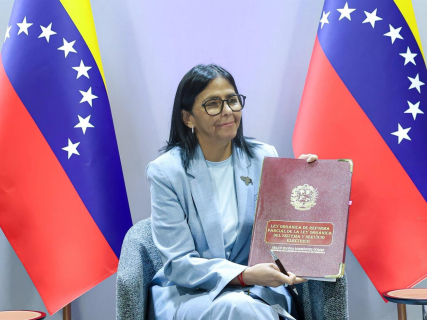

The acting president of Venezuela, Delcy Rodríguez, has signed this Thursday the reform of the Organic Law of the National Electric Service, a legal framework already endorsed by the Venezuelan Parliament that allows the entry of private capital, both domestic and foreign, into the energy system. The regulations also incorporate tax incentives and contemplate the launch of a new regulatory body in the South American country.
During an event held at Expo Venezuela Energética Capítulo Oriente 2026, Rodríguez emphasized that the legal modification will make possible "the involvement of the private, domestic and international sector, in the electricity generation processes" with the aim of strengthening supply in the face of the increase in demand resulting from "economic growth" and the high temperatures associated with the phenomenon of 'El Niño'.
The new law includes the creation of the National Superintendency of the Electric System, an agency dependent on the Ministry of Electric Energy that will carry out regulatory and oversight functions both over the public operator and over the private companies that operate in the Venezuelan market.
The Minister of Electric Energy, Rolando Alcalá, has stressed that the legislation is "innovative" in allowing private participation throughout the entire sector chain, encompassing the activities of "generation, transmission, distribution and commercialization," and also incorporating a specific chapter aimed at promoting electrical self-generation in the hydrocarbons industry to reduce the load on the national grid.
In her speech, the Venezuelan leader defended the urgency of moving toward a diversified economic model "not oil rentier" and placed Venezuela’s current crude oil production at 1,269,000 barrels per day—of which 730,000 come from the Orinoco Oil Belt—while also indicating that the country’s economic growth stands at 7.42% at the close of the third quarter of the year.