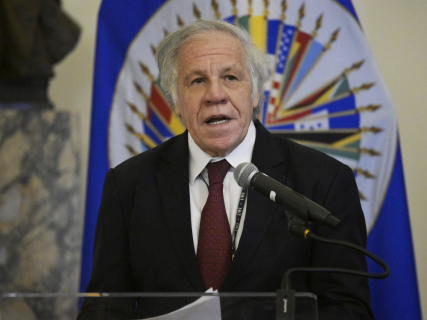

The Government of Ecuador has launched an attack this Thursday against Luis Almagro, former Secretary General of the Organization of American States (OAS), by considering "unacceptable" certain statements in which he warned of a deterioration in the exercise of political rights in the Andean country on the eve of the local elections scheduled for this November 29.
Ecuador's Mission to the OAS has issued a communiqué on social networks in which it emphasizes that "It is unacceptable for him to make statements that are capable of constituting an improper interference in the electoral process of a member State" and in which it urges Almagro to maintain "special and strict responsibility, prudence, and rigor in his public pronouncements."
The Executive of Daniel Noboa interprets that the statement by the former Secretary General, made "at just a few days' remove" from the date with the ballot boxes, reveals "a clear political intention, incompatible with the spirit of respect for sovereignty and democratic institutions that inspires the Inter-American Democratic Charter."
In this context, the Government has recalled that for this Sunday's elections, the presence of the 31st OAS electoral observer mission is scheduled, while at the same time Quito has sent invitations to the European Union and the United Nations to send their own teams, which, in its view, demonstrates "its firm commitment to transparency and the integrity of the electoral process."
For this reason, the Executive has harshly criticized Almagro's remarks, who led the OAS General Secretariat between 2015 and 2025. "It is especially contradictory and blameworthy that someone who previously led these regional mechanisms should express himself in that way," it said, before accusing the Uruguayan diplomat of applying "double standards."
Quito's statement comes one day after Almagro, on his social networks, reposted a call from the Inter-American Court of Human Rights (IACHR) directed in August at Ecuadorian authorities to guarantee "plural" political participation in the elections of this November 29.
In that message, the former OAS secretary maintained that "Since then the situation of the exercise of political rights has worsened, with a sharpening of the judicialization of political opponents, of disqualification of candidates, of forcing candidates to resign, of manufacturing files to prevent political participation (...) factors that seriously affect the pluralism of the electoral contest".
In addition, he denounced that "a scheme of fear and self-censorship has been installed (...) totally contrary to the letter and the spirit of the Inter-American Democratic Charter, as regards (...) the functioning of democracy".
Alongside this controversy, the case of the opposition leader Luisa González persists, who has remained for more than a month in pretrial detention for an alleged money laundering offense. The former presidential candidate, disqualified from running in this Sunday’s election, maintains that she is a victim of "political persecution" and states that she finds herself in a situation of "absolute isolation and inability to communicate".