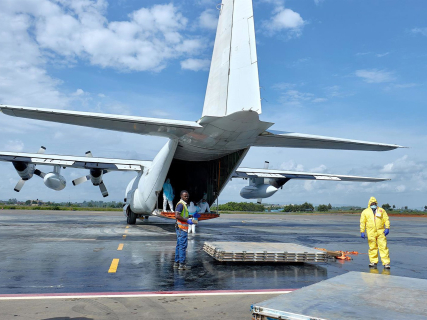

The director of the Africa Centres for Disease Control and Prevention, Dr. Jean Kaseya, announced this Sunday that the Ebola outbreak affecting the north of the Democratic Republic of Congo and which has spread to Uganda has already caused 43 deaths and more than 263 confirmed infections since it was declared until last Saturday.
In an editorial published by the 'Financial Times', Kaseya added that there are currently more than 1,100 suspected cases under investigation in a health emergency that has become a decisive test for the affected countries, for the African agency he leads, and for the African Union, given that "the risk of regional spread is already a reality".
In parallel, the Ministry of Health of the Democratic Republic of Congo has released a new official report in which it states 42 deaths in the country and specifies that 3,200 contacts have been identified, of which 967 remain under active surveillance. The province of Ituri, the main focus of the outbreak, accounts for 245 confirmed cases, while 15 are registered in North Kivu and three in South Kivu. Nine infections have been confirmed in Ugandan territory, including one death.
In a single day, May 29, laboratories received and examined 70 samples, of which 54 tested positive, representing 77.1%.
Kaseya stressed that the context of insecurity is playing a decisive role in the spread of the virus. The clashes between the Army and armed groups operating in the north and northeast of the country have generated a "constant movement of the population across the permeable borders" between the DRC and neighboring Uganda. "Health systems are saturated and, for this strain of the virus, there is currently no authorized vaccine or specific treatment," he warned.
The Director-General of the World Health Organization (WHO) is in Bunia, the capital of Ituri province, this weekend to assess the outbreak's evolution on the ground and hold meetings with Congolese health authorities, led by the Minister of Health, Roger Kamba.
In his first press conference, held this past Saturday, Kamba set a goal of "between four and six months" to "defeat or contain the outbreak". The head of the WHO, for his part, evoked the DRC's response in previous emergencies and argued that, despite there being no vaccine available for the variant involved in this outbreak, the country's accumulated experience constitutes its main resource at this time.
"We know that this is a quite complex crisis, but the DRC already has extensive experience in fighting the virus. We are confident that we will be able to contain this epidemic once again," Tedros stated.