
Iran's Revolutionary Guard has announced that it is taking responsibility for a series of attacks targeting "key" US infrastructure and facilities located in Kuwait and Bahrain, carried out just "one hour after" Washington launched a new wave of bombings on Iranian territory this Wednesday, in what constitutes the second consecutive day of offensive against the Islamic Republic.
In a statement disseminated by the Tasnim agency --linked to the Revolutionary Guard itself--, the military corps has claimed to have "destroyed" the "key infrastructure and facilities" at the US bases of Arifjan and Ali al Salem, in Kuwait, as well as at the US air base Sheij Isa and Jufair, in Bahrain.
"The United States, which fails to honor its commitments, by violating all its commitments, once again attacked several coastal areas in southern Iran and two bridges in the eastern provinces leading to the sacred Mashhad," the Revolutionary Guard stated, also warning that "if the aggression is repeated" its "forceful responses will be extended to other US bases" distributed throughout the Middle East.
In this same note, the military corps insisted that "the warriors of Islam will not leave the aggressions of the US Army, the child killer, unanswered."
Alarms and Defenses Activated in Kuwait and Bahrain
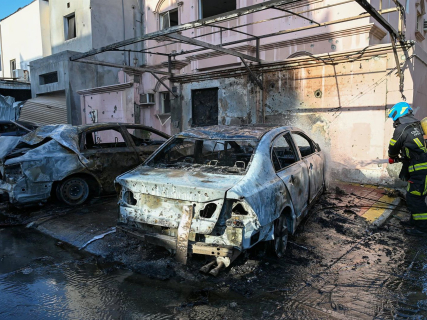
In parallel, Kuwaiti authorities indicated in the early hours of this Thursday that their territory was being subjected to missile and drone attacks, while Bahraini authorities reported the activation of alarm sirens, in both cases shortly after the new round of US attacks against various enclaves of the Islamic Republic.
"Kuwait's air defenses are currently responding to hostile missile and drone threats," the Kuwaiti Army reported in a message published on social media, emphasizing that "any explosions that may be heard are the result of the interception of hostile targets by air defense systems."
After requesting the population to comply with the security instructions issued by the competent authorities, the Kuwaiti Armed Forces asked citizens and residents to "not approach the places where fragments resulting from interception operations have fallen."
Along the same lines, the military institution has urged to "refrain" from "photographing, publishing, or disseminating" any image or video related to these events "through the various social networks in order to preserve public safety and security."
On the other hand, the Ministry of Interior of Bahrain has communicated on several occasions, between Wednesday night and Thursday morning, the activation of alert sirens, asking the population to "remain calm, go to the nearest safe place, and follow the news through official channels."
Escalation in Hormuz and warnings from Iran
This increase in tension occurs amid the worsening of the standoff in the strategic Strait of Hormuz, a few hours after US President Donald Trump threatened new military actions during the NATO summit held in Turkey.
Following the attacks launched by US forces against several targets on Iranian soil, with the argument of "continuing to reduce Tehran's capacity" to "threaten freedom of navigation in the Strait of Hormuz," the Speaker of the Iranian Parliament and chief negotiator in talks with Washington to curb hostilities, Mohammad Bagher Ghalibaf, has harshly criticized the actions of the American troops.
Asserting that intimidation and faith "are no longer unpunished" and that "if you hit (Iran), you will be hit back," Ghalibaf has warned that "the Strait of Hormuz will only be opened through 'Iranian agreements' and not with American threats."