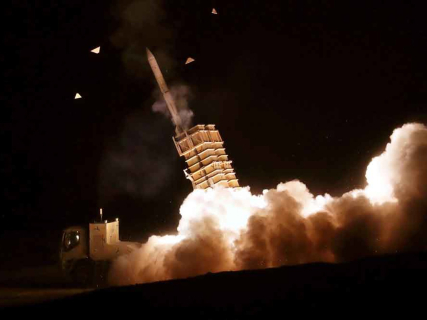

Iran's Revolutionary Guard reported early Monday morning an offensive against military bases with a US presence located in Jordan, Bahrain, Kuwait, and Oman. This action comes after a new round of bombings carried out hours earlier by US forces on various enclaves of the Islamic Republic, which reportedly caused at least two deaths and six injuries.
According to statements released by the Tasnim news agency, linked to the Iranian elite corps, the Army specifically targeted Prince Hassan base in Jordan, Sheikh Isa base in Bahrain, and Ali Al Salem base in Kuwait.
"In the first phase of the response to these aggressions, fervent warriors of Islam set fire to several large missile silos and fuel depots at Prince Hassan Air Base in Jordan, by launching missiles and drones," states one of the official notes, in which the uniformed personnel claim to have set fire to fuel depots and ammunition warehouses at the Jordanian facility.
In parallel, an authorized military source from the General Staff of the Jordanian Armed Forces explained that national air defense systems have "intercepted and shot down four missiles that entered Jordanian airspace, originating from Iranian territory," according to a statement released by the Army itself.
In the same text, Jordanian military authorities emphasize that "any attempt to attack the kingdom's sovereignty or violate its airspace will be met with full force, within the approved rules of engagement and what national interest demands."
Subsequently, and after emphasizing that its "retaliatory" actions are ongoing, the Revolutionary Guard claimed to have "destroyed" the US Army's drone command and control center in Bahrain.
"In the second phase of the counteroffensive operation, important helicopter repair and maintenance centers, the hangar for P-8 electronic warfare aircraft, and the command and control center for the child-killing drones of the United States Army at the US base of Sheikh Isa, in Bahrain, have been destroyed," the statement adds.
In response, the Bahraini Ministry of Interior confirmed the activation of emergency sirens throughout the country and urged the population to remain calm and seek shelter in safe places.
As a "third phase" of this "retaliation operation," the aerospace force of the Revolutionary Guard claims to have "completely destroyed" fuel depots and the Patriot air defense system of Alí Salem base in Kuwait, in addition to a strategic Fixed Phased Array (FPS) radar located at Ahmad al Jaber base. Both facilities house personnel and operations of the United States Air Force.
Later, Tehran has indicated that its ground forces have set fire to two missile launchers of the High Mobility Artillery Rocket System (HIMARS) and have attacked "barracks full of missiles" which, it claims, have been "completely destroyed."
In the same vein, the Revolutionary Guard claims responsibility for attacks against "facilities and infrastructure of the aggressive U.S. Army in Jufair, Bahrain" and against "a ship detection radar in Oman," targets on which it claims to have launched "devastating missile and drone attacks."
The Iranian military corps has also reiterated that it considers the Strait of Hormuz to be Iranian territory and will not allow "a rebellious and child-killing army from the other side of the world to continue its illegal interference in it."
"The only way to open the Strait of Hormuz to maritime traffic is to end the aggressive military interventions of the United States in this strait and respect the sovereignty of countries over their own coastal waters," it has indicated, before warning that "continuing these interventions will cause a greater number of incidents in the global oil and gas sector."
For its part, the United States Army, which maintains that Tehran does not exercise control over this strategic passage, has announced the completion of a new series of "offensive attacks" against "dozens of targets in multiple locations." According to Washington, the stated purpose of the operation is to "weaken Iran's ability" to attack ships transiting the Strait of Hormuz, although among the first targets listed by the military command are "air defense systems."