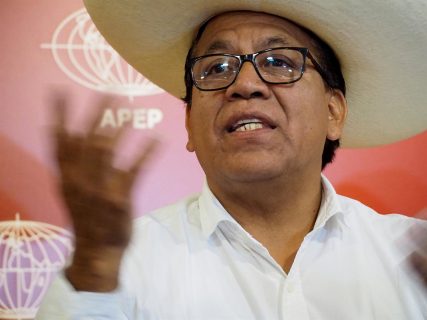

The candidate from Juntos por el Perú (left), Roberto Sánchez, has taken the lead in the second round of Peru's presidential elections, achieving 50.029% of the votes, compared to the 49.971% obtained by the candidate from the far-right Fuerza Popular, Keiko Fujimori, with 94.07% of the ballots counted.
According to official data released by the National Office of Electoral Processes (ONPE), Sánchez has garnered 8,803,745 ballots, while Fujimori has reached 8,793,466 votes, a minimal difference that reflects the country's strong polarization.
In the early hours of the count, partial results gave a slight advantage to Fujimori. However, as the scrutiny progressed, the gap narrowed until the left-wing candidate ended up surpassing the daughter of former president and dictator Alberto Fujimori.
During the count, Fujimori has called for calm from her supporters and has stated that, from now on, the spotlight falls on her legal representatives, who are responsible for reviewing each ballot. She has also emphasized the importance of respecting the verdict of the polls, regardless of who emerges as the winner.
"What is required is patience and a lot of serenity. I also call on the poll watchers, not the precinct poll watchers anymore, but the legal poll watchers, of whom we have more than 100 throughout Peru, as they will have to fight, analyze each of these ballots and well, we will have to wait and respect the results whatever the winner may be," she stated, as reported by the newspaper 'La República'.
From Sánchez's campaign team, Gustavo Guerra García, a member of the technical team of Juntos por el Perú, has praised the ONPE's performance in this second round. He highlighted that more than 95% of the polling stations submitted compliant ballots and that the percentage of challenges was between 1% and 2%, a reduced figure.
"This time the ONPE has been up to the task. We have not had the problems of the last time," he indicated, referring to the first round of elections.
More than 27 million Peruvian citizens, including 1.2 million voters residing abroad, were called to the polls this Sunday in one of the tightest presidential contests in recent years.
In his fourth attempt to reach the head of state, Fujimori has won in the main urban centers, such as Lima, the capital, and Cuzco, while Sánchez has concentrated his support in the regions that have historically denounced the country's excessive centralism.
The candidate from Juntos por el Perú obtains his best results in the center, south, and east of the national territory, where large rural, jungle, and mountain areas are located. Fujimori, for his part, achieves his most favorable figures on the coast.