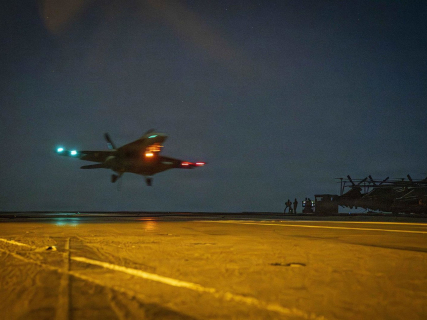

The United States Army has carried out, in the minutes before midnight this Thursday, its twelfth consecutive night of attacks against Iranian territory. This new round of bombings, ordered by the U.S. president, Donald Trump, has lasted about five hours with the declared objective of diminishing Tehran's ability to endanger commercial traffic crossing the Strait of Hormuz.
"Today (Wednesday), at 5:30 PM (Eastern Time, 11:30 PM in mainland Spain and 1:00 AM Thursday in Iran), U.S. forces have begun launching new attacks against Iranian military targets, following the orders of the commander-in-chief," announced on social media the Central Command (CENTCOM) of the United States Army, referring with that last statement to Trump.
Five hours later, the Command has declared this operation concluded, according to a statement also disseminated on social media, in which it specified that "Iranian military targets have been reached, including maritime facilities, missile and drone depots, coastal surveillance posts, and air defense systems."
"This month, U.S. forces have attacked dozens of Iranian military sites on land, while resuming the maritime blockade against Iran," it highlighted.
CENTCOM has also emphasized that its "mission will continue with the goal of further reducing Iran's ability to threaten civilian mariners and merchant vessels transiting the waters of the region." In this way, it refers to the attacks attributed to forces of the Islamic Republic against oil tankers and other vessels, while Tehran maintains an ambiguous stance when referring to these episodes, mentioning for example "fires" and "explosions" without explicitly assuming responsibility.
Shortly before, the Central Command itself had rejected that the Islamic Revolutionary Guard Navy of Iran "implies that international sailors can only use the routes that the Guard deems appropriate," labeling as "false" the idea that this Iranian military body "controls the entry and exit of the Strait of Hormuz."
"Iran does not control the Strait of Hormuz. The international waterway remains open to transit, regardless of the threats and attacks from the Revolutionary Guard," the Central Command has stated, emphasizing that, "since early May, U.S. forces have assisted more than 900 ships in transiting the strait" and that the vessels continue to cross this strategic enclave "with the military support of the United States."
Two dead and eleven injured at the border with Iraq
This latest series of bombings —carried out in the early hours of Thursday according to Iranian time— has caused the most severe damage so far in the border town of Shalamcheh, adjacent to Iraq, where a missile attack is said to have struck near a pedestrian area of the border crossing.
"The area near the passenger terminal at the Shalamcheh border has been attacked with missiles from the U.S. terrorist enemy," the deputy security director of Khuzestan province, Valiolá Hayati, declared to the state agency IRNA.
Moments later, Hayati himself confirmed to the same outlet that "two compatriots have died and eleven have been injured in the missile attack" in question.
This has not been the only bombing scene: the cities of Andimeshk and Ahvaz, also in Khuzestan province, as well as Bushehr, facing the Persian Gulf, have also suffered missile attacks —in the case of Bushehr, on two occasions— although for now the authorities have not reported any casualties in these locations.