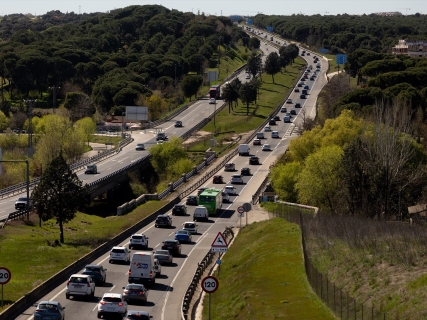

Transport is, by incidence and magnitude, the most transcendent vector in the decarbonization of the economy. And, probably, the one that has the most difficulties in electrifying, at least in areas such as air navigation or maritime.
With the aim of accelerating electrification and the deployment of renewable origin fuels and hydrogen in transport, the Government approved this Tuesday in the Council of Ministers a regulation that establishes a path for reducing emission targets until 2040 and for the penetration of renewable energy in road transport, coastal navigation, and non-electrified rail transport.
The decree, which transposes the so-called DER III directive in the transport sector, aims to constitute a stable framework that guarantees predictability and certainty to all agents in the sector, and sends the necessary signals to the agents in search of the aforementioned decarbonization.
Who is obligated?
The subjects obligated to meet the established targets are the fuel suppliers for the different modes of transport. In the case of road transport, for example, they are the wholesale operators of petroleum products and LPG (liquefied petroleum gas).
That is to say, the obligation does not fall on the end users, but on the energy supplying part, which must incorporate new fuels, such as hydrogen or renewable origin electricity to ensure that its supply contributes to the reduction of emissions.
The obligation directly falls on the sales of these suppliers.
The regulation also obliges subjects, such as Adif, to report information to the Administration about the electricity and fuels consumed in their facilities, for statistical purposes.
What are the objectives?
According to sources from the Ministry for Ecological Transition informing DEMÓCRATA, the regulation that will be published in the coming days in the Official State Bulletin (BOE) includes a wide catalog of annual objectives.
The annex includes both environmental objectives for emission reduction and other paths that require the incorporation of advanced biofuels, biogas, hydrogen, and non-biological origin fuels and advanced bioalcohols.
The Ministry has hardly provided references so far. In the case of fuel intended for road transport, the emission reduction path includes a decrease of 17.6% by 2030 and 30% by 2040.
In the case of the pathways for incorporating biofuels and advanced biogas, they must jointly reach 8% of fuel by 2030 and 22% of all fuel by 2040.
In navigation, a 9% reduction in emissions by 2030 and 33% by 2040 is required, complementary to the obligations already provided for in the European regulation REfuelEU.
In non-electrified rail, the emission reduction reaches 10% by 2030 and 50% by 2040.
In air transport, the targets are those of the ReFuelEU Aviation Regulation: 6% of sustainable fuels by 2030 and 34% by 2040, measured in tons.
Flexibility and sanctions
The regulation includes flexibility mechanisms to meet the targets, allowing to offset other contributions to decarbonization. For example, non-biological origin fuel used in the industry could count towards the required for road transport.
In any case, the regulation includes sanctions, considering non-compliance a very serious offense under the Hydrocarbons Law, which provides for fines of up to 30 million euros for such cases.
E-credits
In order to promote electrification and the production of new fuels, the regulation develops a system that quantifies renewable energy in e-credits and will provide additional income to charging point operators and producers of renewable origin fuels.
These operators will be able to request certificates for renewable fuels and sell them to obligated parties so that they can meet their emission reduction targets.
Sustainability guarantees
It also regulates the sustainability characteristics of these non-biological origin fuels in order to prevent misleading advertising practices and provide security to consumers, with the reinforcement of control and certification systems.
All renewable origin fuels will be subject to the controls already applied to bioethanol and biodiesel.
In addition, a National Sustainability Verification System is created to cover all stages of the value chain and each year those who certify a greater volume of renewable energy will be recognized with quality seals.