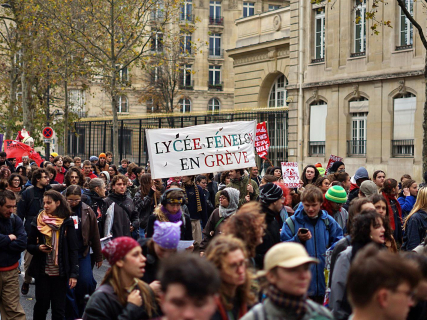

At least 82,500 demonstrators, according to the Ministry of the Interior, and 150,000 according to the calling organizations, have once again taken up the streets of France’s main cities this Saturday, on the sixth consecutive day of social mobilizations. The protests began out of discontent in the education sector and have spread in order to denounce the high cost of living and police violence.
These figures represent a step back from the marches of Saturday, November 14, when the Ministry of the Interior counted 106,000 attendees, compared with the 200,000 demanded by the organizers.
The Ministry of the Interior has underscored that the demonstrations have developed in a "generally peaceful" manner and "with a notable drop compared to previous days". However, it has reported 144 arrests carried out up to 6:00 p.m.
The department has warned of "several groups of high risk and great mobility, made up of several hundred individuals belonging to or led by the far left" who "have caused serious incidents, in particular by forming spontaneous marches and attempts to enter areas of the city centers where demonstrations are prohibited".
According to Interior, "damage to street furniture has been reported, the burning of trash containers, and attempts to loot businesses. These groups have also attacked law enforcement forces with particular violence".
In Paris, the Ministry estimates that 21,500 people have joined the mobilization, while student unions raise participation to 45,000.
"The government must listen"
"Many think that with winter and the upcoming presidential elections, everyone will set aside their anger, but I don’t believe that, because nobody can afford the luxury of waiting six months. The government must listen to these social demands or resign," the France Insoumise MEP Manon Aubry has stated during the march, from Place de la République.
In the French capital, vests and flags of the General Confederation of Labor (CGT), the French Democratic Confederation of Labor (CFDT), Force Ouvrière (FO), the Unitary Trade Union Federation (FSU) and Solidaires were displayed, along with left-wing political formations, student groups and the already known Yellow Vests.
Among the banners, slogans could be read such as "Generation Z against selectivity and militarization" or "No to the license to kill", in reference to the law on the presumption of lawful use of weapons by law enforcement forces approved on Friday in the French Parliament.
During the day, preparations for the upcoming public-sector strike scheduled for December 1 were also recalled. "This will be an important day to reiterate that, as far as the salaries of public officials are concerned, in particular those of National Education staff, the response given is not satisfactory and there is an absolute urgency," the spokesperson for the teachers’ union Snes-FSU, Sophie Vénétitay, said in statements to the BFMTV network.
Student unions have also had a prominent presence. "We have only received crumbs, but we want the whole pie," said a representative of high school students, Ryad Rani, who insisted on the demands, especially the renewal of school buildings. "We won’t give up. We’ll carry on to the end," he added. They are calling for measures against student poverty, an end to university selectivity, and an increase in university places.
From the Yellow Vests movement, they have called for "moving towards a revolution in the noble and peaceful sense of the term." "We want the people to regain power over the institutions," a spokesperson, Azelma Signaux, said.
The call was also heeded in other localities such as Lyon, where the Police resorted to the use of tear gas, or Marseille, where the performance of the Orchestra of the New World stood out in front of around 4,600 people gathered.
The first Saturday of protests, October 17, brought together 565,000 participants according to the Police and 800,000 according to the organizers, in a day marked by episodes of violence and looting in cities such as Paris, Marseille, Lyon, or Lille.