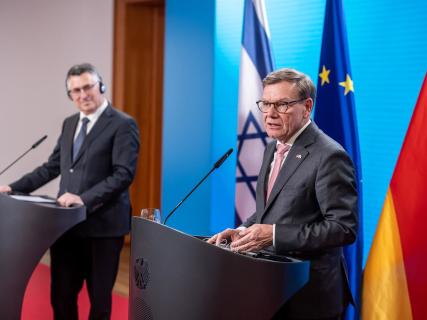

The German Foreign Minister, Johann Wadephul, has described the "continuous" advance of the Israeli Army in southern Lebanon as "of great concern," although he has placed it within "a reaction" to the actions of the Lebanese Shiite party-militia Hezbollah against northern Israel. At the same time, he has called for a definitive end to these attacks before urging all parties involved to cease hostilities.
"The continuous advance of the Israeli army in southern Lebanon is a cause for great concern. At the same time, it is a reaction to the attacks that Hezbollah is carrying out against northern Israel, which must cease definitively," Wadephul stated in a statement released by his ministry.
In that note, the head of German diplomacy has "urgently called on all parties to the conflict to cease hostilities and return to the agreed ceasefire," warning that "any further escalation will worsen the already tense situation and provoke new waves of displacement within Lebanon."
The text further emphasizes that "of course, Israel has legitimate security interests," but warns that "however, if civilians pay the price of military escalation and parts of Lebanon become permanently uninhabitable, this will not make Israel's neighboring region safer in the long term." Therefore, he has urged the Israeli authorities to take extreme precautions to safeguard the civilian population and infrastructure in their operations against Hezbollah.
"The key to stabilizing Lebanon lies in strengthening the Lebanese state. This includes the Lebanese government taking decisive action against Hezbollah and Lebanon exercising its monopoly on the use of force throughout its territory," the minister asserted, pointing to the central role of Lebanese institutions.
At the same time, he has argued that the way out of the conflict lies in the "direct talks" taking place in Washington between delegations from the Israeli and Lebanese governments: "It is the ideal channel," he noted, emphasizing that "a viable diplomatic solution is needed to protect the civilian population on both sides of the Blue Line (which marks the border between the two countries) and establish lasting peace."
"Hezbollah must not be allowed to continue undermining this peace process," Wadephul concluded.
United Kingdom warns that escalation reduces space for diplomacy
In parallel, the UK Foreign Minister, Yvette Cooper, has denounced that "Israel's military escalation in Lebanon has caused the death and displacement of civilians, has destroyed infrastructure and has diminished the room for diplomacy," for which she has called on Benjamin Netanyahu's government to act to "put an end to this situation."
Cooper has also stressed that "Hezbollah must put an end to attacks against Israel" and that, in addition, it must "disarm," a demand that the Shiite group repeatedly rejects, considering that it responds to the Israeli objective of the Lebanese state concentrating the monopoly of weapons.
"All parties must respect the ceasefire and participate in negotiations in good faith," added the British minister, referring to the peace process sponsored by the United States, also rejected by Hezbollah.