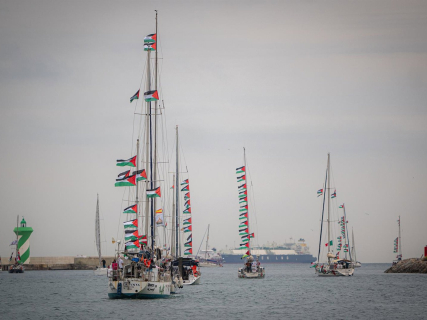

The Global Sumud Flotilla organization has denounced this Thursday that activists detained by Israeli authorities have suffered sexual assault and numerous injuries, after the interception in international waters of a dozen boats from its latest humanitarian flotilla in the Mediterranean Sea as it was heading towards the Gaza Strip.
In a telematic press conference, the platform's spokesperson, Bader Alnoaimi, described the current situation of the participants, emphasizing that data gathered on the ground points to "widespread and systematic physical and sexual violence" exercised by Israel against the members of the flotilla.
According to Alnoaimi, "multiple injuries were recorded, some of them serious enough to require hospitalization, and we also know, from the moment of interception, that at least three participants were injured as a result of the use of non-lethal weapons fired at their vessels during the interception," he indicated, alluding to the Israeli operation.
Global Sumud Flotilla has condemned the boarding by Israeli forces, which it describes as a "kidnapping" of the activists, and has stressed that in the operation six of the vessels were hit by gunfire and one of them was rammed by a military ship, which would have caused some of the injuries.
Regarding the legal response, Alnoaimi pointed out that the organization has initiated legal proceedings in several states, including Turkey, Poland, Morocco, Italy, Indonesia, Spain, and France. In the latter case, the process aims to denounce the "complicity and inaction" of the French state in protecting its nationals who were traveling on the flotilla.
The spokesperson added that the legal route also seeks to hold accountable seven identified agents from Ktziot prison, where the international activists were transferred. Global Sumud Flotilla has emphasized that they are "responsible for crimes" and that complaints have been filed, in the corresponding countries, "to demand arrest warrants against these individuals."
Alnoaimi has also highlighted the international coordination of the campaign: "We have more than 30 teams in 30 different countries, and that gives us an opportunity to ensure that we can seek accountability at a national level in any country, and we can also seek accountability at an international level and in international institutions such as the International Court of Justice or regional courts such as the European Court of Human Rights or the African Court of Human Rights," he explained.