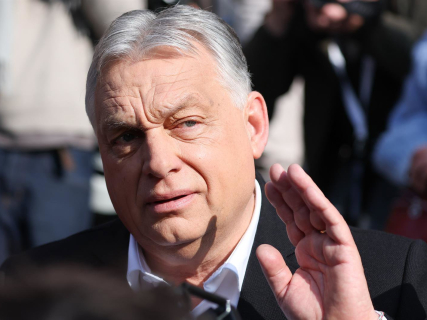

Hungarian authorities have recovered about 17.6 million euros in cash during an operation against alleged corruption linked to the government of former prime minister Viktor Orbán. The money was hidden in different points across the country, including forests, agricultural facilities, warehouses, residences, and safe deposit boxes located in remote places. The operation forms part of a judicial investigation against Miklós Seszták, former minister of National Development between 2014 and 2018, suspected of participating in a bribery scheme and public contracts allegedly awarded at inflated prices.
The discovery was announced this Friday, November 13, by the National Office for Recovery and Asset Protection (NVVH), a body created by the current Hungarian executive to investigate possible irregularities committed during the 16 years in which Orbán was in charge of the government. According to information published by Reuters, Associated Press and the Hungarian newspaper Telex, the investigators carried out searches over two days in Budapest and in the provinces of Pest, Békés and Nógrád, where they found large quantities of banknotes hidden on different properties.
The seized money exceeds 17.6 million euros at the exchange rate, although it was distributed in three currencies: Hungarian forints, euros and US dollars. The discovery represents one of the main advances of the anti-corruption campaign promoted by the prime minister Péter Magyar, who came to power after defeating Orbán’s Fidesz party in the April 2026 elections.
Banknotes buried in forests and hidden in safe deposit boxes: this was the discovery
The investigation made it possible to locate cash in several places spread across Hungarian territory. As detailed by the National Office for Recovery and Asset Protection, the agents found bundles of banknotes buried in forest areas, hidden in agricultural buildings and warehouses, kept in homes and deposited in safe deposit boxes located in concealed sites.
The tally of the operation includes 5.071 million forints, 2.65 million euros and 1.25 million dollars, amounts that add up to approximately 17.6 million euros according to the valuation released by the Hungarian authorities.
The scale of the discovery forced the mobilization of State Treasury staff to verify the recovered money. The Minister of Finance, András Kármán, explained that twelve employees needed eight hours and five counting machines to account for the banknotes. The funds were later deposited in the Hungarian Treasury.
The operation involved the collaboration of different police and tax agencies. The NVVH also disseminated images and videos of the records, in which large amounts of stacked money and the excavation work carried out by the investigators during the night can be seen.
However, the discovery of the cash alone does not prove that all the money belongs to the ex-minister being investigated, nor that it necessarily comes from the offences attributed to him. It will be for the judicial authorities to determine its origin, who had control of the funds, and what relationship they maintain with the investigated operations.
Who is Miklós Seszták and what public contracts is Justice investigating
Miklós Seszták held the Ministry of National Development of Hungary between 2014 and 2018, during one of Viktor Orbán’s governments. Linked to the Christian Democratic People’s Party (KDNP), Fidesz’s traditional partner, the former minister was detained in late September within an investigation into possible corruption offences related to the management of public resources.
One of the main lines of the inquiries focuses on the acquisition of more than 600 used buses by public transport companies between 2015 and 2018. The investigators suspect that the vehicles were bought at prices far above their actual value, which would have caused harm of around 10,000 million forints to the state-owned companies.
The procedure also examines the purchase of a property in the city of Kecskemét, for which the public transport company would have paid at least 550 million forints more than its estimated value, according to information published by the Hungarian outlet Telex.
The authorities are investigating whether the markups generated through these operations ended up benefiting certain political and business officials. To do so, they examine intermediation contracts, financial leasing transactions and allegedly fictitious loans that could have been used to move the funds between different companies.
According to the Hungarian Prosecution Office, Seszták and the former person responsible for managing state assets, Norbert Szivek, would have obtained around 11 billion forints through these operations. The businessman Dániel Jellinek is also among the people being investigated for his alleged involvement in certain financial transactions.
Seszták denies having committed any crime. The investigations remain ongoing and the suspicions raised against those involved do not amount to a judicial conviction.
Péter Magyar intensifies investigations into Orbán’s circle
The discovery comes in a political context very different from the one Hungary experienced over the past two decades. Viktor Orbán lost power in April 2026 after 16 years at the head of the Executive, following the victory of the Tisza party, led by Péter Magyar.
The new prime minister entered Government with the commitment to investigate alleged corruption cases related to the management of his predecessor and to recover public resources that may have been diverted. His administration has launched a campaign called "Operation Purge", which includes actions against former ministers, businesspeople, and officials in public institutions.
Magyar hailed the discovery of the funds and presented it as a turning point in the fight against alleged corruption networks. The prime minister said on his social networks that the discovery marked the end of what he calls the "Fidesz-KDNP mafia", a political accusation aimed at the former governing coalition.
The investigation into Seszták is not the only one opened against former members of Hungarian power. Two other former ministers and the former governor of the Central Bank, György Matolcsy, are in custody for investigations related to alleged economic irregularities. Their proceedings are independent and those affected have denied having committed the crimes attributed to them.
The authorities have also recently detained a brother of Viktor Orbán in a separate investigation related to alleged human trafficking and trafficking in influence.
Orbán denounces political persecution and Fidesz distances itself from the former minister
The judicial offensive has caused a strong confrontation between the current Government and the opposition. Viktor Orbán has denounced that the investigations into former members of his circle respond to political persecution, intended, as he claims, to remove him definitively from public life.
The former prime minister has described the actions against his collaborators as a form of retaliation and has questioned the use of judicial procedures by Magyar’s Executive.
For its part, Fidesz has distanced itself from the alleged irregularities attributed to Seszták. In statements collected by Telex, the party’s spokesperson, Bertalan Havasi, defended that public representatives are obliged to respect the law and expressed his confidence that the images disseminated by the authorities are not related to the former minister.
These reactions make clear the political dimension of the investigations, although the criminal liability of each of those involved must be determined through the corresponding judicial procedures.
What will happen with the 17.6 million euros recovered
The money discovered during the searches has already been transferred to the Hungarian State Treasury, but its deposit does not mean that its illicit origin has been definitively established nor that it can be considered definitively recovered for the public coffers.
The investigators will have to reconstruct the origin of the funds and check whether they are related to the contracts being investigated, the financial transactions of the companies involved, or possible money-laundering offenses.
The National Office for Asset Recovery and Protection will also have to determine whether there are other properties or hidden amounts related to the scheme. In earlier phases of the investigation, indications had already appeared about the possible existence of significant cash reserves, although some of those findings are still subject to judicial review.
The discovery of 17.6 million euros hidden in forests and buildings constitutes one of the most striking episodes of the new Hungarian Government’s anti-corruption offensive. However, the investigation into Miklós Seszták remains open and it will be up to the Justice system to determine whether that money comes from bribes and irregular awards during the years of Viktor Orbán’s Government.