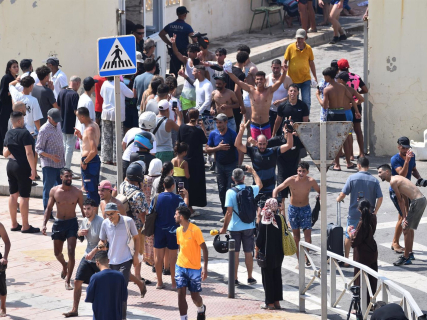

Several media outlets in Morocco have pointed this Thursday to social networks as responsible for coordinating the crossing of young Moroccans to the autonomous city of Ceuta, interpreting it as an attempt to damage the country's image and present it as a state from which its youth is experiencing an exodus and that is unable to control its borders, just as the 27th anniversary of the enthronement of King Mohamed VI is being celebrated.
In the midst of the migration crisis recorded this Thursday, with thousands of people, mostly from the Maghreb, entering massively and uncontrollably into Ceuta both by the beach and by the fence at the height of the El Tarajal breakwater, the Moroccan press has echoed the reaction of the Government of Spain and the understanding reached with Rabat for the delivery "as soon as possible" of "all" migrants who have entered Ceuta irregularly, a territory they describe as "occupied".
In this context, the media insist on the version shared by Madrid and Rabat that cooperation between both parties is exemplary and emphasize that the Ministry of the Interior attributes the events to networks dedicated to human trafficking that seek to promote new flows, especially of young people, protected against so-called pushbacks.
ORGANIZED MOVEMENT TO SMEAR THE IMAGE OF THE KING AND THE COUNTRY
Regarding the origin of the crisis in Ceuta, the newspaper Alyaoum24 questions whether it is "a simple new wave of irregular migration, nor reduced to a group of young people who suddenly and at the same time decided to launch themselves into the sea in search of the other shore." "Who is playing with the minds of the youth in the region? And who devised the remote control and the digital campaign with perverse purposes and objectives?" the newspaper emphasized.
While admitting that there are young people "who dream of emigrating and that there are economic and psychological factors" that explain this phenomenon, the newspaper emphasizes that this situation coincides with the celebrations of Throne Day and argues that there is an intention to amplify a "digital narrative" to project a negative image of Morocco and contrast the achievements of the monarch with "scenes of young Moroccans swimming towards occupied Ceuta."
"The videos spread quickly on social media, accompanied by headlines and comments that present the scene as a 'mass exodus' from Morocco," notes Alyaoum24, which highlights that the images in the autonomous city are being used "as proof of Morocco's failure or of its youth's rejection of that reality, and directly linking them to national celebrations."
In the same vein, the Moroccan newspaper 'Ajbarona' maintains that the massive crossing of the border, both by swimming and on foot, has been coordinated through Whatsapp groups and "was preceded by an organized digital mobilization campaign." "Suspicious movements and posts were observed on social media, aimed at mobilizing the population for an attempt at mass migration," it reports.
The outlet specifies that the group involved is managed from a phone number with an Algerian prefix and that it encouraged young people to gather at a specific place and time, with detailed instructions to cross the border.
Moroccan media add that the mobilization would also have been articulated through closed groups on Facebook, where calls were made to prepare for the crossing and previous attempts at mass crossings by young people in the area were recalled.