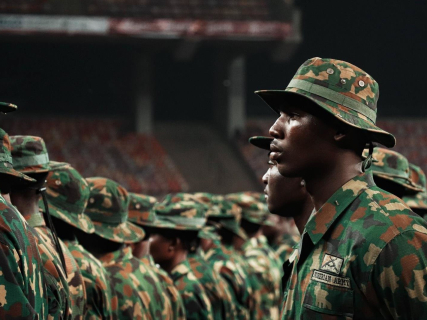

The Nigerian Army has reported this Thursday the death of more than two dozen alleged fighters of the jihadist group Islamic State, including a senior official from its regional branch, following several bombings and operations carried out in recent days in the state of Borno, in the northeast of the African country.
The spokesperson for the "Hadin Kai" operation, Mohammed Goni, said in a statement circulated on social media that these "precision bombings" in the vicinity of Monguno and in the southern sector of Lake Chad have made it possible to "neutralize 21 Islamic State fighters in West Africa (ISWA) and seriously injure another ten."
According to his account, a first offensive was launched after receiving information about the movement of jihadists toward Monguno, which prompted the deployment of drones to monitor the area and a subsequent airstrike that ended the lives of seven suspects, including "members of the network of improvised explosive devices" of the group.
Goni detailed that a man identified as Abba Bomma, considered a "key explosives team expert" of ISWA, was left "incapacitated" by the bombing, while four other alleged militiamen suffered "serious injuries," without it being possible to confirm their identity yet.
At the same time, a second airstrike in Arinna dealt "a significant blow to ISWA’s leadership structure and operations" by causing the deaths of fourteen other alleged jihadists, including Mallam Sharki, described as a "prominent member" of the organization’s Shura Council.
"The attacks have significantly damaged the group’s leadership structure, disrupted its network of improvised explosive devices, and weakened its operational capabilities," he stressed, before insisting on the Army’s intention to "maintain constant operational pressure on the terrorists until lasting peace and normality are restored" in the region.
The state of Borno and other territories in Nigeria’s northeast have consolidated as the epicenter of ISWA and Boko Haram’s — the group from which the former split — actions. Both organizations maintain high activity in this part of the country and in the Lake Chad basin, where dozens of attacks have taken place in recent months.
Armed attacks in Nigeria, which were concentrated above all in the northeast, have spread in recent times to other areas of the north and the northwest, which has triggered alerts about the possible expansion of these terrorist networks and other criminal groups that obtain funding through raids and kidnappings.
This context has led the United States to carry out various bombings in Nigerian territory since 2025, as part of a reinforcement of bilateral cooperation that intensified after the then occupant of the White House, Donald Trump, threatened military intervention by denouncing the alleged killing of Christians by the terrorist group, which he described as "a genocide," an accusation rejected by Abuja.
Christian communities have been targeted by attacks on repeated occasions in Nigeria, although specialists point out that the majority of the victims of armed violence in the country are Muslims, since much of the offensives are recorded in the north, which is predominantly Muslim and where Boko Haram and ISWA operate mainly.