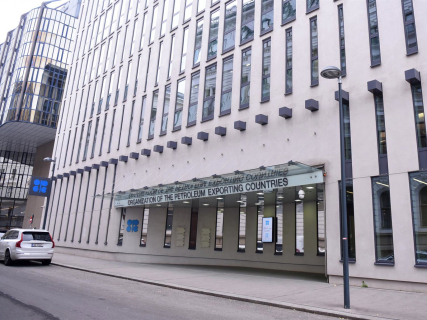

The Organization of the Petroleum Exporting Countries, in its expanded format OPEC+, communicated this Sunday that it will add another 188,000 barrels per day of crude to its production starting in September, under an agreement reached in its fourth meeting following the unexpected decision announced in May by the United Arab Emirates to leave the group amid the war in Iran.
At the close of the telematic meeting this Sunday, the seven partners of OPEC+ (Algeria, Iraq, Kuwait, Saudi Arabia, Kazakhstan, Oman, and Russia) opted to maintain their line of "commitment to market stability" and continue with the gradual increases that have added 940,000 barrels per day to the quotas, nearly 1% of global demand, since the outbreak of the conflict on February 28.
To date, these increases have been mostly nominal, as the war has blocked the Strait of Hormuz and prevented Gulf producers from effectively raising their exports and pumping. However, following the signing of the Memorandum of Understanding between Tehran and Washington, Saudi Arabia and neighboring countries have begun to normalize shipments, which has contributed to generating a surplus in strategic Asian markets.
The increase of 188,000 barrels per day planned by OPEC+ for September culminates, although mainly in a theoretical manner, the deactivation of two layers of production cuts applied in 2023, when the alliance was trying to avoid an oversupply.
Excluding the contribution of the United Arab Emirates, those cuts totaled around 3.5 million barrels per day, although in practice only a fraction of that volume has been recovered, due to technical limitations preventing many producers from raising their pumping to the authorized levels.
Delegates of the group indicated last week that, after the increase in September, production quotas would remain unchanged until the end of the year, in line with the strategy of keeping a third layer of inactive supply frozen that was withdrawn from the market in 2022. However, the plan could be modified if conditions require it, warned one of those representatives.
As is the case with the first two layers, several OPEC+ countries would have serious difficulties in reactivating a substantial part of this last one, due to the deterioration of their production capacity in recent years. Even before the war forced Gulf producers to halt part of their activity, most of the alliance's idle capacity was already concentrated in Saudi Arabia.
Russia, for example, has been pumping well below the cap assigned to it, facing the sanctions imposed after its invasion of Ukraine, according to data from the International Energy Agency (IEA).
Kazakhstan, for its part, has been forced to cut production after a series of attacks on vessels loading crude at the Caspian Pipeline Consortium (CPC) terminal, located on the Russian coast of the Black Sea, which channels around 80% of the country's oil exports. In any case, Kazakhstan has repeatedly failed to meet its quota within OPEC+, which reduces the real impact of any increase in its official target.