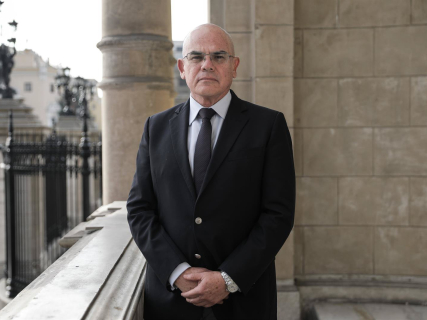

The Executive of Peru has confirmed the launch of two “megaprisons,” one of them with backing from the authorities of the United States, although it has underscored that it does not intend to reproduce the scheme of the Terrorism Confinement Center (CECOT) of El Salvador, since the reality of Peruvian security is not comparable to that of the Central American country.
The Minister of Justice and Human Rights, Ernesto Álvarez, has advanced that one of these “megapenal institutions” will be “maximum security” and will have “support already offered and accepted by the United States,” without, for the moment, any specific details having been provided regarding Washington’s cooperation.
As he has indicated, the complex known as Huacho X will be “absolutely new” and will be “created from the start with technology of this century,” as reported by the newspaper 'El Comercio'. “This will lead the vanguard of treatment, at a Latin American level, of inmates of high dangerousness,” he has specified.
Álvarez added that “at the same time, on adjacent land, what we call Huacho XIV will be built, which is the opposite, a megapenal for first-timers.” He detailed that “we have reserved the largest plot of land for first-timers because there we are going to take productive prisons to that program, which was already devised by other governments and which we have rescued, but with a quality leap.”
Along these lines, the minister defended that inmates will not be limited to tasks of “ceramics or textiles,” but that “machinery” will be installed and that “those instruments with the private company that allow really providing non-dangerous inmates with a new life project” will be incorporated.
He emphasized that “we want to bring to the market carpentry products, mechanics, with various options for economic activities, just as we have seen in the experience of other countries. We want to emulate that,” referring to experiences of prison labor such as those in El Salvador.
At the same time, the head of Justice stressed that “fortunately,” it is not required to build a prison copied from the salvadorean CECOT, recently visited by the Peruvian president, Keiko Fujimori, before her meeting with President Nayib Bukele during her official trip in late October.
“It’s not necessary, fortunately, to make a CECOT or to take measures that restrict fundamental rights to such an extent,” he insisted, reiterating that this center “is not the maximum-danger prison model” that the Peruvian Administration is considering.
However, he has warned that the country is facing “a wave of crime” that could, “in ten years,” lead to a scenario of “disorder” similar to that of “other countries” if “nothing is done,” although he has reiterated that, for now, prison design is not about replicating the CECOT.
Álvarez explained that “what we aspire to is that, as for the most violent and dangerous, we can judge them quickly with the subsystem that already began in its first module in Trujillo and that continues with Lima Norte and Lima Este,” while at the same time emphasizing the obligation to respect “fundamental rights” of these people.
Registration of Criminal Organizations with Terrorist Practices
On the other hand, the minister stated that the Council of Ministers approved on Thursday four legislative decrees aimed at strengthening the fight against organized crime, including one that creates a Register of Criminal Organizations with Terrorist Practices.
He has specified that the roster of groups will be prepared by the Secretaría de Seguridad y Defensa Nacional (Sedena), while the Consejo de Seguridad y Defensa Nacional (Cosedena) will be the body in charge of discussing it and validating it. “Sedena proposes the registration of these organizations in this register, Cosedena debates and approves,” he explained.
Álvarez has warned that “this involves several legal consequences, such as, for example: it’s not enough to kill a person as a hitman, it’s not enough to extort them, by throwing the bomb to be considered a member of the extortion criminal group—also the one who finances, leases the armaments, the one who prepares the bomb, the one who launders the money, the one who lends his bank accounts.”
“All of them, (information from) Intelligence services, through, are going to be incorporated into that criminal organization in the register that Cosedena will manage,” the minister concluded, in the context of the tightening of security policies promoted by the Government of Fujimori since it took power in July.