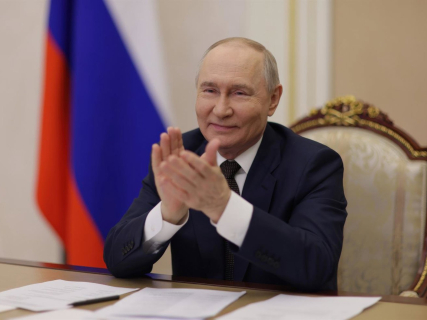

The Russian president, Vladimir Putin, has sent a congratulatory message this Saturday to the United States on the occasion of the 250th anniversary of its independence, in which he has highlighted the role that Russia played in supporting the break of the thirteen North American colonies from the British Empire, a process that he described as a "milestone in world history" linked to the Declaration of Independence.
In his letter addressed to the US president, Donald Trump, Putin recalled that "Russia extended its unequivocal support to the North American settlers in their struggle for freedom from the British yoke" and has framed that support within a long history of contacts between Moscow and Washington.
The Russian leader evoked the "important pages" of bilateral relations forged over these 250 years, including cooperation during the two world wars and the "liberation of humanity from the horrors of Nazism," which, as he emphasized, consolidated a decisive alliance in critical moments of the 20th century.
Putin also highlighted that, after those episodes, both powers worked side by side to "shape the foundations of the contemporary world order" and that, currently, "they are the largest nuclear powers," which, in his words, gives them "a special responsibility to maintain international security and stability."
In this context, the Russian president expressed his desire for a new stage to open in the ties between the two countries and stated: "I am confident in the establishment of constructive, equitable, and mutually beneficial relations" between Moscow and Washington "for our peoples and also for the entire international community."
The message concludes with a more personal tone, in which the head of the Kremlin addresses his US counterpart directly: "Donald, I wish you and your loved ones health, well-being, and all success, and I wish happiness and prosperity to all citizens of the United States."
In parallel, the Russian Embassy in Washington has released a statement in which it emphasizes that, currently, the two countries "have no fundamental ideological divisions" and that their leaders "have excellent personal chemistry" based on their "defense of traditional family and religious values, state-nation sovereignty, and opposition to the liberal-globalist 'rules-based order' that dominates modern Europe."
The diplomatic legation has insisted that "Russia and the United States could and should coexist constructively to build an economically viable and mutually respectful and egalitarian partnership", insisting on the potential for a more pragmatic and stable relationship between both capitals.