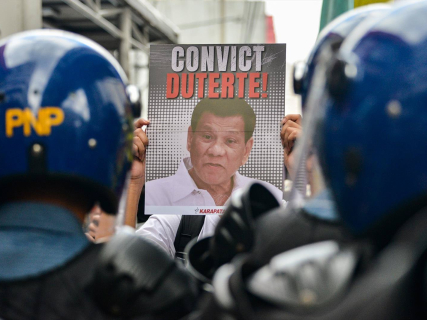

The former Philippine president Rodrigo Duterte sits from this Monday in the dock of the International Criminal Court (ICC) in an unprecedented process for alleged crimes against humanity linked to the so-called 'war on drugs'. He thus becomes the first former head of state in Asia to answer to international justice for acts committed while he was in the Presidency.
The trial begins more than a year after his arrest in Manila and subsequent transfer to The Hague, at a particularly delicate moment for the ICC, which is going through its greatest crisis of functioning and trust since it was created in 2002, under strong reproaches from governments such as that of the United States.
During the campaign and execution of his 'war on drugs', Duterte came to promise to "kill" alleged criminals and throw their corpses into the capital's bay. The court's Prosecution argues that he financed and equipped death squads responsible for nearly 30,000 murders, in open violation of Human Rights, although official figures reduce the deaths in those operations to about 6,000.
The former leader faces three counts of crimes against humanity, including murder and attempted murder, for deaths recorded between 2011 and 2018, a period in which the Philippines remained party to the Rome Statute and before the country formally left the ICC.
In this first session, it is planned that Duterte will respond to the accusations. His defense has already indicated that it will reject all charges and plead not guilty. With this, a week of hearings will open in which the Prosecution will present its initial submissions and the central pillars of the case. The witnesses will begin appearing on Tuesday.
Despite the abundant evidence gathered and the testimony of thousands of families, the proceedings continue to generate a strong division in the Philippines. Duterte was handed over to the ICC in March 2025 by the country's own authorities, under the mandate of Ferdinand Marcos Jr, belonging to a clan historically allied with the former president, who carried out the arrest order issued by the court.
The former head of state, however, maintains a solid core of social support, joined by his daughter Sara Duterte, the current vice president, who has denied that the process initiated this Monday can be considered a "fair trial". In her view, the existential crisis that the ICC is going through—which she reproaches for lack of impartiality—will be decisive in the outcome.
"It is the only case left for them, and they want to give a lesson," he said on Friday, also questioning the requirement for Duterte's daily presence in the courtroom, given the health conditions of the former leader, 81 years old.
The trial coincides with the impeachment proceedings that Sara Duterte herself is facing in the Philippine Senate, which could lead to her removal for alleged illicit enrichment and to a possible lifelong political disqualification.
Crises and pressures on the International Criminal Court
The review of actions by the United States and arrest warrants against senior officials of Israel, including Prime Minister Benjamin Netanyahu, have triggered a wave of sanctions and pressures from the Donald Trump Administration. Nearly half of the ICC judges are subject to this kind of restrictions, including its president, Tomoko Akane, along with a large part of the court's staff.
At the same time, Washington has proceeded this year to freeze assets and transactions of the ICC under U.S. jurisdiction, while also pushing a campaign for other States to withdraw from the court. The organization also lacks recognition from Russia—whose president, Vladimir Putin, is likewise subject to an arrest warrant—nor from Israel.
This scenario has led some governments to reduce or suspend their cooperation with the court, which has deepened the clash between the United States and the European Union, a firm defender of the ICC alongside the United Nations and other multilateral entities.
Over the last twelve months, seven countries—Niger, Burkina Faso, Mali, Venezuela, Chad, Nauru and Tajikistan—have announced their withdrawal from the Rome Statute, a dynamic that human rights organizations describe as "a way of undermining all efforts made to achieve the universal adoption of the court's founding treaty."
Duterte, declared fit to sit in the dock
In October, the ICC concluded that Duterte presents no physical or mental limitations that would prevent him from facing the process for crimes against humanity, and confirmed the start of the hearings for November 30.
The panel of specialists designated by the court determined “unanimously” that Duterte “has the ability to understand the charges, understand the purpose and consequences of the proceedings, follow the course of the proceedings, including the nature and implications of pleading guilty, understand the evidence, and instruct his lawyer in the preparation and conduct of his defense.”
Despite this, his legal representatives have been trying for months to avoid the trial by claiming incapacity stemming from his advanced age. The TPI has responded that “it has taken all necessary measures to facilitate the accused’s participation,” pointing to the fact that the former president will end up testifying before the judges.
For now, the chamber has ordered the Prosecution to reduce the number of witnesses— the current list does not reach a hundred— and to limit the volume of evidence that will be presented. It has also been decided to shorten the daily duration of the hearings.
The court has also ruled that Duterte’s health be monitored constantly and that, if “changes occur in the accused’s state of health,” the relevant information be sent immediately to activate the necessary protocols.
On the eve of the trial’s start, international attention is focused on The Hague. Victims and family members see this process as a real option to obtain justice in the face of the prolonged inaction of the Philippine judicial system and despite the ongoing attempts to halt impunity.
Various NGOs, including Amnesty International and Human Rights Watch (HRW), emphasize the need to “protect international justice” and call on States Parties to “drive and prioritize” measures in that regard. In their view, the Duterte case has become a decisive test for the future of the TPI.
“The efforts by the United States to pressure countries to withdraw from the Rome Statute constitute an attack both on the States that have decided to become part of the TPI and on international justice itself. The Trump Administration lacks moral authority on both fronts,” HRW’s director for international justice, Liz Evenson, lamented, who pointed to the “urgent need to protect the rule of law at a global level.”
From Amnesty, they have reminded the thousands of relatives of the victims for whom this trial represents “something that has been denied to them for years”: the opportunity to “see how those responsible for horrible crimes are brought to trial.”